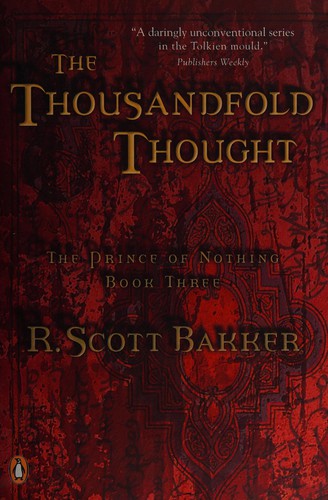
The Thousandfold Thought is the trilogy’s shortest and densest volume: the battles matter, but the true destination is a conversation — Kellhus meeting Moënghus, the father whose thirty-year plan set the entire Holy War in motion.
Bakker gives nearly every major relationship an ugly resolution — and the honesty is the point. Achamian finally sees what submission to Kellhus has cost him; Cnaiür reaches the object of his hatred without gaining an inch of freedom; Esmenet chooses a security that cannot be separated from manipulation.
The fall of Shimeh delivers the trilogy’s biggest sorcerous set piece, but the basement meeting beneath it is the real climax: Moënghus explaining the Thousandfold Thought — a decades-long probability calculation to seize the Three Seas and ready humanity for the Consult — and Kellhus judging it inadequate.
The compression can make political reversals feel abrupt, and readers wanting conventional catharsis should look elsewhere.
But the conceptual payoff is substantial. Kellhus does not reject his father’s plan; he absorbs it, adds what Moënghus could not calculate — the Outside is real — and emerges as something the Dûnyain never modeled. Achamian’s final walk away from prophet, wife and school is the trilogy’s one unbroken act of refusal, and it opens straight onto the Second Apocalypse.