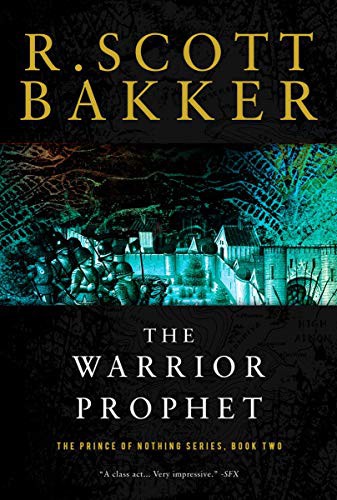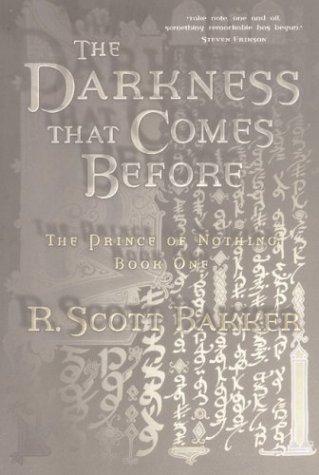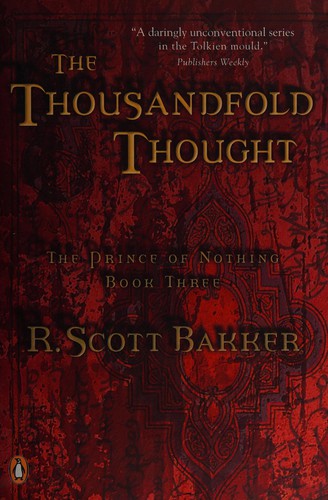
The Book in Brief
Kellhus leads the Holy War toward Shimeh as prophet and commander, absorbing religious, military and personal loyalties while Conphas and the Scarlet Spires scheme to preserve their own power. Achamian wrestles with Kellhus’s possession of Esmenet and the fear that his student is using the Gnosis for purposes no follower understands; Cnaiür stays close because revenge is the only identity he has left. Shimeh falls, and beneath the city Kellhus meets Moënghus, who reveals the Thousandfold Thought — a long calculation meant to seize the Three Seas against the Consult. Kellhus judges his father obsolete; Moënghus dies through Cnaiür’s hand, and Achamian walks away as the world turns toward the Second Apocalypse.
Important Characters
Kellhus: The Warrior-Prophet whose encounter with his father determines whether he is instrument, successor, or something stranger.
Moënghus: Kellhus’s Dûnyain father and author of the Thousandfold Thought.
Achamian: The Mandate sorcerer forced to decide whether knowledge of the Consult justifies serving Kellhus.
Esmenet: Kellhus’s partner and future empress, choosing a position that offers power and protection at moral cost.
Cnaiür: A warrior consumed by his history with Moënghus and his inability to escape Kellhus’s conditioning.
Conphas: The imperial commander whose claim to rule cannot coexist with Kellhus’s sacred empire.
Maithanet: The Shriah, revealed as part of Moënghus’s long preparation and Kellhus’s half brother.
What to Remember from the Previous Book
The Warrior-Prophet ended with Kellhus surviving circumfixion and becoming the Holy War’s sacred commander. Achamian escaped the Scarlet Spires but lost Xinemus’s sight and his former place with Esmenet. The army defeated the Padirajah and resumed its march toward Shimeh under Kellhus’s near-total authority.
The Final March
Chapter 1
The Holy War advances under Kellhus’s prophetic rule, and older commanders discover that rank now depends on devotion.
Chapter 2
Achamian teaches Kellhus the Gnosis while fearing that every lesson gives a manipulator greater power.
Chapter 3
Esmenet’s place beside Kellhus offers security and influence but deepens her separation from Achamian.
Chapter 4
Conphas organizes resistance among elites who see that Kellhus’s new order will erase their independence.
Chapter 5
Cnaiür remains useful as a commander while privately orienting every decision toward Moënghus and revenge.
The Final March, continued
Chapter 6
In Xerash, Achamian watches Kellhus administer the marching host and feels his own detachment grow.
Chapter 7
The Scarlet Spires commit sorcery while calculating whether Kellhus or the Cishaurim pose the greater future threat.
Chapter 8
Achamian’s power becomes indispensable even as his personal loyalty to Kellhus collapses.
Chapter 9
Conphas attempts to convert military prestige into a political break from the Warrior-Prophet.
Chapter 10
Kellhus expels Conphas from Caraskand and sends him back to Nansur under Cnaiür's guard.
Chapter 11
The Holy War leaves Gim for Holy Amoteu, while Conphas — free of Joktha — gathers Nansur reinforcements and proclaims himself Emperor.
The Final March, concluded
Chapter 12
Still in Holy Amoteu, Aurang moves against Esmenet in Kellhus's guise and the Thousandfold Thought is made manifest.
Chapter 13
The Holy War arrives before Shimeh on the Plains of Shairizor, and Kellhus grasps how thoroughly his road was Conditioned.
Chapter 14
Moënghus explains how he summoned Kellhus and engineered the Holy War through agents including Maithanet.
Chapter 15
The Thousandfold Thought is revealed as a plan to unite the Three Seas against the Consult’s coming apocalypse.
Chapter 16
Kellhus concludes that Moënghus’s world-bound Dûnyain reasoning cannot account for the gods and the Outside.
Chapter 17
Moënghus dies through Cnaiür; Kellhus claims the plan and empire for himself, while Achamian leaves Esmenet and the new prophet.
Ending Explained
Moënghus is not the secret master of everything: his Thousandfold Thought predicts and manipulates enormous systems, but his thin connection to the Outside blinds him to the metaphysical forces Kellhus has actually encountered. Kellhus causes his father’s death because he judges him both obsolete and dangerous — then takes the plan over, adding claims and capacities Moënghus could not calculate. Achamian’s departure is the last act of refusal: he cannot save Esmenet or defeat Kellhus, but he stops treating knowledge of the Consult as a reason to surrender every personal and moral judgment. The trilogy closes with its prophet enthroned and its one honest man walking into the wilderness.
Themes and Analysis
Prediction and blindness. The Thousandfold Thought models human behavior brilliantly while missing realities outside its assumptions.
Ends and means. Preparing for apocalypse becomes the justification for empire, manipulation, and private betrayal.
Sacred and secular power. Kellhus defeats rivals by making political obedience feel cosmically necessary.
Refusal. Achamian’s exit is limited and painful, yet it preserves a perspective outside Kellhus’s total claim.
Content Notes
This book contains graphic war violence, torture, sexual violence and misogyny, religious extremism and coercion, psychological manipulation and mass death.