The Book in Brief
In ancient Eärwa, the royal refuge of Ishuäl survives the First Apocalypse and becomes home to the Dûnyain. The sect spends almost two thousand years breeding and conditioning itself to understand the laws governing thought and behavior. In 4110 Year-of-the-Tusk, Anasûrimbor Kellhus receives dreams sent by his father, Moënghus, who left Ishuäl decades earlier. The Dûnyain order Kellhus to find and kill him in Shimeh, far to the south.
Kellhus leaves the only world he knows and quickly demonstrates the power of his conditioning. He manipulates a trapper named Leweth into friendship, uses him to learn the languages and beliefs of the outside world, and abandons him when Sranc make rescue impractical. An encounter with a Nonman and sorcery reveals that the Dûnyain understanding of reality is incomplete. Kellhus continues toward Shimeh, now aware that the world contains forces his training did not predict.
Elsewhere, the Shriah Maithanet declares a Holy War to recover Shimeh from the Fanim. The decision draws nobles, pilgrims, mercenaries, and priests toward the Nansur capital of Momemn. Emperor Ikurei Xerius III intends to exploit their faith. He will provide the supplies required to cross hostile territory only if the leaders sign an Indenture surrendering conquered lands to his empire.
Drusas Achamian, a spy and sorcerer of the Mandate, is ordered to investigate Maithanet. The Mandate fears that the Holy War may be connected to the Consult, the hidden enemy responsible for the First Apocalypse. Achamian travels to Sumna and recruits his former student Inrau, now a priest, to spy within the Thousand Temples. Inrau discovers evidence of a skin-spy and is killed. His death transforms Achamian's assignment into grief and guilt.
Achamian's former lover Esmenet remains in Sumna, surviving as a prostitute. A Consult creature interrogates and violates her while searching for information about Achamian and Inrau. She leaves for Momemn, is nearly killed by a religious mob, and is rescued by the Shrial Knight Sarcellus. She reaches the capital hoping to find Achamian, though fear and shame keep complicating the reunion she imagines.
On the Jiünati Steppe, the Nansur general Ikurei Conphas lures the Scylvendi into a devastating trap at Kiyuth. Cnaiür urs Skiötha predicts the strategy, but his warning is ignored. After the defeat, Cnaiür finds Kellhus near the barrow of his father. Kellhus resembles Moënghus, the Dûnyain who manipulated Cnaiür in his youth. Cnaiür agrees to guide the son to Shimeh because both men claim to want Moënghus dead.
Kellhus and Cnaiür rescue a young Nymbricani woman named Serwë from raiders and learn that the Holy War offers the best route south. Serwë becomes devoted to Kellhus, while Cnaiür recognizes that the Dûnyain is repeating his father's methods. Kellhus defeats Cnaiür during a confrontation in the mountains but spares him because he needs the Scylvendi's knowledge of war.
The first, undisciplined wave of crusaders—the Vulgar Holy War—marches without adequate preparation and is annihilated at Mengedda. Its destruction strengthens Xerius's attempt to make the remaining lords dependent on imperial supplies and on Conphas. When Cnaiür arrives in Momemn, however, Prince Nersei Proyas presents him as an alternative commander with direct knowledge of Fanim warfare.
Achamian meets Kellhus through Proyas and the Marshal Krijates Xinemus. Kellhus encourages him to speak about the Mandate dreams, the First Apocalypse, and the Anasûrimbor prophecy. Achamian is overwhelmed by the apparent significance of Kellhus's name and by the understanding Kellhus performs. He agrees to teach the Dûnyain, unaware that Kellhus regards his knowledge and loneliness as tools.
At a final council on the Andiamine Heights, Xerius tries to force the Holy War into his service. Proyas instead offers Cnaiür as a surrogate for Conphas — a Scylvendi expert whose counsel removes any need to sign the Indenture — and Maithanet's authority compels the emperor to release the needed provisions. During the confrontation Kellhus notices that Xerius's adviser Skeaös has a face he cannot read. The emperor has Skeaös seized.
Achamian is brought to examine the prisoner. Skeaös bears no sorcerous Mark, but under torture he reveals impossible strength and knowledge connected to the Mandate's nightmares. The creature is exposed as a Consult skin-spy and destroyed. For the first time in centuries, the Mandate has direct proof that its enemy is not a legend.
As Momemn celebrates, Esmenet goes to find Achamian. He returns from the palace shattered by the revelation and walks past her without seeing her. The Holy War finally prepares to march. Kellhus has entered its heart, Cnaiür has become essential to its survival, and Achamian understands that the Second Apocalypse may already have begun.
Important Characters
Anasûrimbor Kellhus: A Dûnyain monk sent from Ishuäl to assassinate his father in Shimeh. His ability to read and manipulate people makes him appear compassionate, prophetic, or divine to those he conditions.
Drusas Achamian: A sorcerer and field spy of the School of Mandate. He relives Seswatha's memories of the First Apocalypse and becomes the emotional center of the Consult investigation.
Esmenet: A prostitute in Sumna and Achamian's former lover. Intelligent, perceptive, and socially vulnerable, she sees the consequences of power from below.
Cnaiür urs Skiötha: A violent Scylvendi chieftain haunted by his youthful relationship with Moënghus. He understands Dûnyain manipulation better than anyone around Kellhus but cannot escape it.
Serwë: A young Nymbricani woman rescued from captivity by Cnaiür and Kellhus. Her suffering and desire for meaning make Kellhus's manufactured compassion irresistible to her.
Ikurei Xerius III: Emperor of Nansur, who tries to convert the Holy War into an instrument for restoring his empire's lost territory.
Ikurei Conphas: Xerius's nephew and a gifted, narcissistic general. His victory over the Scylvendi at Kiyuth makes him the emperor's preferred commander for the Holy War.
Maithanet: The enigmatic Shriah of the Thousand Temples. His call for a Holy War unites the Inrithi world and overturns the political balance around the Nansur Empire.
Nersei Proyas: Prince of Conriya, devout leader of the Holy War, former student of Achamian, and friend of Marshal Xinemus.
Krijates Xinemus: Marshal of Attrempus and Achamian's closest friend. His loyalty gives Achamian access to Proyas and the Holy War's leadership.
Inrau: Achamian's former student, who abandoned sorcery for the priesthood. Achamian recruits him to investigate Maithanet, with fatal consequences.
Skeaös: Xerius's trusted imperial adviser. Kellhus's inability to read him exposes the disguise of a Consult skin-spy.
Sarcellus: A Knight of the Tusk who rescues Esmenet during her journey to Momemn. His apparent kindness places her close to the Holy War and its hidden dangers.
Spoiler Warning: The summaries below reveal every major event, including Inrau's death, Kellhus's manipulation of Cnaiür and Serwë, Skeaös's true nature, and the final confirmation that the Consult survives. Chapter headings follow the location-based structure of the original English text.
Prologue — The Wastes of Kûniüri. In 2147 Year-of-the-Tusk, the Anasûrimbor dynasty dies at Ishuäl while the First Apocalypse destroys the surrounding world. A nameless royal bastard survives the plague and the violence of the refuge. Dûnyain refugees later discover the hidden citadel and take the boy into their new community. Over the next two thousand years, the sect seals Ishuäl from history and devotes itself to conditioning human beings who can apprehend the causes of thought.
In 4110, Anasûrimbor Kellhus receives dreams from his father, Moënghus, who abandoned Ishuäl thirty years earlier. Because the messages prove that Moënghus has acquired a power capable of reaching the Dûnyain, Kellhus is sent to find and kill him in Shimeh. Outside, Kellhus is rescued from starvation by the trapper Leweth. He studies Leweth, manufactures friendship, and learns the rudiments of the world.
Sranc attack. Kellhus uses Leweth as part of his escape and leaves him mortally wounded rather than risk the mission. He then encounters a Nonman whose sorcery violates the explanatory limits of Dûnyain training. Kellhus survives, but his certainty has been altered: the world contains real forces that the Logos alone has not mastered.
Part I — The Sorcerer
Chapter 1 — Carythusal. Drusas Achamian meets Geshrunni in the Holy Leper, a tavern in Carythusal. Geshrunni serves the Scarlet Spires and reports that the powerful School is preparing for war against the Cishaurim, the sorcerer-priests who defend the Fanim. The assassination of the Scarlet Spires' grandmaster, Sasheoka, has made the conflict personal and politically volatile.
Achamian listens as both a Mandate spy and a man exhausted by secrecy. Each night he dreams the First Apocalypse through Seswatha's eyes: ruined cities, the No-God, and a war everyone else treats as legend. News of Maithanet's growing authority and the call gathering the Inrithi world toward holy war gives the Mandate another possible sign that ancient patterns are returning.
Chapter 2 — Atyersus. At the Mandate stronghold of Atyersus, Achamian appears before the Quorum. The School's leaders debate Maithanet, the Cishaurim, and the possibility that the Consult is directing events from concealment. Their institutional certainty does not eliminate fear. If they see the Consult everywhere, they become prisoners of their own prophecy; if they dismiss the wrong sign, humanity may be destroyed again.
The Quorum orders Achamian to investigate the Thousand Temples from within. His best opening is Inrau, a gifted former student who renounced the Mandate and entered the priesthood in Sumna. Achamian hates the idea of using him. He also understands that the School regards personal affection as a weakness history cannot afford.
Chapter 3 — Sumna. Achamian arrives in Sumna amid crowds transformed by Maithanet's declaration of Holy War. The city seethes with pilgrims, zealots, rumors, and men who believe the recovery of Shimeh will redeem their private failures. As a sorcerer, Achamian stands outside that shared conviction. The faithful see his kind as damned even when they need the Mandate's knowledge.
He reunites with Esmenet, whose rooms and company once gave him refuge during earlier assignments. Their affection survives, but neither knows how to cross the years and injuries between them. Achamian also locates Inrau and begins preparing the appeal that will draw his former student back into the secrets he tried to escape.
Chapter 4 — Sumna. Achamian asks Inrau to observe Maithanet and the inner workings of the Thousand Temples. Inrau resists because the request threatens both his faith and the life he constructed after leaving the Mandate. Achamian nevertheless uses their old bond and the stakes of the Consult investigation. He recognizes the manipulation while performing it.
Inrau discovers evidence that something inhuman has penetrated the religious hierarchy. His attempt to learn more brings him into contact with a skin-spy. He is killed before he can expose the conspiracy. To preserve secrecy, his death is made to appear self-inflicted. Achamian is left with the knowledge that his obedience to the Mandate placed Inrau in the path of the very enemy they feared.
Part II — The Emperor
Chapter 5 — Momemn. In Momemn, Emperor Ikurei Xerius III receives leaders arriving for the Holy War. He presents himself as the indispensable host of a sacred undertaking while privately calculating how to recover the provinces lost to the Fanim. His proposed Indenture requires the crusaders to surrender any conquests to Nansur rule in exchange for imperial supplies.
Nersei Calmemunis, Palatine of the Conriyan province of Kanampurea and cousin to Proyas, becomes an early target for imperial pressure. Court scenes also reveal Xerius's unstable mixture of intelligence, vanity, cruelty, and dependence on his mother Istriya and his adviser Skeaös. A Cishaurim emissary and an absurdly humiliating omen puncture the grandeur he performs, but they do not weaken his conviction that every gathering can be converted into obedience.
Chapter 6 — The Jiünati Steppe. On the steppe, the Nansur army under Ikurei Conphas faces the Scylvendi. Cnaiür urs Skiötha studies the imperial deployment and recognizes that Conphas is inviting an attack under false conditions. He warns the Scylvendi king Xunnurit that the Nansur have prepared a trap. Pride and tribal politics make the warning easy to dismiss, especially because Cnaiür's standing has long been poisoned by rumors surrounding his youth.
The Scylvendi charge and discover disciplined fortifications, missile fire, and reserves positioned to destroy them. Conphas wins a spectacular victory at Kiyuth. Cnaiür survives the catastrophe he predicted, carrying both proof of his insight and the familiar humiliation of being unable to make others see it.
Chapter 7 — Momemn. Conphas returns to Momemn as the Lion of Kiyuth. The capital celebrates him as the genius who broke the Scylvendi, and Xerius sees the victory as evidence that his nephew can lead the Holy War through Fanim territory. Conphas accepts admiration as confirmation of his own exceptional nature rather than as one element of imperial propaganda.
The emperor's satisfaction contains anxiety. Conphas is family, heir, weapon, and potential rival. The Holy War's princes continue to arrive without accepting the Indenture, while provisions become the point at which religious enthusiasm meets political reality. Xerius believes scarcity will eventually force them to accept his terms.
Chapter 8 — Momemn. The least disciplined pilgrims and minor nobles grow impatient with negotiations. Calmemunis signs the Indenture and leads the force later called the Vulgar Holy War south before the great leaders have settled command or supply. Xerius allows the departure because either success or disaster can serve him: victory expands the empire, while defeat proves that the crusade cannot survive without Nansur support.
The Vulgar Holy War is annihilated at Mengedda. Its destruction hardens the standoff in Momemn and gives Xerius another argument for placing Conphas at the head of the surviving army. Faith has produced numbers, but numbers without food, discipline, and knowledge have become a massacre.
Part III — The Harlot
Chapter 9 — Sumna. Esmenet remains in Sumna after Achamian leaves. Her thoughts return to him, to the daughter she abandoned years earlier, and to the compromises required by her profession. The Holy War's rhetoric of purity offers no place for a woman whom its adherents already regard as polluted.
A man connected to the Consult attacks and interrogates her for information about Achamian and Inrau. His violation is both sexual and investigative, reducing intimacy to another instrument of war. The encounter convinces Esmenet that remaining in Sumna is no longer possible. She sets out for Momemn, hoping the man who repeatedly leaves her may still be the nearest thing she has to a home.
Chapter 10 — Sumna. On the road, Esmenet falls among pilgrims whose sacred purpose does not restrain their cruelty. When they identify her as a prostitute, a crowd nearly stones her. Cutias Sarcellus, a Knight of the Tusk, intervenes and saves her. His status turns the mob aside, demonstrating that power—not principle—determines whose version of holiness prevails.
Sarcellus accompanies Esmenet toward Momemn, offering protection and an intimacy she does not fully trust. Meanwhile Achamian reaches the enormous encampment around the capital. He reunites with Krijates Xinemus, Marshal of Attrempus and his closest friend, whose loyalty gives him a path back to Nersei Proyas.
Chapter 11 — Momemn. Prince Proyas arrives to find the Holy War stalled and the Vulgar Holy War destroyed. As a devout prince he wants to treat the expedition as obedience to God; as a commander he must confront hunger, faction, massacre, and the emperor's attempt to purchase control with grain. The contradiction makes every practical compromise feel like a spiritual failure.
Through Xinemus, Achamian meets Proyas, whom he once taught. Their old affection has been divided by religion: Proyas reveres the Tusk and regards sorcery as damnation, while Achamian carries knowledge the prince needs. Achamian asks him to question Maithanet about Inrau and the hidden threat inside the Thousand Temples. The appeal forces Proyas to choose between confidence in the Shriah and the teacher he has never entirely ceased to love.
Part IV — The Warrior
Chapter 12 — The Jiünati Steppe. After Kiyuth, Cnaiür returns to the Utemot and the barrow of his father, Skiötha. The place draws him into memories of Moënghus, the foreign captive who understood the young Cnaiür's desires, seduced him, and used that bond to manipulate Scylvendi custom. Moënghus persuaded Cnaiür to murder Skiötha himself, which made Cnaiür chieftain, bought Moënghus his freedom, and left Cnaiür despised among his own people for the patricide and for what lay behind it.
Near the barrow, Cnaiür finds Kellhus wounded among dead Sranc. The resemblance to Moënghus is unmistakable. He captures the Dûnyain and tests his story, fully aware that every answer may be designed to control him. When Kellhus says he has been sent to kill his father in Shimeh, Cnaiür agrees to guide him. He calls the bargain revenge, though he has already entered the son's calculation.
Chapter 13 — The Hethanta Mountains. Kellhus and Cnaiür cross the steppe toward the Nansur Empire. Their conversations become a contest between Dûnyain observation and Cnaiür's memory of being observed by Moënghus. Cnaiür tries to deny Kellhus useful reactions, but rage, shame, and the need to prove himself provide information even when his words do not.
They encounter raiders and rescue Serwë, a Nymbricani captive. From her they learn that Maithanet's Holy War is gathering in Momemn and will eventually march toward Shimeh. The army offers Kellhus the route, protection, and human material he needs. Serwë is treated as Cnaiür's prize but responds most strongly to Kellhus's carefully measured compassion.
At the mountain heights, Cnaiür attacks Kellhus before the Dûnyain can discard him. Kellhus defeats him but refuses to kill him. He needs Cnaiür's knowledge of the Fanim and his ability to command warriors. Mercy becomes another form of domination because it leaves Cnaiür alive for a purpose Kellhus has chosen.
Chapter 14 — The Kyranae Plain. Kellhus, Cnaiür, and Serwë cross the Nansur frontier while imperial Kidruhil pursue them. Serwë experiences the journey through fear and the first stages of religious devotion. Kellhus gives calm attention to wounds and shame that others have treated as proof of her worthlessness. Because his concern feels like revelation, she begins to see him as more than a man.
Cnaiür protects the group with extreme violence while watching Serwë turn toward Kellhus. The dynamic repeats his past with Moënghus in a form he can recognize but cannot stop. After evading their pursuers, the three approach Momemn and the Holy War, where Kellhus will have access to princes, priests, sorcerers, and an army already prepared to mistake conviction for truth.
Part V — The Holy War
Chapter 15 — Momemn. Achamian and Xinemus visit Proyas amid the crisis of the stalled Holy War. Supplies are scarce, discipline is breaking down, and violence among the encamped factions exposes how little sacred purpose has unified them. Proyas is searching for a way to escape Xerius's demand that Conphas lead the expedition.
Cnaiür arrives with Kellhus and Serwë. His Scylvendi identity initially makes him an enemy in the eyes of the Inrithi, but his knowledge of Fanim tactics and the southern route makes him invaluable. Proyas considers presenting him to the other leaders as their commander. Achamian hears the name Anasûrimbor Kellhus and is shaken by its connection to the prophecies preserved in the Mandate's dreams.
Chapter 16 — Momemn. Achamian meets Kellhus and tries to understand why an Anasûrimbor has appeared at the beginning of a Holy War. Kellhus claims that dreams led him south. He encourages Achamian to explain Seswatha, the No-God, the Consult, and the Celmomian prophecy concerning the return of the Anasûrimbor line.
Kellhus makes Achamian feel seen rather than merely questioned. The sorcerer, burdened by secrets that repel almost everyone else, responds with trust and agrees to teach him. Kellhus gains access to history, language, and eventually the principles of sorcery. Cnaiür watches the attachment form and sees another repetition of Moënghus's method, while Serwë's devotion to Kellhus deepens.
Chapter 17 — The Andiamine Heights. The leaders of the Holy War assemble in Xerius's palace for the decisive council. Xerius offers provisions on the condition that they accept the Indenture and Conphas's command. Proyas presents Cnaiür as the man capable of leading them through Fanim lands without surrendering their conquests to the empire.
Cnaiür answers aristocratic contempt with a brutal account of what the coming war will require. His experience impresses the Great Names and provokes Conphas, who recognizes both a useful strategist and an insult to his triumph at Kiyuth. Kellhus speaks carefully from the margins, influencing the room without appearing to seek authority.
Maithanet's representative uses the Shriah's spiritual power to break the deadlock and compel imperial provisioning. During the confrontation, Kellhus studies Skeaös and discovers that the adviser has no readable expression beneath his expression. He alerts Xerius, who has his oldest counselor seized.
Chapter 18 — The Andiamine Heights. Xerius orders Skeaös tortured and summons Achamian to determine whether the prisoner is a sorcerer. Achamian sees no Mark, which should mean that no sorcery is involved. Skeaös nevertheless recognizes him and speaks with knowledge connected to the Mandate's dreams. He breaks his restraints with inhuman strength and kills guards before sorcery and violence destroy him.
The body reveals Skeaös as a skin-spy: a Consult creature capable of wearing a human identity without bearing the Mark. The discovery vindicates the Mandate's oldest fear. The Consult has survived, learned to hide inside courts and temples, and stood beside the emperor for years.
Outside the palace, Momemn celebrates the end of the political standoff. Esmenet leaves Sarcellus and goes in search of Achamian. Her hope for reunion exists beside the reader's new awareness that familiar faces can no longer be trusted.
Chapter 19 — Momemn. Serwë's devotion to Kellhus becomes worship. He interprets her suffering in a way that transforms pain from evidence of abandonment into part of a meaningful design. The comfort is real to her even though the design has been manufactured. Cnaiür watches with jealousy and terror, understanding that Kellhus can make instruments who experience their use as salvation.
Achamian returns from the palace stunned by the proof of the Consult. Esmenet sees him and approaches, but he walks past without recognizing her. The missed reunion condenses the tragedy of their relationship: each travels toward the other, yet history, shame, and apocalypse occupy the space between them.
Alone, Achamian links Skeaös, Inrau's death, Maithanet's rise, and the appearance of an Anasûrimbor. He realizes that the Second Apocalypse is no longer a Mandate abstraction. As the Holy War prepares to march for Shimeh, Achamian weeps because the nightmare has entered waking history.
Ending Explained
Skeaös is the decisive proof that the Consult survives. He bears no Mark because the skin-spy is not a sorcerer disguised by sorcery; it is a created body capable of imitating a person. This makes the threat far worse than a visible enemy. If the Consult can replace the emperor's most trusted adviser, then every court, temple, and military command may already be compromised.
Kellhus detects Skeaös because ordinary human expressions expose the pressures beneath them. The skin-spy can reproduce a face but not the causal soul Kellhus expects to read. The moment places the Dûnyain and the Consult on intersecting paths. Kellhus helps reveal humanity's enemy, but he does so because the creature is an anomaly within his own project of control, not because he has become a conventional hero.
Cnaiür's arrival solves the Holy War's immediate problem and creates another. He possesses the experience the Inrithi leaders lack, yet his reason for joining is private revenge against Moënghus. Kellhus needs his expertise and has already begun converting his violence, shame, and jealousy into predictable behavior. The man who best understands Kellhus is becoming the first foundation of Kellhus's power.
Esmenet and Achamian end within sight of each other but do not reunite. Achamian has just received the confirmation around which his entire life has been organized, and the revelation makes him blind to the person he loves. The apocalypse is not only approaching through armies and monsters; it is already destroying the ordinary acts of recognition that might save these characters from isolation.
The Holy War's march is therefore a false resolution. The princes have provisions, a commander, and a sacred destination. They do not know that Kellhus intends to dominate them, that the Consult has agents among them, or that Moënghus has summoned his son toward the same city. The first book ends when the apparent story can finally begin because Bakker has spent the volume revealing the hidden stories already controlling it.
Major Themes
The darkness that comes before: Characters call themselves free because they cannot see the causes of their decisions. Kellhus's power comes from seeing those causes and arranging them before others experience a choice.
Belief as an instrument: Faith can create courage and collective purpose, but it can also be engineered. Maithanet mobilizes nations, Xerius monetizes devotion, and Kellhus learns to make personal understanding feel like revelation.
History as trauma: The Mandate preserves the First Apocalypse through dreams rather than archives alone. Achamian does not merely know the past; he wakes inside its terror. The world dismisses him because inherited trauma resembles madness to those spared from it.
Knowledge without freedom: Cnaiür understands that Kellhus manipulates him, and Achamian knows institutions use affection as leverage. Neither insight is sufficient. The novel repeatedly separates awareness from the power to act differently.
Holy war and logistics: Sacred conviction cannot feed an army. Xerius's provisioning scheme demonstrates that every transcendent project depends on roads, grain, money, and the authority to organize bodies.
Identity and performance: Skeaös performs humanity, Xerius performs imperial control, Conphas performs invincibility, and Kellhus performs whatever form of compassion his listener requires. The difference is not between honest and false people but between those who know they are performing and those who mistake the role for the self.
Unresolved Questions
Why did Moënghus summon Kellhus to Shimeh, and what has he become since leaving Ishuäl?
Is Maithanet connected to Moënghus, the Consult, or an independent plan?
How deeply have skin-spies penetrated the Thousand Temples and the Holy War?
Will Achamian tell the Mandate about Kellhus and the Anasûrimbor prophecy?
Can Cnaiür use Kellhus long enough to take revenge, or is that hope already part of Kellhus's design?
What will Kellhus learn from Achamian about sorcery and the First Apocalypse?
Will Esmenet find Achamian, and what danger follows her connection to Sarcellus?
Can the Holy War survive the route to Shimeh on Cnaiür's counsel?
Why did the Cishaurim believe the Scarlet Spires responsible for the skin-spies in Shimeh, and who set them on that path?
Is the coming catastrophe a repetition of the First Apocalypse or the creation of something new?
About the Book
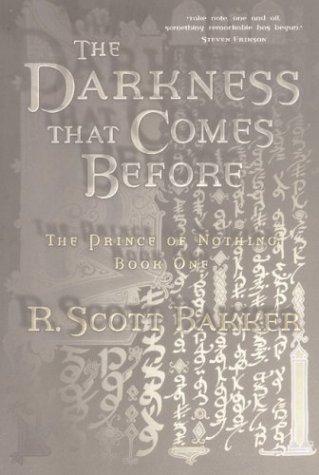
Penguin Canada first published The Darkness That Comes Before in 2003. It is R. Scott Bakker's debut novel and the opening volume of The Prince of Nothing, followed by The Warrior-Prophet and The Thousandfold Thought. The trilogy forms the first movement of the larger Second Apocalypse sequence.
The novel contains a prologue and nineteen numbered chapters arranged across five named parts: "The Sorcerer," "The Emperor," "The Harlot," "The Warrior," and "The Holy War." Its structure moves between several viewpoint characters and locations before gathering them in Momemn at the end.