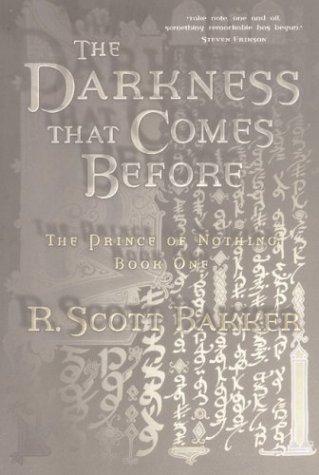
R. Scott Bakker begins The Darkness That Comes Before with the end of one world and the training of a man who may end another. Nearly two thousand years before the main story, the citadel of Ishuäl becomes the refuge of the Dûnyain, a secret sect devoted to mastering cause and effect within the human soul. When Anasûrimbor Kellhus finally emerges from that isolation, he can read desire in a pause, manufacture devotion with a look, and turn another person's history into a lever. The novel's most unsettling idea is not that Kellhus possesses magic. It is that he scarcely needs it.
The book takes place in Eärwa, a world still living in the shadow of the First Apocalypse. The Consult once nearly exterminated humanity, the legendary sorcerer Seswatha preserved the warning, and the School of Mandate continues to relive his trauma through nightly dreams. Most people now regard the Consult as a story kept alive by Mandate obsession. Drusas Achamian, a weary Mandate spy, is therefore trapped between absolute knowledge and public disbelief. He knows the apocalypse happened, but even he does not know whether its architects survived.
That tension gives the novel its title. A person stands in darkness about the causes that made him. He experiences a decision as freedom because he cannot see the hunger, memory, fear, and social pressure that prepared it. The Dûnyain call this unseen chain the darkness that comes before. Kellhus has been trained to illuminate those causes in other people while concealing his own. Every conversation with him becomes a conquest conducted inside the victim's sense of self.
Bakker wisely refuses to make Kellhus the emotional center. That role belongs primarily to Achamian, Esmenet, and Cnaiür. Achamian is intelligent enough to recognize manipulation in theory and lonely enough to surrender to it in practice. His love for the prostitute Esmenet, his guilt over the former student Inrau, and the inherited nightmares of Seswatha make him the book's most humane figure. He can explain ancient history to princes and still fail to say what matters to the person waiting for him.
Esmenet sees the world from its most exposed social position. She survives by reading men, yet the civilization around her treats intelligence in a woman as either an erotic novelty or a threat. Her chapters give the imperial councils and theological arguments a necessary physical cost. Holy war is not only a contest between emperors and priests; it is hunger, shame, sexual commerce, and a crowd searching for someone safe to punish.
Cnaiür urs Skiötha is the novel's rawest contradiction. He is the most violent man in the book and one of the few people equipped to understand Kellhus. Decades earlier, Kellhus's father Moënghus seduced and manipulated the young Cnaiür, using intimacy, humiliation, and Scylvendi custom to destroy his standing. Cnaiür recognizes the same methods in the son. His knowledge does not protect him because recognition is not freedom. He joins Kellhus while telling himself that revenge makes him the master of the bargain.
The worldbuilding is immense and aggressively unhelpful on first contact. Nations, castes, dynasties, Schools, gods, ancient wars, and religious offices arrive before the reader has a framework for them. Bakker rarely pauses to explain a term when a character would already know it. This creates extraordinary historical weight, but it also makes the opening third feel like being handed fragments of five chronicles at once.
The prose has the same double edge. At its best it is biblical, incantatory, and capable of making weather or memory feel like judgment. Bakker writes crowds especially well: conviction moves through them as contagion, transforming private grievance into sacred certainty. At its weakest, the solemnity becomes relentless. Nearly every thought arrives at the edge of revelation, and the density can flatten scenes that would benefit from ordinary human rhythm.
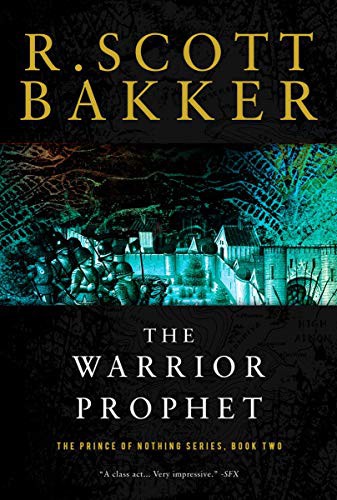
Readers expecting the crusade promised by the premise should also know that this is a book about assembling a Holy War rather than fighting one. The Vulgar Holy War ends in disaster off the center of the narrative, the great lords spend hundreds of pages trapped by provisioning and imperial politics, and the true march begins only at the end. The delay is thematically meaningful—the novel shows belief being converted into logistics and authority—but it makes the volume feel like an enormous prologue to The Warrior-Prophet.
The most difficult issue, for me, is the treatment of women. Eärwa is deliberately patriarchal, and Bakker uses Esmenet and Serwë to expose its cruelty. That intention does not remove the cumulative effect. Women are repeatedly defined through prostitution, enslavement, sexual desirability, assault, or their usefulness to men. Sexual violence is both frequent and graphically threatening. Esmenet is one of the novel's best characters, but she must carry almost the entire burden of proving that the book sees more than the misogyny it depicts. For many readers, that will not be enough.
The novel's great achievement is the collision between its two central threats. The Consult represents ancient, supernatural horror: skin-spies, sorcery, and a second apocalypse hidden beneath political history. Kellhus represents something colder—the possibility that a human being who perfectly understands belief would become indistinguishable from a prophet. Achamian approaches him hoping to interpret the return of legend. Kellhus approaches Achamian as another soul with usable causes.
The ending does not resolve the collision. It places every necessary piece on the board. The Holy War has a route, Cnaiür has the Great Names' ear, Kellhus has entered its inner circle, Esmenet has reached Momemn, and Achamian has seen proof that the Consult survives. The characters believe they are finally beginning their great undertaking. The reader understands that two separate instruments of catastrophe have just entered the same army.
The Darkness That Comes Before is demanding, oppressive, intellectually serious, and often brilliant. It is easier to admire than to love, and impossible to recommend without substantial warnings. For readers willing to accept a slow first volume, a deliberately alien moral world, and a cast whose insight rarely produces virtue, it offers one of modern epic fantasy's most formidable beginnings.