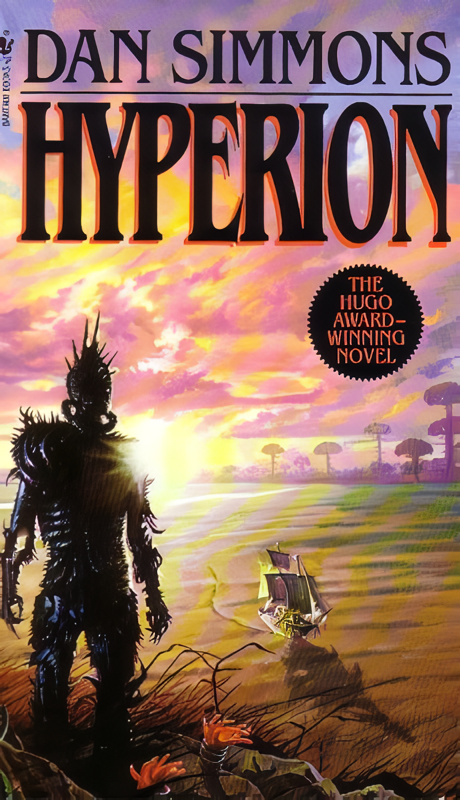
Dan Simmons builds Hyperion from an approaching catastrophe and six stories told on the road toward it. Seven pilgrims travel to the Time Tombs, where the metallic creature called the Shrike is said to grant one request and kill the rest. An Ouster invasion is imminent, the Tombs are opening, and the Hegemony may lose the planet. Instead of driving directly into the crisis, Simmons pauses the journey so the pilgrims can explain why each has been selected. The apparent delay becomes the novel.
The debt to The Canterbury Tales is explicit, but the structure is more than literary decoration. Each tale changes genre: theological horror, military tragedy, artistic autobiography, family drama, cyberpunk detective story, and anti-colonial romance. The Hegemony looks different from every position. Its farcasters create effortless movement for the privileged, its AIs make civilization possible while concealing their own interests, and its abundance depends on worlds treated as resources. The pilgrims' stories transform setting into testimony.
The Priest's Tale is the most complete horror story in the book. Father Paul Duré discovers the Bikura, a community made "immortal" by cruciform parasites that reconstruct their hosts after death while gradually eroding intellect, sexuality, and identity. Resurrection becomes repetition without spiritual continuity. Father Lenar Hoyt's account turns a theological promise into bodily imprisonment and gives the novel its first argument that survival can be worse than death.
The Soldier's Tale offers kinetic contrast. Fedmahn Kassad meets the mysterious Moneta in military simulations and later on Hyperion, where time itself becomes a weapon. Their erotic bond is inseparable from violence, and Kassad learns that the Shrike may be shaping him into the agent of a war that will kill billions. The section is thrilling and deliberately troubling: heroic competence becomes a form of recruitment.
The Poet's Tale is the broadest satire. Martin Silenus survives Earth's destruction, loses and recovers language, becomes rich through work he despises, and spends centuries failing to finish the poem that matters. His vanity is immense, but so is his fear that artistic creation and the Shrike's murders are connected. Simmons gives him some of the novel's funniest and most self-indulgent material. Readers who dislike Silenus may find the section exhausting, yet his vulgarity prevents the book's literary ambition from becoming solemn worship of itself.
The Scholar's Tale is, for me, the emotional center of the book. Sol Weintraub's daughter Rachel contracts a temporal illness that makes her age backward one day at a time. Her adult memories disappear as her body becomes younger, while Sol and his wife are forced to raise and lose the same child in reverse. The premise is cosmic, but the pain remains domestic: meals, photographs, vocabulary, sleep, and the terror of an approaching birth that will also be death.
The Detective's and Consul's Tales expose the systems behind the pilgrimage. Brawne Lamia's investigation reveals conflict within the TechnoCore and preserves the John Keats cybrid's consciousness inside her. The Consul's family history shows how the Hegemony converted Maui-Covenant into a commodity and destroyed the resistance that opposed it. His final confession—that he activated the Ouster device that opened the Tombs—turns the dignified diplomat into a man willing to risk humanity for inherited revenge.
The novel's great strength is accumulation. Objects and names cross between stories until coincidence begins to resemble design: the Shrike, the Tree of Pain, the Keats persona, the TechnoCore, the Ousters, time reversal, and the destruction of worlds. Its principal weakness is incompleteness. The pilgrimage barely reaches the Tombs before the book ends, Het Masteen never tells his tale, and almost every central conflict continues into The Fall of Hyperion. Some sexual material is dated or awkward, and the women are not always granted the same interior freedom as the men who desire or interpret them.
Even with those limitations, Hyperion remains one of space opera's great acts of structural confidence. It argues that a civilization cannot be understood from a single protagonist, genre, or ideology. Its monster may be god, machine, punishment, weapon, or evolutionary pressure. Its future may belong to humans, AIs, Ousters, or something none of them can contain. The unanswered questions are not an absence of meaning; they are the field in which the novel's meanings compete.