The Book in Brief
In 2732, Hegemony leader Meina Gladstone orders the Consul to join a final pilgrimage to the Time Tombs on Hyperion. The planet is about to be invaded by Ousters, while the Tombs are opening and moving toward ordinary time. The Consul travels aboard the Templar treeship Yggdrasill with Father Lenar Hoyt, Colonel Fedmahn Kassad, poet Martin Silenus, scholar Sol Weintraub and his infant daughter Rachel, private investigator Brawne Lamia, and Templar captain Het Masteen. On Hyperion they decide to tell the stories that brought them to the Shrike.
Hoyt reads the journals of Father Paul Duré, who discovered the Bikura and their cruciform parasites. The organisms resurrect hosts after death but degrade them with every reconstruction. Duré attempted to escape by crucifying himself to an electrified tesla tree, dying and returning for seven years until Hoyt found him. The plantation man Orlandi destroyed the Bikura village with shaped nuclear charges over Hoyt's objections; Hoyt came away carrying both his own cruciform and Duré's.
Kassad explains that he met Moneta inside military simulations and later crashed on Hyperion after an Ouster attack. Moneta gave him time-altering armor and joined him in a massacre aided by the Shrike. Kassad discovered the Tree of Pain and realized that Moneta and the Shrike were cultivating his appetite for violence in order to produce a vast war. He returns hoping to kill the creature.
Silenus recounts his escape from doomed Earth, his loss and recovery of language, and his success with the commercial epic The Dying Earth. On Hyperion he joined King Billy's artistic colony and resumed his serious poem, the Hyperion Cantos. As the Shrike murdered members of the colony, Silenus came to believe the deaths fed his creativity. Sad King Billy burned the manuscript; the Shrike took him. Silenus was later sent away and now hopes to finish the work.
Sol tells how Rachel studied the Time Tombs and was struck by the "Merlin sickness," causing her to age backward. Every morning she woke one day younger and forgot the previous day. Sol dreamed again and again of a red-lit temple and an unnamed voice quoting Genesis, telling him to take his only daughter to Hyperion and offer her there as a burnt offering. Sarai dreamed it too. He rejected the command as monstrous, but after his wife Sarai died and Rachel regressed into infancy, he chose the pilgrimage as the only remaining chance to save her.
Lamia describes being hired by a John Keats cybrid named Johnny to investigate the theft of his recent memories. They discover that the TechnoCore is divided over plans to create an Ultimate Intelligence and that Johnny's Keats identity is connected to Hyperion. After the pair become lovers, Core agents kill Johnny. He transfers his personality into Lamia's neural implant. Pregnant with his child and carrying his consciousness, Lamia accepts sanctuary from the Shrike Church in exchange for joining the pilgrimage.
The Consul tells the story of his grandparents, Merin Aspic and Siri. Merin repeatedly returned to Maui-Covenant while helping build its farcaster, but time dilation meant Siri aged far faster between their meetings. After her death, Merin sabotaged the portal and joined resistance against Hegemony colonization. The revolt failed, and the world was ecologically ruined. The Consul admits that he inherited their hatred and activated an Ouster device that accelerated the Tombs and released the Shrike, knowing the act might cause interstellar war.
During the journey, the pilgrims' treeship is destroyed, apparently by Ousters, and Het Masteen disappears from a locked room that contains blood. The six remaining pilgrims continue across the desert. Rather than separating or turning back, they decide to confront the Shrike together. They approach the glowing Time Tombs singing, and the novel ends before their requests or fates are revealed.
Important Characters
The Consul: Former Hegemony diplomat and descendant of Siri and Merin Aspic. He presents himself as a neutral observer but has committed the act that helped open the Time Tombs.
Father Lenar Hoyt: Young Catholic priest carrying two cruciform parasites, one linked to him and one to Paul Duré. He seeks release from their pain.
Father Paul Duré: Jesuit archaeologist exiled for falsifying evidence. His encounter with the Bikura and cruciform transforms the idea of resurrection into horror.
Colonel Fedmahn Kassad: Celebrated FORCE soldier whose relationship with Moneta ties erotic desire, temporal manipulation, and mass violence together.
Moneta: Mysterious woman who meets Kassad across simulations and time. She is allied with the Shrike and may be guiding him toward a future war.
Martin Silenus: Ancient, wealthy, profane poet trying to complete the Hyperion Cantos. He believes the Shrike may be both his subject and his muse.
Sol Weintraub: Jewish scholar and father of Rachel. He opposes the divine command in his dreams yet carries his daughter toward the only power that might save her.
Rachel Weintraub: Archaeologist afflicted with the Merlin sickness after entering the Sphinx. She ages backward while losing memories in reverse order.
Brawne Lamia: Private investigator who uncovers TechnoCore conflict. She carries Johnny's stored consciousness and is pregnant with his child.
Johnny: Cybrid reconstruction of the poet John Keats. His investigation of his own missing memories reveals that the Core has plans centered on Hyperion.
Het Masteen: Templar captain of the Yggdrasill and a chosen pilgrim. He disappears before telling his story.
The Shrike: Four-armed metallic being associated with the Time Tombs, temporal distortion, the Church of the Final Atonement, and the Tree of Pain. Its origin and purpose remain uncertain.
Meina Gladstone: Chief Executive of the Hegemony. She authorizes the pilgrimage while managing the Ouster crisis and the unstable alliance with the TechnoCore.
King Billy: Patron of the artists' colony on Hyperion. He recognizes the moral danger in Silenus's relationship to the Shrike and attempts to destroy the poem.
Siri and Merin Aspic: Lovers separated by relativistic time during the construction of Maui-Covenant's farcaster. Their tragedy becomes the source of the Consul's hatred of the Hegemony.
Spoiler Warning: The section summaries below reveal every pilgrim's confession, the nature of Rachel's illness, Johnny's death, the Consul's betrayal, and the novel's unresolved ending. Hyperion is organized around a framing pilgrimage and six completed tales; Het Masteen disappears before telling the seventh.
Prologue
The Consul receives Gladstone's order while living in retirement and, taking a three-week time-debt, catches the living treeship Yggdrasill before it goes quantum from the Parvati system; the other six, chosen by the Shrike Church, are already aboard. Hyperion lies outside the farcaster Web, so the whole passage is made by ship. The group understands that Ousters are approaching, evacuation is impossible for most residents, and the Shrike pilgrimage may be a political gesture, sacrifice, or last attempt to understand the Time Tombs. On Hyperion they travel by windwagon and agree to explain their connections to the planet before they meet the creature.
The Priest's Tale: "The Man Who Cried God"
Hoyt reads Paul Duré's journal. Disgraced after falsifying archaeological evidence, Duré travels to Hyperion seeking the isolated Bikura. He discovers a diminished human community that worships cross-shaped organisms embedded in their chests. The cruciform restores its host after death by rebuilding body and mind, but centuries of repeated reconstruction have reduced the Bikura physically and intellectually. The Shrike implants Duré with a cruciform, and pain prevents him from leaving its region. Hoyt later reveals that he followed Duré and found him crucified to a tesla tree, where lightning had killed and resurrected him continuously for seven years. When Hoyt touches him, Duré's parasite transfers away and the priest finally dies. Hoyt destroys the Bikura with a nuclear charge but becomes host to two cruciforms. He seeks the Shrike because the parasites inflict unbearable pain when carried away from Hyperion.
The Soldier's Tale: "The War Lovers"
Kassad grows from a violent youth into a brilliant FORCE officer. During combat simulations he repeatedly encounters Moneta, a woman who appears inside reconstructed battles and becomes his lover. His real campaigns make him famous and feared for strategies that blur victory with atrocity. After an Ouster attack on a hospital ship, Kassad escapes in a shuttle and crashes on Hyperion, where Moneta meets him in physical reality. She provides temporal armor and weapons that let him move with devastating speed. With the Shrike's assistance they slaughter Ouster attackers. Kassad then sees the Tree of Pain, bearing countless victims, and realizes Moneta is allied with the Shrike. Their relationship has cultivated him as a weapon for an apocalyptic war. Rescued and disgusted by his own legend, he becomes an antiwar voice. He returns to Hyperion intending to kill the Shrike before the future it showed him can occur.
The Poet's Tale: "Hyperion Cantos"
Silenus is born into wealth on Old Earth but escapes when the planet is destroyed by the Kiev Team's black hole. A long cryogenic voyage leaves him with brain damage and almost no language. Hard labor and a long process of recovery restore his vocabulary, though profanity returns first. He writes The Dying Earth, which is mistaken for accessible entertainment and makes him fabulously rich through sequels he despises. Centuries later he joins King Billy's artistic settlement on Hyperion and resumes the unfinished poem that matters to him, the Hyperion Cantos. Colonists begin dying at the Shrike's hands, and Silenus finds that murder seems to release his blocked creativity. King Billy recognizes the connection and tries to burn the manuscript; the Shrike takes him to the Tree of Pain. Silenus is removed from Hyperion before completing the work. He returns because he believes the Shrike is necessary to his poem and may preserve King Billy in torment.
The Scholar's Tale: "The River Lethe's Taste Is Bitter"
Sol Weintraub and his wife Sarai raise Rachel within a skeptical Jewish household. As an adult Rachel studies the Time Tombs and enters the Sphinx just as its temporal fields surge. She returns with the Merlin sickness: her body becomes one day younger after every sleep, and her memory resets to the corresponding earlier point in her life. At first she can keep notebooks and understand the diagnosis, but each day removes another layer of adult identity. Sol and Sarai abandon their careers to care for her, reliving childhood in reverse while mourning the person disappearing before them. Sol dreams that the Shrike commands him to bring Rachel to Hyperion and sacrifice her, echoing Abraham and Isaac. He refuses a god who requires a child's death. Sarai dies before the regression is complete. When Rachel becomes an infant and the final day approaches, Sol joins the pilgrimage, not in obedience but in hope that confronting the source may save her.
The Detective's Tale: "The Long Good-Bye"
Brawne Lamia is hired by Johnny, a cybrid whose human body houses an AI recreation of John Keats. He was attacked on the world Madhya and cut off from the TechnoCore for about a minute, losing five days of memory — which he counts as a murder, and hires her to investigate. Their investigation moves through the farcaster-connected Web and into a replica of Old Earth maintained by the TechnoCore. They become lovers while discovering that the Core is divided into factions: some favor continued dependence on humanity, some favor separation, and some seek an Ultimate Intelligence capable of dominating both. Hyperion and the surviving Keats personality appear central to this conflict. Core agents ambush them and kill Johnny's body. Before death he transfers his consciousness into Lamia's neural implant. Shrike cultists rescue her, but their protection has a price: she must join the pilgrimage. She is also pregnant with Johnny's child, making her body the meeting place of human, cybrid, Core, and whatever future the Shrike represents.
The Consul's Tale: "Remembering Siri"
The Consul begins with the history of his grandparents. Young Merin Aspic works aboard ships constructing a farcaster on Maui-Covenant and falls in love with Siri. Because his voyages involve relativistic time dilation, years pass for her between his visits while he ages slowly. Their repeated reunions turn romance into a long argument about what the Hegemony's arrival will do to the planet. By Merin's final return, Siri is dead and the portal is ready to admit tourists, corporations, and political control. He destroys the farcaster and joins the resistance she inspired, but the rebellion fails; the Hegemony's suppression damages the ecology as surely as commercial development would have. The Consul reveals that he served the system he hated while waiting for revenge. He then admits activating an Ouster device that accelerated the Time Tombs and released the Shrike. His act helped create the present crisis and may expose humanity to destruction.
Epilogue
The pilgrims absorb the Consul's confession without killing or abandoning him. Their situation has already worsened: the Yggdrasill has been destroyed, Het Masteen has vanished from a guarded room marked by blood, and Ouster invasion appears inevitable. The six remaining travelers cross Hyperion's desert toward the Time Tombs. Each has a different purpose—healing, death, revenge, artistic completion, rescue, or understanding—but none can predict whether the Shrike distinguishes among them. As the Tombs glow and the boundaries of time weaken, the group chooses solidarity over isolation. They walk forward singing "We're Off to See the Wizard." The novel ends before they reach the Shrike, deliberately withholding the encounter the entire frame has promised.
Ending Explained
The abrupt ending makes Hyperion the first half of a larger narrative rather than a conventionally complete quest novel. The pilgrims have finished explaining themselves, but the pilgrimage has not reached its answer. The Fall of Hyperion continues the crisis and resolves many of the questions about the Tombs, the war, and the TechnoCore.
Their song is comic, frightened, and defiant. Like the travelers in The Wizard of Oz, the pilgrims approach a figure onto which they have projected incompatible hopes. The Shrike may be less a wish-granting god than the center of a system manipulating their desires. Singing together does not guarantee survival, but it establishes that they will not let the pilgrimage reduce them to six competing sacrifices.
The Consul's confession also changes the frame. The crisis is not something that merely happened to the pilgrims; one of them helped cause it. He betrayed the Hegemony to the Ousters, then shot the Ouster scouts when they came and triggered the device himself, so his revenge served neither side and endangered worlds that never consented to it. The group continues with him because every tale has revealed some mixture of guilt and victimhood. No pilgrim arrives morally pure.
Unresolved Questions
What is the Shrike: organism, machine, weapon, god, servant, or a being from another time?
Who created the Time Tombs, and what happens when they finish opening?
Why was Het Masteen selected, and who removed him before he could tell his tale?
Can the cruciforms be removed from Hoyt without killing him?
Will the Shrike save Rachel, accept Sol's sacrifice, or reveal that the command came from another source?
What does Moneta want from Kassad, and which future war is she trying to create?
Why is the Keats persona important to the TechnoCore's Ultimate Intelligence project?
What will happen to Johnny's consciousness inside Lamia and to their unborn child?
Did the Ousters destroy the Yggdrasill, or is another power responsible?
Can the Hegemony survive an Ouster invasion and a revolt within the TechnoCore at the same time?
Is the Consul's revenge complete, or has he become another instrument in a plan he does not understand?
About the Book
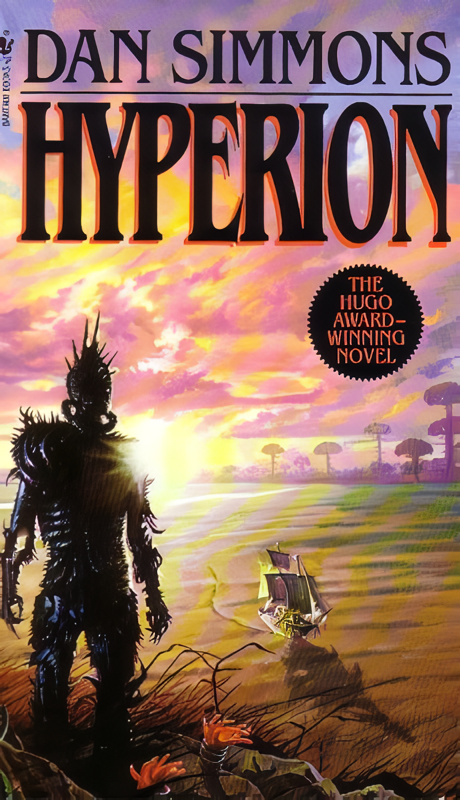
Doubleday published Hyperion in 1989. It is the first volume of the Hyperion Cantos, followed by The Fall of Hyperion, Endymion, and The Rise of Endymion. The Consul's Tale developed from Simmons's earlier story "Remembering Siri," first published in Asimov's Science Fiction in 1983.
Hyperion won the 1990 Hugo Award and Locus Award for Best Science Fiction Novel. The book's structure draws openly on Geoffrey Chaucer's The Canterbury Tales and repeatedly invokes the life and poetry of John Keats. This article follows the standard English-language structure: Prologue, six completed pilgrims' tales, and Epilogue.