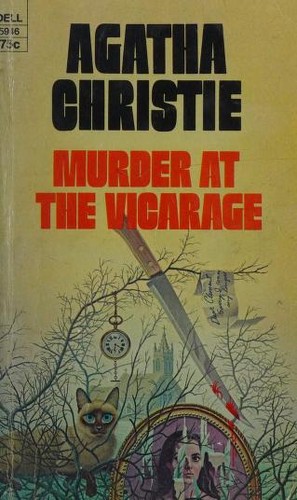
This is the novel that gave Miss Marple her first full-length outing, and Christie makes the canny choice of not telling it from Marple's point of view. The narrator is Leonard Clement, vicar of St. Mary Mead, who jokes over a bad lunch that ridding the world of Colonel Protheroe would be a public service, and within days finds the man shot at his own study desk. The premise is pure engine: a victim the whole village had reason to hate, a corpse in the most respectable room imaginable, and, before the body is cold, two separate confessions that cannot both be true and that the evidence suggests are both false.
Clement is one of Christie's best narrative decisions. His dry, self-deprecating account of parish life, his running marital comedy with Griselda, a wife twenty years his junior who regards housekeeping as a doomed experiment, and his slow-burning feud with the abrasive Inspector Slack give the book a warmth her plot-machines rarely reach. Christie is routinely accused of flat prose; this book is genuinely funny, and the humor does structural work, because the gossips who supply the jokes are the same instrument that supplies the clues.
The novel's founding insight is that a village is a surveillance network, and the spinster at her garden gate is its best-placed sensor.
And that is the real invention here. The novel's founding insight is that a village is a surveillance network, and the spinster at her garden gate is its best-placed sensor. Marple enters as one busybody among four, initially hard to distinguish from the parody spinsters around her, and earns her separation scene by scene: she deals in the same raw gossip but refuses to sentimentalize it, testing every rumor against a lifetime's catalogue of small human misbehavior. Her method, reasoning from petty village precedents up to murder, is stated openly, mocked by her modernist novelist nephew, and vindicated completely.
As a puzzle it is fair and dense: a study clock deliberately kept fifteen minutes fast, an unfinished note whose time heading sits in the wrong ink, a gunshot everyone heard but no one can place, and seven suspects Marple can count on her fingers without naming. The double-confession opening is a superb gambit that inverts the usual rhythm, giving the police too many solutions rather than too few, and the final mechanism has the satisfying property that nearly every oddity planted along the way turns out to be load-bearing.
What dates and drags is real but survivable. The long middle rotates through interviews and red herrings at a pace modern readers may find sedate, and a subplot about a visiting archaeologist and his secretary spends many pages earning a modest payoff. The period's attitudes surface in the servant comedy, in breezy generalizations about women and the lower classes, and in some vintage pseudo-medicine linking illness to criminal character. The murder gadgetry also asks a little goodwill: the timing depends on a contraption that works better in summary than under close scrutiny.
Still, this is one of the best-machined of Christie's early novels and the template for nearly a century of village mysteries since. Read it for the puzzle and stay for the voice, and for the pleasure of watching the genre's greatest amateur detective walk on almost unannounced, get dismissed by every official in sight, and quietly take the whole book away from them.