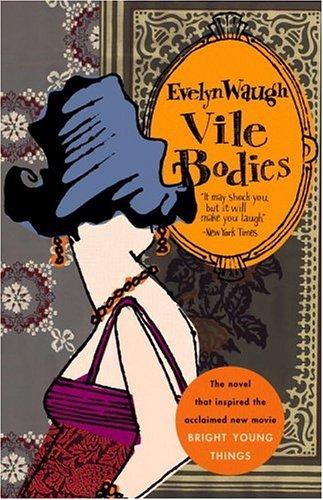
The comedy of Vile Bodies runs almost entirely on talk that fails to connect. People ring each other up to break off an engagement and ring back forty minutes later to restore it; a customs officer burns a manuscript he is incapable of reading; two tipsy old sisters conduct an entire feud about smelling salts through a Channel gale, from adjacent bunks, without once looking at each other. Waugh hardly ever tells you what anyone feels. He starts the dialogue and lets the distance between what is said and what is actually going on do all the damage, which is why a book from 1930 still moves faster than most novels written since.
The shape is a circuit rather than an arc. Adam Fenwick-Symes arrives at Dover engaged to be married, loses his book to the censor, wins a thousand pounds off a stranger on a bar trick, hands the thousand to a drunk Major within the hour, and then spends the rest of the novel revolving through the same three conditions — engaged, solvent, neither — while the parties change fancy dress around him. A savage party in a borrowed house, a party in a moored airship, a motor race that is really a party with casualties attached. The settings escalate; the people do not. Waugh even lets Adam run off the whole catalogue of parties in one exhausted parenthesis, and it is as close as the book comes to admitting what it is up to.
The gossip column is the machinery underneath all of it. Simon Balcairn, shut out of a party he is required to describe, telephones in a two-column fantasy of duchesses flinging their tiaras on the floor and peeresses confessing their sins, then lies down in his gas oven; Adam inherits the column and discovers that invention is simply the job. He manufactures a Polish sculptor, an Italian count, a fashion for bottle-green bowler hats, and a young married woman so exquisite that Hanover Square starts addressing hatboxes to her. The joke is not that the press lies. The joke is that the lie is absorbed instantly and without friction, and that the only thing capable of destroying Adam is being caught contradicting his own fiction.
Money behaves exactly like the gossip: it works only as long as nobody tests it. A thousand pounds materialises twice on two consecutive evenings and evaporates twice. Colonel Blount signs a cheque Charlie Chaplin. The drunk Major carries Adam's fortune around England in a permanent state of near-delivery. The single transaction that actually clears is the one that stings: Adam sells his claim on Nina to Ginger Littlejohn for seventy-eight pounds sixteen and twopence, which is the exact total of his hotel bill, and Nina is informed afterwards by telephone. Her objection is that it was rather caddish. Nobody in this book is capable of being wounded in a way that would slow them down, and that incapacity is the thing Waugh is actually writing about.
The film company at Doubting Hall is the finest sustained set piece here. Colonel Blount has let his house to a producer shooting the life of John Wesley with fee-paying pupils in the cast and two fencing instructors from the Aylesbury gym playing the duel, and he cannot hold on to Adam's identity from one visit to the next. Two chapters later that failure of memory is the only thing propping up the plot, when Adam turns up for Christmas impersonating Nina's husband and is welcomed as the ideal son-in-law. The Christmas chapter is genuinely warm — the banner in the hall, the carol singers, the sherry in the servants' hall — and the warmth is precisely what makes the next page intolerable.
The Rector comes in to announce that war has been declared, and the final chapter drops Adam onto a ruined battlefield with a germ bomb in his pocket and a letter from Nina in his tunic: she is pregnant, Ginger has decided the child is his, and a gossip writer is busy inventing Adam's heroism for the papers. The drunk Major reappears as a General who has mislaid an entire division, offers at last to write out the thirty-five thousand pounds now that the currency is worthless, and produces champagne in a staff car sunk to its axles in mud. Asleep in the back is Chastity, one of Mrs. Ape's angels, who recites in one flat unpunctuated breath how she was sold to Buenos Aires, handed from army to army, renamed by each of them and left in a ditch. Adam sleeps while the General starts on her. That is the happy ending.
Waugh's people do not learn anything; they simply keep moving until something larger than a party stops them.
It is not flawless, and some of the flaws are not merely of their period but ugly in any period: the film producer is a Jewish caricature, the night-club scene reaches for a racial slur as a throwaway, Miles exists largely as a joke about how he talks. Waugh is also indifferent to interiority — Nina is mostly a voice on a telephone, and Adam is a hole in the middle of the book where a protagonist should be, which is half the point and half a limitation. Waugh's people do not learn anything; they simply keep moving until something larger than a party stops them. Four and a half stars: the funniest English novel of its decade and the coldest, and the only one that had the nerve to end its own party with a war.