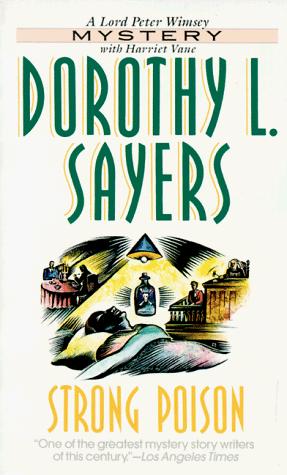
Strong Poison opens in the deadliest place a detective story can begin: at the end, with the case already made. Harriet Vane, a writer of mysteries, stands in the Old Bailey dock while an ancient judge rehearses the evidence against her — she bought arsenic and other poisons under false names while researching a poison novel, her former lover Philip Boyes died in agony days after drinking coffee alone with her, and nobody else appears to have had motive, means or opportunity. Watching from the gallery, Lord Peter Wimsey decides two things at once: that she is innocent, and that he is going to marry her. When one immovable juror forces a retrial, he gets about a month to make good on the first conviction before the second becomes academic.
The construction is bravura. Sayers pours the whole prosecution case into the judge's summing-up, so the reader arrives fully briefed and already uneasy: the old man's fussy asides about how to treat an omelette, his lecture on commercial arsenic, and his acid little sermon on Harriet's morals do double duty as exposition and as an indictment of the society judging her. The trial chapters make clear that Harriet is on trial as much for having lived with a man unmarried as for killing him, and the book knows it — the artist juror who understands her world, and the spinster who refuses to convict on demeanour, are the only people in the room actually weighing evidence.
Sayers understands that gratitude is a terrible foundation for marriage, and she lets Harriet say no to her own rescuer.
What made the book famous, though, is the courtship. Wimsey proposes across a prison visiting table at their first meeting, and Sayers immediately punctures the fairy tale: Harriet drily informs him that he is proposal number forty-seven since her notoriety began. She is allowed to be bruised, sardonic and unwilling; he is refused more than once, and the novel treats the refusals as reasonable rather than as coyness to be worn down. Sayers understands that gratitude is a terrible foundation for marriage, and she lets Harriet say no to her own rescuer. The famous partnership starts here precisely because it does not conclude here.
The actual detection, meanwhile, is largely subcontracted to two magnificent middle-aged women from Wimsey's typing bureau of so-called superfluous females. Miss Climpson — the jury holdout — is despatched north to locate a hidden will, and her campaign of fraudulent seances, run with a soapbox clicker strapped above her knee and a conscience in open revolt, is the comic and moral high point of the novel. Miss Murchison, planted as a typist in a solicitor's office, learns lock-picking from a reformed safecracker turned street evangelist and calmly burgles her employer. Sayers takes visible pleasure in showing that the women nobody looks at twice are the ones who crack the case.
Not everything has aged as well. A Christmas chapter at Duke's Denver is mostly series housekeeping — an engagement subplot for Freddy Arbuthnot whose chatter carries the casual antisemitic stereotyping of its period, and matchmaking for Parker and Lady Mary — and the Bohemian party scenes, though funny, run long. As a fair-play puzzle it is also thin: there is effectively one alternative suspect from early on, and a reader who notices which books Wimsey leaves open on his desk after his all-night reading session can beat him to the method. The interest lies less in whodunit than in how the impossible dinner is unpicked, and in the trap — half chemistry, half theatre — that springs the ending.
Still, the thinness of the puzzle barely matters, because everything around it is so alive: the anatomy of a prosecution built on respectable prejudice, the portrait of a woman refusing to be either hanged or handed over, and a detective who for once has something personal to lose. As a mystery it is good; as the hinge on which the whole Wimsey series turns from ingenious pastime toward something like a novel, it is essential.