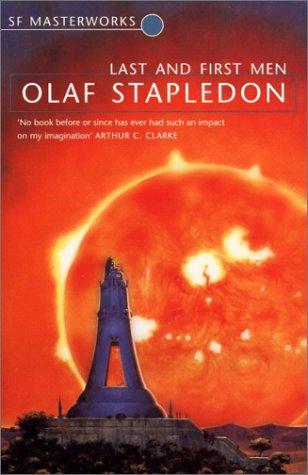
Last and First Men is not a novel, and the reader who opens it expecting one will bounce off within thirty pages. It has no protagonist, almost no dialogue, and no scene that lasts longer than a few paragraphs. What it is instead is a chronicle: a history of the next two billion years, dictated — so the fictional Introduction insists — by one of the Last Men, a member of the eighteenth and final human species, working through the borrowed brain of a 1930s Englishman. Stapledon commits to the conceit absolutely. The book reads like the condensed textbook of a civilization that does not yet exist, complete with digressions, apologies for compression, and the serene assurance of a narrator for whom the fall of a species is a paragraph.
It is less a story than a geology of the future, stratum on stratum, and the cumulative effect is unlike anything else: a vertigo that becomes, by the final chapters, something close to awe.
The instrument this form makes possible is scale. The early chapters cover decades; the late ones swallow hundreds of millions of years between sentences. Eighteen human species rise and fall across three planets: men who live two centuries, men bred as immense brains in forty-foot concrete turrets, winged men who die of despair when grounded, Last Men with quarter-million-year lifespans and an extra eye for the stars. Whole civilizations — a world state ruled by a science-religion of divine energy, a musical theocracy, a culture that breeds animals as living art — are built, furnished, and demolished in a chapter. It is less a story than a geology of the future, stratum on stratum, and the cumulative effect is unlike anything else: a vertigo that becomes, by the final chapters, something close to awe.
It must also be said plainly: the opening quarter has aged badly, and in more than one way. As prophecy, the near-future chapters are a 1930 political cartoon — an Anglo-French air war sparked by a tabloid sex scandal, a Sino-American world war settled by two businessmen and a symbolic woman on a beach — and the satire of Americanism, though sometimes very funny, grinds on well past its point. Worse is the era's intellectual furniture. Stapledon writes of national and racial characters as if they were fixed essences; his future assigns the Jews a hereditary caste of finance, imagines a sacred ritual of lynching in a degenerate America with unsettling aesthetic detachment, and generally breathes the racial essentialism of its decade. The authorial preface disarms some of this — the book is offered as myth, not forecast, with half an apology to American readers — but a modern reader should know what the first hundred pages contain.
Then the First Men die, and the book becomes what it was always meant to be. The Martian invasions are among the great alien inventions in the literature: not humanoids but sentient clouds of viral dust, whose group mind is at once their glory and their spiritual prison, and whose crusades are driven partly by the conviction that our diamonds are being blasphemed. The chapters on the Great Brains form a still-unmatched parable of intelligence divorced from value. The Flying Men of Venus — bat-winged pygmies whose entire culture is an ecstatic aesthetics of flight, and who choose extinction in a volcano over life on the ground — compress more tragedy into a dozen pages than most trilogies manage. And the closing portrait of the Last Men on Neptune, with their group minds, their communal exploration of the past, and their discovery that a diseased star has already sealed their doom, sustains a grandeur that science fiction has been drawing on ever since.
Underneath the taxonomy of species runs a single argument, restated in every age: what should mind do in a universe that will outlast and erase it? Stapledon's races keep attempting the same spiritual feat — to admire fate without lying about it — and keep breaking on the attempt; the Second Men are destroyed less by Mars than by their failure to experience racial tragedy as beauty. The Last Men finally manage it, and then the ending strips even that from them: a dying species spends its final strength scattering artificial seeds of life toward other stars while its own faculties rot in the poisoned sunlight. The last pages, given to the youngest of the Last Men, turn a two-billion-year defeat into something like a benediction.
This is a book to be read the way one reads Gibbon, a chapter at a night, not gulped like a thriller. Readers who need character, momentum, or even scenes should stay away; everyone else should treat it as essential. Its first movement is dated and sometimes ugly, its prose can turn to lecture, and yet no other single volume of science fiction attempts so much or delivers so much of what it attempts. Nearly a century on, its scale has still not been outbuilt — only borrowed from.