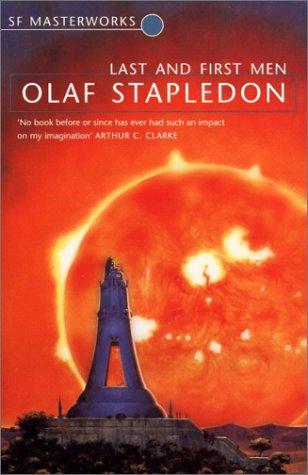
How does the world of the Last Men end?
A neighboring star succumbs to a unique disintegrating disease; its radiation infects nearby bodies and finally the sun itself, and within about thirty thousand years no life will be possible anywhere near it. Neptune cannot be propelled away fast enough to escape.
How do the Last Men respond to their death sentence?
After initial inner turmoil they spend a full Neptunian year in a racial-mind trance, emerge with grief transfigured into peace, and resolve on two last works — seeding the galaxy with artificial life, and completing their loving exploration of the human past.
What is the Scattering of the Seed?
A manufactured living dust, hardy enough for a voyage of millions of years and biased toward the eventual evolution of intelligence, launched in vast quantities on the pressure of solar radiation toward promising regions of the galaxy — a last gamble that mind may rise again elsewhere.
Does the book explain its own existence?
Yes — the Last Men can reach past minds through eternity, and the narrator states that this chronicle was planted in the brain of a twentieth-century writer, arriving in considerable disorder.
How far have the Last Men fallen by the Epilogue?
Twenty thousand years of stellar radiation have destroyed the racial mind, telepathy, and even their dispassionate wills; plague, famine, and incipient war wrack the polar remnant, and the Brotherhood of the Condemned keeps the spirit alive until the seed is sown and death becomes permissible.
What is the final note of the book?
The youngest of the Last Men speaks the close — man, conceived by one star and killed by another, remains eternally a beauty within the everlasting shape of things, and humanity may go to its end with laughter and peace, making a fair conclusion to its brief music.
Themes and What the Ending Means
Deep time: The book's basic instrument is scale — chapters that swallow millennia, then aeons, until all recorded history shrinks to an unanalysable point. Against that backdrop every civilization becomes a brief flicker whose worth must be found in something other than permanence.
Man remaking man: From the Patagonian breeders to the Great Brains to the deliberate design of the Fifth, Ninth, and Eighteenth species, the chronicle's central thread is humanity taking its own evolution in hand, with results by turns monstrous and magnificent.
Tragedy admired: Stapledon's races repeatedly attempt the same spiritual feat — to face racial disaster not with consolation or despair but with a dispassionate, almost musical admiration of fate. The Second Men break in the attempt; the Last Men achieve it, and then, cruelly, begin to lose it.
The cycle of rise and fall: Civilization here is not a ladder but a tide — eighteen species and dozens of world orders, each undone by war, plague, astronomical accident, or its own ruling obsession, and each rebuilding on the ruins of the last.
Individuality and communion: From the Martians' tyrannical race-mind to the Last Men's sexual groups and racial awakenings, the book keeps testing how far separate minds can join without erasing the person, treating telepathic union as both the great prize and the great danger.
The persistence of the past: Time in this book is eternal as well as passing — past minds can be visited, loved, and even faintly influenced from the far future, and the Last Men treat piety toward the dead ages as a religious duty, the book itself being such an act.