The Book in Brief
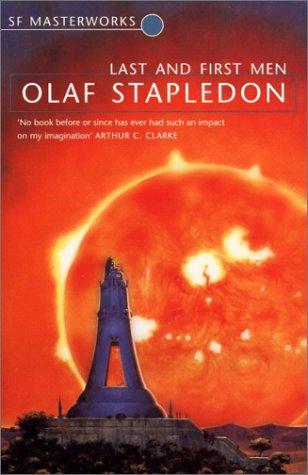
Last and First Men presents itself as a message from the Eighteenth and final human species, transmitted two billion years back through the brain of a twentieth-century writer. It opens with the fall of the First Men — us — through a chain of wars (Anglo-French, Russo-German, Euro-American, and the last great war between America and China), a four-thousand-year world state ruled by an energy-worshipping science-religion, the exhaustion of fossil fuels, a dark age, a Patagonian revival, and finally a mishandled rediscovery of atomic power that burns the planet down to thirty-five Arctic survivors. From their descendants rise the noble Second Men, broken by fifty thousand years of war with cloudlike Martian invaders; the animal-breeding Third Men; the monstrous Great Brains they construct, who in turn design the near-perfect Fifth Men. When the moon inexplicably begins to fall, the Fifth Men exterminate the native intelligences of Venus and migrate there; Venus later produces the ecstatic winged Seventh Men, and when astronomers learn that a wandering gas cloud will strike the sun, the industrial Eighth Men seed Neptune with a dwarfed successor species before the collision incinerates the inner worlds.
On Neptune humanity spends three hundred million years as mere beasts, then climbs through eight further species to the Eighteenth — the Last Men — a world of ninety-six-member group minds, occasional racial consciousness, direct exploration of past minds through eternity, and philosophic calm. Their maturity is cut short: a nearby star, deranged by a unique disease, infects the sun, and man is given roughly thirty thousand years. The Last Men respond by manufacturing an artificial seed of life and scattering it toward other stars, by lovingly exploring and faintly influencing all past minds — the writing of this very book among the results — and, as their faculties decay in the poisoned light, by holding to the conviction that man is forever a beauty within the eternal shape of things, and that being man was, after all, good.
Important Characters
The Narrator (One of the Last Men): A member of the Eighteenth species, writing from Neptune two thousand million years hence, who claims to be dictating this chronicle through the brain of a twentieth-century writer. Urbane, ironic, and infinitely patient, he treats all eighteen human species — his own included — with mingled pity and admiration.
The First Men: Our own species, portrayed as brilliant but half-formed animals whose ideals persistently outrun their nervous systems. They build a world state on the worship of movement, squander the planet's fuel, decline into ritualized stupidity, and finally incinerate their civilization with mishandled atomic energy, leaving thirty-five survivors at the North Pole.
The Young Chinese Physicist (the Discoverer): The scientist who achieves the annihilation of matter, demonstrates it by vaporizing Lundy Island, annihilates an American air fleet at his colleagues' urging, then burns his instrument and papers and wills himself dead rather than leave the secret among savages. Later ages venerate him as prophet, incarnate Buddha, and second Christ.
The Daughter of Man: A woman of blended ancestry, raised by a hermit on a Pacific island outside the modern world, who interrupts the secret peace conference between America and China. She chooses the American envoy — soon the first President of the World — as the father of her child, and her televised image becomes the erotic and religious symbol of the unified planet.
The Divine Boy: The Patagonian prophet of youth, a biological throwback whose vigor and sexual energy seem miraculous to a prematurely aging race. He preaches keeping young while growing up, sees life as a game watched by a cosmic playwright, laughs at the idol of Power in its own temple, and is executed for sacrilege — becoming the distorted god of the next world religion.
The Second Men: Titans with two-century lifespans and an inborn generosity the narrator likens to natural Christianity, nearly incapable of selfishness. Their glory is broken not from within but by fifty thousand years of Martian invasion and by a spiritual defeat: they cannot make themselves experience racial tragedy as beauty, and sink into a thirty-million-year trance.
The Martians: Cloudlike swarms of ultramicroscopic units held together by radiation — sometimes millions of separate cloudlet minds, sometimes a single planetary will. Intelligent but spiritually stunted, they mistake radiation for mentality, revere rigid crystals and above all diamonds as sacred, and are finally exterminated, along with most of humanity, by a manmade virus.
The Third Men: Small, golden-eyed, six-fingered, and short-lived, with vast mobile ears, a genius for music, and an obsessive sympathy with living things. Their civilizations practice vital art — the breeding of animals as living sculpture — and their final project, the creation of a superhuman brain, becomes their own destruction.
The Fourth Men (the Great Brains): Immortal brains housed in forty-foot concrete turrets, tended by machinery, designed by the Third Men as pure intelligence. Devoid of love, fear, and every motive but curiosity, they enslave and then exterminate their makers and nearly all animal life, discover that their own blindness to value is incurable, and design their perfected successors.
The Fifth Men: The first fully human species, in the narrator's judgment: giants living for millennia, telepathic through inherited Martian units, builders of the greatest terrestrial civilization. They learn to inspect past minds directly through eternity, despair over the everlasting suffering of history, and, when the moon begins to fall, exterminate the Venerians and lead humanity to Venus.
The Venerians: The swordfish-shaped natives of the deep oceans of Venus, powered by radioactive decay, builders of coral-like submarine cities and practitioners of rituals no human mind could interpret. Already doomed by their dwindling radioactive stores, they resist the terraforming of their world and are deliberately wiped out by man — a genocide whose guilt haunts the species for ages.
The Seventh Men (the Flying Men of Venus): Bat-winged pygmies whose whole civilization is an aesthetic of flight: airborne they know a dispassionate ecstasy, and grounded they wither and die of grief. When flightless mutants seize the world and outlaw natural flight, the last million fliers rise together and fly in procession into a volcano.
The Last Men (the Eighteenth species): A million million potential immortals on Neptune, wildly various in body, equipped with an upward-gazing astronomical eye, organized in ninety-six-member sexual groups that wake into group minds and, rarely, into a single racial mind spanning the species. Philosophers of a dark-bright cosmos, they meet the sun's infection as artists judging a finished work.
The Youngest of the Last Men: The final child conceived before the species learned its doom, and the noblest, able to withstand the poisoned sunlight longer than any other. Moving among the Brotherhood of the Condemned, he speaks the book's closing words: man, conceived by one star and killed by another, remains forever a beauty in the eternal shape of things.
Chapter-by-Chapter Summary
Headings follow the complete text — the fictional Introduction by One of the Last Men, which is part of the work, plus the sixteen titled chapters — and every recap below was written directly against it.
Introduction: By One of the Last Men
The fictional Introduction is signed by one of the Last Men, who explains that the book has two authors: the twentieth-century writer who believes he is inventing fiction, and the far-future intelligence directing his brain. The narrator asks readers to entertain, at least as fiction, the idea that this chronicle is an authentic message from the Eighteenth Men, and promises not a utopia but a record of vast fluctuations of joy and woe as human nature itself changes. He warns that mind's hardest ascents still lie ahead, and closes by coaching the reader in the cosmic magnitudes of time the coming flight over the aeons requires.
Chapter 1: Balkan Europe
Surveying our era from the far future, the narrator traces the First Men's decline through a chain of European wars: a brief war between France and Italy, then an Anglo-French war ignited by a fabricated sexual scandal and rivalry over air power. Bombed London's government broadcasts an astonishing message of unilateral peace, but a straggling French plane crashes beside a school and palace, killing a beloved princess, and the resulting fury obliterates Paris and cripples both nations. Decades later a Russo-German war over a nationalist insult drenches western Russia in poison gas, leaving the soil from the Black Sea to the Baltic dead for years. Europe's mentality permanently deteriorates, and the promising Russian fusion of Western intellect with Eastern mysticism is destroyed.
Chapter 2: Europe's Downfall
America and China rise as rival world powers, and war erupts between America and a European Confederacy. At a scientific gathering on the Devon coast, a young Chinese physicist demonstrates the annihilation of matter by vaporizing Lundy Island; the assembled scientists vote to destroy the discovery, but he first annihilates the approaching American air fleet, then kills himself to bury the secret. Enraged, America floods every European city with poison gas, murdering the continent's population. The one surviving insider, an English physicist, deliberately steers all subsequent research down a blind alley, while collective guilt warps America into superstition and intolerance.
Chapter 3: America and China
The world crystallizes into American and Chinese blocs, and a war of poison, microbes, and the mind-destroying American madness drags on for a quarter of a century. Two envoys meet secretly on a Pacific island to arrange peace under a World Finance Directorate, and the negotiation is transformed by a nude island woman of blended ancestry, self-styled a daughter of man, who has never left her island. Choosing the American representative as her mate, she tips the settlement toward America: the treaty imposes energy-worship and puritan reforms on the East, and the Chinese vice-president ironically accedes to save Chinese access to Antarctic resources.
Chapter 4: An Americanized Planet
The World Financial Directorate founds the first World State, whose religion fuses science and faith into worship of Gordelpus, the divine energy, administered by the Sacred Order of Scientists. For four thousand years culture ossifies around ritual aviation — newborns are dropped by parachute onto a plane's wings, a rite that culls the weak — while curiosity is criminalized, intelligence declines, and Jews and racial throwbacks are held in ritualized honor and contempt. When Antarctica's coal gives out, the scientists, who possess no divine secret of power, stall with faked miracles until a prominent Jew broadcasts the truth. The world state dissolves in riots, engineered plagues, and cannibal chaos, and the jungle reclaims the planet.
Chapter 5: The Fall of the First Men
Through the hundred-thousand-year First Dark Age, degraded survivors scratch a living beneath the pylon ruins while the species ages ever faster, adolescence ending by fifteen. Civilization revives in Patagonia, a sober, prematurely old culture that worships youth through the Divine Boy, a miraculously vigorous prophet executed for smashing the Creator's idol. Archaeologists then unearth the ancient world from buried printing plates, and Patagonia bends its science toward rediscovering subatomic power; a riot at a mine accidentally unleashes it, detonating deposits of the critical element around the globe. The firestorm boils the oceans' margins and kills every human being except thirty-five near the North Pole.
Chapter 6: Transition
The survivors, crew of an Arctic exploration ship, plant a settlement at a Siberian river mouth as self-appointed guardians of the human future. The community splits: the seafaring party wrecks on Labrador, where its few descendants degenerate into submen, while the Siberian remnant engraves an outline of human knowledge on thousands of stone tablets before sinking, across the ten-million-year Second Dark Age, into Arctic savagery on an isolated island. When the climate turns, a handful drift on an iceberg to the Asian mainland. There, through racial interfusion and mineral-rich volcanic soil, humanity slowly recovers its vitality.
Chapter 7: The Rise of the Second Men
Ten million years after the Patagonian disaster the Second Men appear: titans with massive heads, two-century lifespans, and an innate generosity the narrator calls natural Christianity. In Africa they encounter an intelligent monkey species that keeps diseased submen — descendants of the Labrador castaways — as slaves and food; the jealous monkeys nearly annihilate the newcomers with plague-infected nuts before being devoured by their own rebellious cattle. The Second Men weather glaciations, epidemics, a lethal tendency of the brain to outgrow its body, and one uniquely savage religious world war. At their zenith they resolve to remake human nature itself — just as something crosses from Mars.
Chapter 8: The Martians
Swarms of green cloudlets descend on the ranges that were once the Hindu Kush, crush a town, and pulp curious onlookers before concentrated beam radiation routs them: the first Martian invasion. The narrator then anatomizes Mars, where the dominant life evolved as ultramicroscopic units linked by radiation into living clouds — each cloudlet an individual, all capable of waking together as the mind of the race. Brilliant in physics but philosophically naive, the Martians have confused radiation with mentality and hold rigid crystals, above all diamonds, to be sacred. They covet the earth's water and vegetation, and burn to liberate its improperly worshipped diamonds.
Chapter 9: Earth and Mars
For fifty thousand years Martian invasions alternate with slow recoveries, each clash ending with the clouds slaughtered and their disintegrated units crippling mankind as a pulmonary virus. A permanent Martian colony on the Antarctic tableland repeatedly begins a spiritual renaissance, and is repeatedly purged by the orthodox home planet. Meanwhile the Second Men, failing at the acceptance of tragedy their own wisdom demands, slide into perversion and nationalism; in the final war a human bacteriologist looses a virus that exterminates the Martians on both planets and nearly all of humanity with them. The remnant falls into a racial trance lasting thirty million years, while the Martian units settle into symbiosis with certain terrestrial mammals.
Chapter 10: The Third Men in the Wilderness
On an island continent risen from the North Atlantic seabed, the tranced remnant evolves into the Third Men: small, golden-eyed, six-fingered beings, short-lived, incurious about theory, and passionately absorbed in music and in living things. Among their many civilizations is a thousand-year musical theocracy, complete with a mad imprisoned prophet and a disastrous caste bred for hypersensitive musical souls. Their most brilliant culture perfects plastic vital art, redesigning animal species — and cautiously, man — as living artworks under a biological priesthood. It finally splits into rival enterprises: one breeding trance-mediums to consult the unseen world, the other secretly breeding pure brain.
Chapter 11: Man Remakes Himself
The brain-breeders succeed: after tragic failures they produce an immortal brain housed in a forty-foot concrete turret, which fathers some ten thousand fellow Great Brains, the Fourth Men. Pure curiosity without mercy, the Brains reduce the Third Men to serfs, crush their rebellion with telepathically controlled slave-men, exterminate them and nearly all animals, and torture caged specimens in a vain search for a higher mode of knowledge. Realizing their blindness to every value but intellection is incurable, they design harmonious successors — the Fifth Men, telepathic giants with three-thousand-year lifespans — who destroy their makers in war. Rebuilding from the resulting barbarism, the Fifth Men create the most brilliant civilization the earth has known.
Chapter 12: The Last Terrestrials
The long-lived Fifth Men refuse personal immortality, school themselves in the beauty of evanescence, and then discover that the past is not gone: disciplined minds can directly inspect any past mind through eternity. The gift brings history in the flesh — and the crushing knowledge that all past agony exists forever. Amid this melancholy the moon inexplicably begins spiraling inward, dooming the earth; the species builds ether-ships, chooses Venus, and spends ages electrolysing its ocean to make breathable oxygen. The intelligent, radioactivity-powered natives of the Venerian deep fight the invasion and are deliberately exterminated — already doomed, the colonists tell themselves — before mankind abandons the earth to the falling moon.
Chapter 13: Humanity on Venus
On Venus the species withers: explosions, plagues, and a nervous cancer strip away telepathy and civilization, and the remnant speciates into seal-like submen and the diminished Sixth Men. After hundreds of millions of years the Sixth Men fulfill their oldest religious dream by engineering the Seventh Men, bat-winged fliers for whom life aloft is dispassionate ecstasy and life on the ground a slow death. When flightless mutant intellectuals rebuild industry and outlaw natural flight, the last million fliers rise together and stream in procession into a volcano. The pedestrian Eighth Men then learn that a wandering mass of gas will strike the sun; they design the dwarfed Ninth Men for distant Neptune and transport them there before the collision engulfs Saturn and incinerates the earth and Venus.
Chapter 14: Neptune
The frail Ninth Men collapse into brutehood, and for three hundred million years Neptune knows humanity only as beasts — hoofed grazers, tiny predators, even bat-sized fliers descended from man. From a persecuted rabbit-like survivor a new toolmaking line arises, the Tenth Men, and species succeed species through savage and civilized ages, including the imperfect Fourteenth, who endure three hundred million years of rise and collapse. With the great-headed Fifteenth Men deliberate self-remaking resumes; the Sixteenth Men gain control of their planet's orbit, re-enter the past, and conceive a crusade to redeem it. Their flawed successors, the Seventeenth, quickly fashion the Eighteenth — the Last Men.
Chapter 15: The Last Men
The narrator now describes his own species: a million million potential immortals, wildly diverse in body, bearing a third astronomical eye on the crown, with lifespans near a quarter of a million years and childhoods lasting a millennium. Their crowning feature is the ninety-six-member sexual group, whose specialized sub-sexes wake together into group minds — and, on rare occasions, the whole species wakes as a single racial mind perceiving the planet, the ages, and the galaxy as one experience. Their cosmology finds time cyclic yet unrepeating, minded worlds vanishingly rare, and the cosmos very beautiful yet perhaps imperfect, unless some future spirit should wake as the soul of all. The chapter closes on their deepest uncertainty: whether existence is music or mostly noise.
Chapter 16: The Last of Man
Astronomers discover that a nearby star, deranged by a unique disease, is infecting neighboring bodies with runaway disintegration; the sun must follow, and within roughly thirty thousand years nothing will live near it — Neptune cannot flee far enough. After a year-long trance of the racial mind, the Last Men accept their end as the tragic close of a completed work of art and undertake two final labors: manufacturing an artificial seed of life, biased toward the eventual evolution of mind, to be blown by solar radiation toward promising stars; and completing their loving exploration — and subtle influencing — of past minds, this book being one such transmission, garbled in passage. The Epilogue, twenty thousand years on, shows the species already ruined: the racial mind, telepathy, and even their famous dispassion destroyed by the poisoned sunlight, with the Brotherhood of the Condemned holding together until the seed is sown. The youngest of the Last Men speaks the close: man, conceived by one star and killed by another, is forever a beauty in the eternal shape of things, and may go to his end with laughter, peace, and gratitude.
Ending Explained
How does the world of the Last Men end?: A neighboring star succumbs to a unique disintegrating disease; its radiation infects nearby bodies and finally the sun itself, and within about thirty thousand years no life will be possible anywhere near it. Neptune cannot be propelled away fast enough to escape.
How do the Last Men respond to their death sentence?: After initial inner turmoil they spend a full Neptunian year in a racial-mind trance, emerge with grief transfigured into peace, and resolve on two last works — seeding the galaxy with artificial life, and completing their loving exploration of the human past.
What is the Scattering of the Seed?: A manufactured living dust, hardy enough for a voyage of millions of years and biased toward the eventual evolution of intelligence, launched in vast quantities on the pressure of solar radiation toward promising regions of the galaxy — a last gamble that mind may rise again elsewhere.
Does the book explain its own existence?: Yes — the Last Men can reach past minds through eternity, and the narrator states that this chronicle was planted in the brain of a twentieth-century writer, arriving in considerable disorder.
How far have the Last Men fallen by the Epilogue?: Twenty thousand years of stellar radiation have destroyed the racial mind, telepathy, and even their dispassionate wills; plague, famine, and incipient war wrack the polar remnant, and the Brotherhood of the Condemned keeps the spirit alive until the seed is sown and death becomes permissible.
What is the final note of the book?: The youngest of the Last Men speaks the close — man, conceived by one star and killed by another, remains eternally a beauty within the everlasting shape of things, and humanity may go to its end with laughter and peace, making a fair conclusion to its brief music.
Themes and Motifs
Deep time: The book's basic instrument is scale — chapters that swallow millennia, then aeons, until all recorded history shrinks to an unanalysable point. Against that backdrop every civilization becomes a brief flicker whose worth must be found in something other than permanence.
Man remaking man: From the Patagonian breeders to the Great Brains to the deliberate design of the Fifth, Ninth, and Eighteenth species, the chronicle's central thread is humanity taking its own evolution in hand, with results by turns monstrous and magnificent.
Tragedy admired: Stapledon's races repeatedly attempt the same spiritual feat — to face racial disaster not with consolation or despair but with a dispassionate, almost musical admiration of fate. The Second Men break in the attempt; the Last Men achieve it, and then, cruelly, begin to lose it.
The cycle of rise and fall: Civilization here is not a ladder but a tide — eighteen species and dozens of world orders, each undone by war, plague, astronomical accident, or its own ruling obsession, and each rebuilding on the ruins of the last.
Individuality and communion: From the Martians' tyrannical race-mind to the Last Men's sexual groups and racial awakenings, the book keeps testing how far separate minds can join without erasing the person, treating telepathic union as both the great prize and the great danger.
The persistence of the past: Time in this book is eternal as well as passing — past minds can be visited, loved, and even faintly influenced from the far future, and the Last Men treat piety toward the dead ages as a religious duty, the book itself being such an act.
Content Notes
This book contains the era-typical racial essentialism of its 1930 origin — fixed national and racial characters, an antisemitic caste portrait of Jews, and an imagined sacred lynching ritual, concentrated in the near-future chapters — along with genocide, plague, mass death, individual and racial suicide, animal cruelty and experimentation, eugenics, and frank sexual content.
About the Book
Best for: patient readers of idea-driven science fiction who will trade plot and character for two billion years of imaginative scope, and anyone curious to see the genre's biggest ideas drawn at full size for the first time.
Primary text: Olaf Stapledon, Last and First Men, Project Gutenberg eBook #79003, read in the Standard Ebooks edition of the 1930 text. Recaps cover the fictional Introduction and all sixteen chapters, written directly against that text.
Selection evidence: chosen from the January 2026 US public-domain cohort (works first published in 1930) — new Project Gutenberg releases with strong continuing search interest and thin existing chapter-summary coverage.