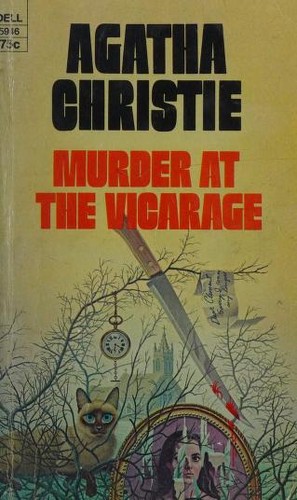
Who really murdered Colonel Protheroe?
Anne Protheroe pulled the trigger, and her lover Lawrence Redding designed every detail. Redding, who would never have run off with a penniless woman, wanted the colonel dead so that Anne would be free and rich, and Anne, wretched in her marriage and wholly under his influence, stood to inherit half the estate. Their guilt is finally proven when Redding, panicked by a planted hint, rushes to Old Hall at night to warn Anne and two police officers overhear the whole conversation.
How was the murder actually carried out?
Redding hid his pistol and a silencer in the potted palm in the vicar's study, lured the vicar away with a fake 5:30 telephone call in an assumed woman's voice, and left a picric acid charge under a stone in the woods on a slow fuse. Anne, conspicuously without a handbag, passed Miss Marple at 6:20, walked to the study window, shot her deaf husband from behind with the silenced pistol, and strolled on to the studio; the woodland explosion at about 6:30 supplied the gunshot everyone heard while both conspirators stood in public view. The muffled real shot was the odd sneeze a neighboring maid reported.
Why did Lawrence and Anne both confess early on?
The confessions were engineered to fail. Redding's story collided with Dr. Haydock's firm medical evidence that Protheroe died by 6:30, and Anne's collapsed on Miss Marple's testimony that she carried nothing that could hide a pistol, so each lover was formally cleared and pitied as nobly shielding the other. Miss Marple admits the trick fooled even her, since she had suspected Redding from the start until his arrest upset her reasoning.
What happened to the curate Hawes?
Hawes had been stealing church funds, the very irregularities Protheroe meant to expose, and the colonel's genuine unfinished letter accused an ordained priest. Redding kept that letter after the murder, later swapped a poisoned cachet into Hawes's headache box, and planted the letter on him so his death would read as a murderer's remorseful suicide. The vicar reaches him in time, Haydock saves his life, and his hysterical telephone confession proves to concern only the embezzlement, stirred up by the vicar's sermon.
Who is Mrs. Lestrange and why did she visit Protheroe?
She is Protheroe's first wife and Lettice's mother, terminally ill and living under an assumed name so she could see her daughter before dying. She confronted the colonel the night before the murder to ask for access to Lettice and was brutally refused; her missing hour on the fatal evening was spent partly with Dr. Haydock, an old love who shields her throughout, and partly meeting Lettice by the footpath. She is innocent, and Lettice leaves to spend her mother's last months abroad with her.
What was the fake Dr. Stone really doing in the village?
The man excavating the barrow was not the real archaeologist but a professional cracksman impersonating him in order to replace Colonel Protheroe's antique silver, the trencher salts and the Charles II tazza, with copies before a scheduled valuation could expose the theft. Gladys Cram hid his suitcase of loot and disguise clothes in the woods, by her account in good faith, and the vicar's discovery of it unmasks the scheme. Stone is cleared of the murder itself, since he was in plain view when the decoy shot went off.
Themes and What the Ending Means
Gossip as intelligence: The village's tireless watchers, dismissed as idle cats, turn out to operate the only surveillance system that actually solves the crime; Miss Marple simply treats tittle-tattle as data and tests it.
The manufactured obvious: Confessions, a clock, a dated note, and even a heard gunshot are all planted evidence; the novel keeps insisting that what everyone knows is precisely what someone arranged for them to know.
Justice versus mercy: Protheroe's pitiless magistracy, the vicar's plea for mercy over strict justice, and Haydock's medical view of crime as disease form a running argument about what punishment is actually for.
Human nature in miniature: Miss Marple's method of matching present crimes to remembered village parallels argues that people fall into a few recurring types, and that a small stagnant pool contains every species of sin.
Marriage, age, and loyalty: From the Clements' teasing happiness across a wide age gap to Anne's wretched union and the ruined first Protheroe marriage, the book measures its couples by honesty rather than propriety.
Performance and disguise: Nearly everyone is acting a part, from a cracksman playing archaeologist and a dying woman under a false name to a vague girl who is really shrewd and a killer whose confession is his best mask.