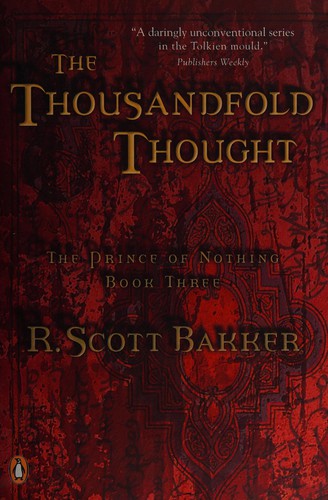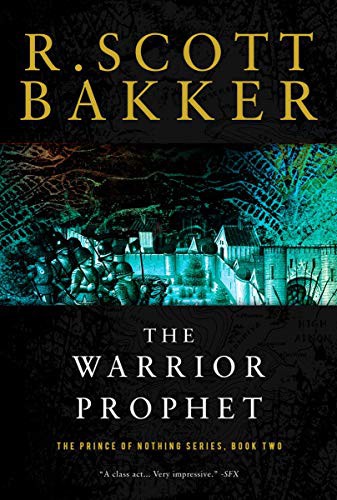
The Warrior-Prophet turns a crusading army into a laboratory for belief: Kellhus gains his following not through prophecy but by reading needs, predicting reactions and converting suffering into proof of his authority. It is the rare epic fantasy where the most dangerous weapon on the field is applied psychology.
The Holy War’s suffering becomes raw material — every famine and defeat converts more believers.
Bakker’s depiction of the march south — hunger, plague, siege, ideological violence — is uncompromising. The Holy War’s suffering becomes raw material: every famine and defeat converts more believers, and Kellhus harvests the despair with Dûnyain precision. Achamian and Esmenet supply the emotional counterweight, because their love is real even as Kellhus learns to use it.
Achamian’s captivity under the Scarlet Spires shows what Mandate sorcery costs and what it can do; his escape is the book’s most terrifying display of power, and Xinemus pays its price in sight and freedom.
Fair warning: the novel is intentionally bleak and often brutal toward women. Readers who accept that severity get an unusually rigorous study of charisma and collective conviction; readers seeking heroic release will find its manipulations exhausting.
The circumfixion at Caraskand is the decisive gamble — Kellhus’s enemies hand his followers the exact image their faith requires, a man fused to the corpse of the woman who believed in him. He comes down from the ring a martyr made flesh, and the Holy War belongs to the Warrior-Prophet.