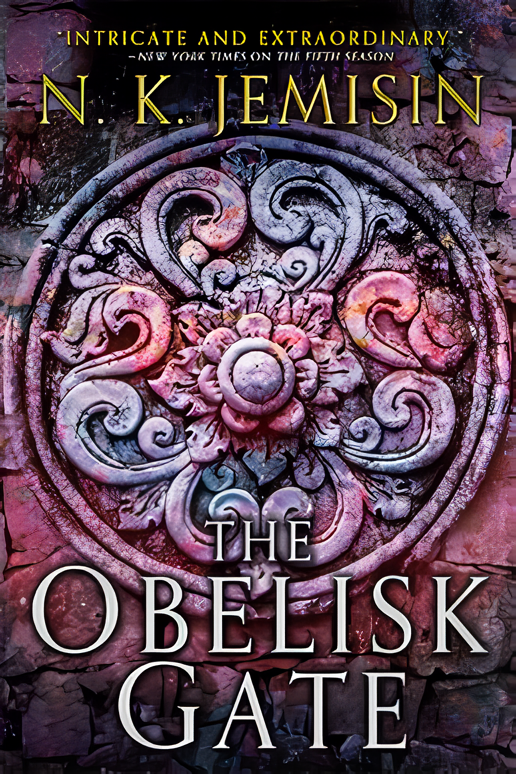
The Obelisk Gate is that rare middle volume that wins its genre's top prize — the second of N.K. Jemisin's three consecutive Best Novel Hugos — and it earns the honor by deepening its trilogy rather than merely sustaining it. It is also, unmistakably, a middle book, and this review has to hold both of those things at once.
The Fifth Season worked a magic trick: three braided timelines revealed, at the last moment, to be one woman's single life. That structural fireworks display is gone here, and it was never going to be repeated — you can only pull that particular rug once. What Jemisin does instead is quieter and, in its way, braver. She splits the novel into two straightforward parallel threads: Essun, stationary now in the geode-comm of Castrima, learning the deeper mechanics of her power from a dying Alabaster; and — finally — her daughter Nassun, traveling south into the orbit of the very Guardian who once broke Essun's own hand. The book trades momentum for depth, and readers expecting the propulsion of book one sometimes feel the drop. That's the fair case for four stars rather than five: the middle section sags, a good deal of the Essun material is teaching and worldbuilding rather than event, and the novel is structurally a bridge, assuming book one and setting up book three rather than standing on its own.
But what the book builds on that bridge is extraordinary. The single best decision Jemisin makes is giving Nassun her own point of view, and letting it play as an indictment of the protagonist we spent an entire novel learning to love. From Nassun's side, Essun — the grieving, heroic mother of book one — is the woman who broke her hand and taught her to fear her own gift. The two threads become a mirror: mother and daughter, both prodigies, both capable of turning armies to stone, both learning the same forbidden power independently, being aimed by the plot straight at each other. It is a quietly devastating structural choice, because it refuses to let the reader keep a simple hero — I haven't stopped thinking about it. A mother's love here is real and it is also a wound, and Jemisin will not resolve that contradiction into comfort.
The Schaffa material is the book's other triumph, and it is morally vertiginous in a way very few writers attempt. Schaffa is a man who has murdered orogene children, who tortured Essun as a girl, whose skull is colonized by a hostile god that keeps ordering him to kill — and who becomes, for Nassun, the first person to love and accept her exactly as she is. Jemisin makes his tenderness genuine without laundering his history, and she makes Nassun's need for him heartbreaking precisely because we can see it was manufactured by her own family's failures. The knot of abuse and love here is one the book steadfastly refuses to cut, and it is the richest character work in the trilogy.
The worldbuilding expands in ways that recontextualize everything. The revelation that orogeny is only the surface of a deeper system — magic, the silver threads of life-energy running through all things and into the obelisks — reframes the mechanics of the entire series, and it's delivered through Alabaster's slow, calcifying death in a way that ties the exposition to genuine grief. Bigger still is the cosmological turn: Father Earth as a literal, conscious, wronged entity, the Seasons as its long revenge for a stolen Moon, and the Obelisk Gate as the machine that might put the Moon back. The book takes what looked like a geological catastrophe and reveals it as a war with a victim on the other side, which sharpens the trilogy's central question — whether a civilization built on this much cruelty deserves to survive at all — into something genuinely unanswerable.
The second-person narration continues, and Hoa steps further out of the shadows as the storyteller behind the "you," which pays off the frame of book one and quietly raises the stakes of book three. Essun's Battle of Castrima climax — opening the Gate, turning an entire city to stone, and paying for it as her arm calcifies — is the kind of set piece that lands harder because we've watched exactly what this power costs.
The reservations are the ones that keep it from five stars. This is the slowest book of the three; the Castrima political material occasionally spins in place; and the novel's pleasures are almost entirely deepening pleasures — theme, character, cosmology — rather than the momentum and revelation that made The Fifth Season impossible to put down. Read as a standalone it would feel truncated at both ends. It is not designed to be read that way, and shouldn't be.
Four stars, then, and the four is meaningful in a library where the trilogy opener earned five. The Obelisk Gate is a superb middle volume — arguably the best-executed "book two" in modern epic fantasy that still reads, unmistakably, like a book two. It sacrifices a little of book one's forward drive and buys, in exchange, the mother-daughter tragedy and the cosmic reframing that make the trilogy's finale land as hard as it does. If you finished The Fifth Season, this is not optional and not a letdown. It's the deepening the whole story needed.