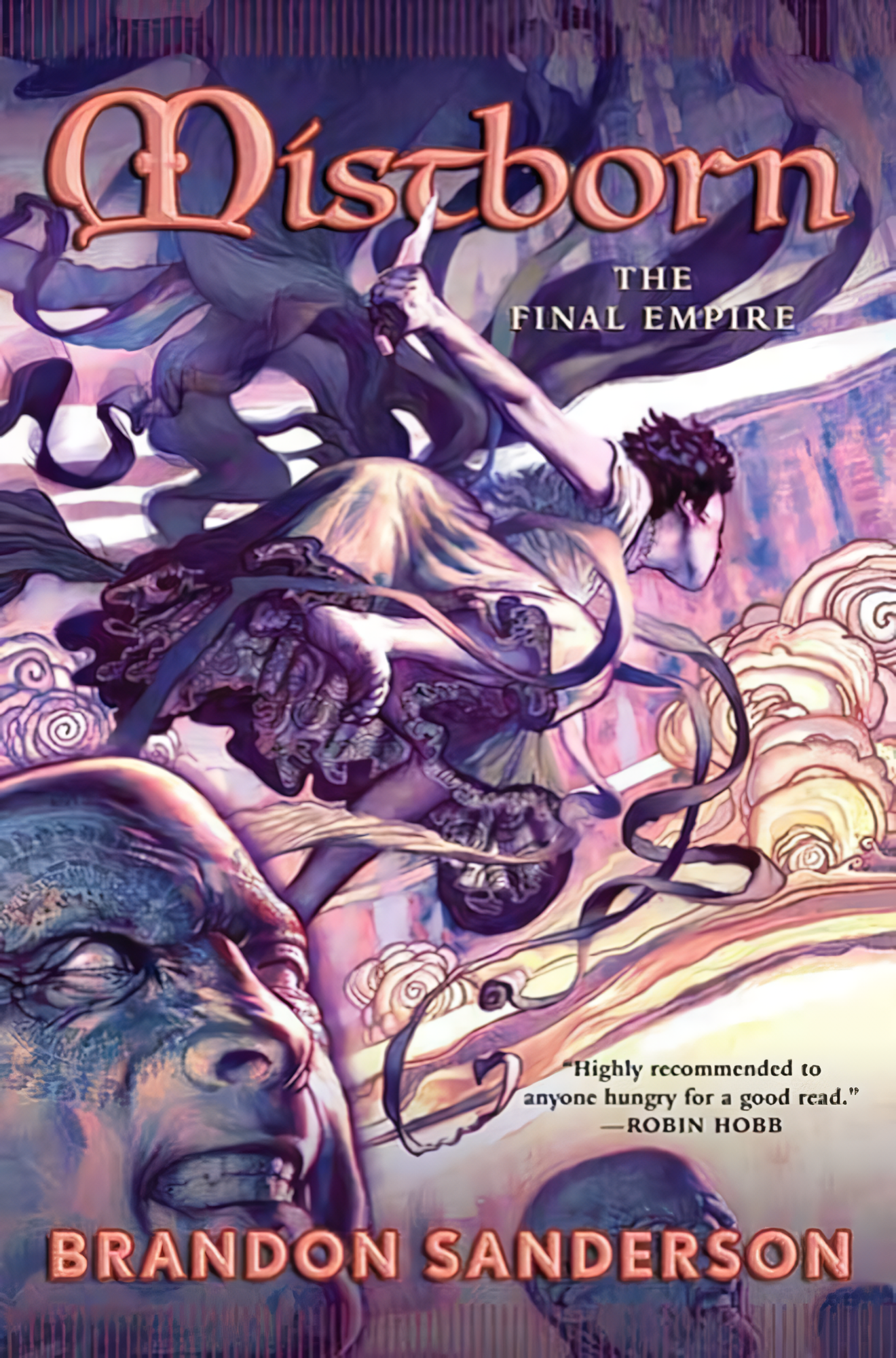
Mistborn: The Final Empire set the template for the modern hard-magic fantasy debut, and it remains the template for how a hard-magic fantasy novel is built.
The premise is a deliberate inversion of every Chosen One novel that came before it. A thousand years ago, the prophesied Hero of Ages confronted a world-ending evil called the Deepness and seemingly won. He then declared himself the immortal Lord Ruler and ground the world under his heel for the next millennium. Ash falls from the sky daily. The sun is red. The peasantry — the skaa — are property. Into that world Sanderson drops a heist crew, a half-skaa street urchin, and the audacious idea of robbing a god. The book that follows is part Ocean's Eleven, part Dickensian street-orphan narrative, part political-philosophy seminar, and part rules-lawyer's love letter to a magic system more rigorously constructed than most modern programming languages.
What Sanderson did with Allomancy was a quiet revolution. By 2006 the genre had been arguing for thirty years about whether "soft" Tolkien-style magic or "hard" rules-based magic produced better fiction. The Final Empire settled the debate by example. Allomancy has sixteen metals, each with a specific paired effect — pull versus push, internal versus external, mental versus physical — and Sanderson refuses to cheat. Every action scene in the book is choreographed against the rules he laid down in chapter four, and the climax of the novel turns on the reader having internalized those rules well enough to feel the shock when Vin breaks them. The result is a magic system that reads like an extended logic puzzle and a series of fights that read like ballet. Twenty years of imitators have not equaled it.
The characters are the second miracle. Kelsier is one of the great charismatic-revolutionary protagonists in modern fantasy — a Robin Hood with a god complex who is, by the book's end, revealed to have planned his own martyrdom all along. Vin is the trilogy's anchor: a half-skaa street thief who has spent her entire life expecting betrayal and who, over the course of the novel, slowly chooses to trust her crew, fall in love with a noble heir, and become the person willing to walk into the throne room of an immortal god-emperor and try to kill him. Her arc from the wary opening chapter to her last line in the epilogue is one of the cleanest character transformations in the genre. Around her, the crew — Breeze the manipulative Soother, Ham the philosophical Thug, Clubs the grumpy Smoker, Sazed the gentle Terrisman steward who carries the religions of a thousand dead peoples in his head, Spook the unintelligible Tineye nephew — read like Sanderson is showing off, but each one earns their pages.
The plotting is where Sanderson's reputation as the most controlled commercial novelist of his generation was made. The Final Empire runs 541 pages and almost none of them are wasted. The first hundred set up the heist; the next two hundred run two operations in parallel — Vin spying on noble balls while the crew raises a secret skaa army — and braid them together; the final hundred are a single sustained climax in which the rebellion ignites, the truth about the Lord Ruler's identity is revealed, Kelsier dies in the public square as planned, Vin pierces an Inquisitor's defenses, the journal epigraphs that have been opening every chapter pay off as a single revelation, and the god-emperor of the world falls to a wooden spear. Sanderson's fans call this kind of compressed escalation the Sanderson Avalanche. The Final Empire is the book that named the move.
The twist about the Lord Ruler is the book's quiet masterpiece, and it is the kind of twist that only works if the writer has been disciplined about every page leading to it. The reader has been reading the journal of a man called Alendi as chapter epigraphs for thirty-eight chapters. The reveal is that Alendi was the actual Hero of Ages, a thousand years ago — and that the Lord Ruler the world has been groaning under for a millennium is Alendi's Terris packman, Rashek, who murdered his master at the Well of Ascension and stole the power. The empire the book has been building toward overthrowing turns out to be founded not on dark prophecy but on a peasant's resentment of a man richer and more famous than himself. The book's politics suddenly snap into focus around that revelation. It is the single best plot beat of Sanderson's career.
The book is not flawless. Sanderson's prose is workmanlike rather than ornate — he writes scene-clear sentences, not lyrical ones, and readers coming from Hobb or Le Guin or Wolfe will notice the difference. Vin's voice in the middle stretch occasionally repeats itself. The Vin/Elend romance is light here and most of its real work happens in The Well of Ascension. Sazed's religious teaching sequences slow Part Three slightly. And the moment in chapter thirty-eight where the mists themselves flow into Vin to fuel her Allomancy is, by Sanderson's own published annotations, a magic-system rule bent for drama — the trilogy spends the next two books explaining it, but it lands in this book as a moment of magic-system whiplash rather than payoff.
None of that meaningfully dents the achievement. The Final Empire is the book that established Brandon Sanderson as the dominant voice in commercial epic fantasy for a generation, the foundational work of the Cosmere universe that has gone on to anchor The Stormlight Archive and a dozen other novels and novellas, and the safest recommendation I know how to give a new fantasy reader to a friend who has never read the genre before. The hard-magic-system school as it now exists was largely built on this book's foundation. The fact that Sanderson stuck the landing twice more — The Well of Ascension and The Hero of Ages are both rare second and third books that match their opener — is what makes Mistborn a touchstone rather than a curiosity.
Twenty years on, the book holds. Five stars, without hesitation.