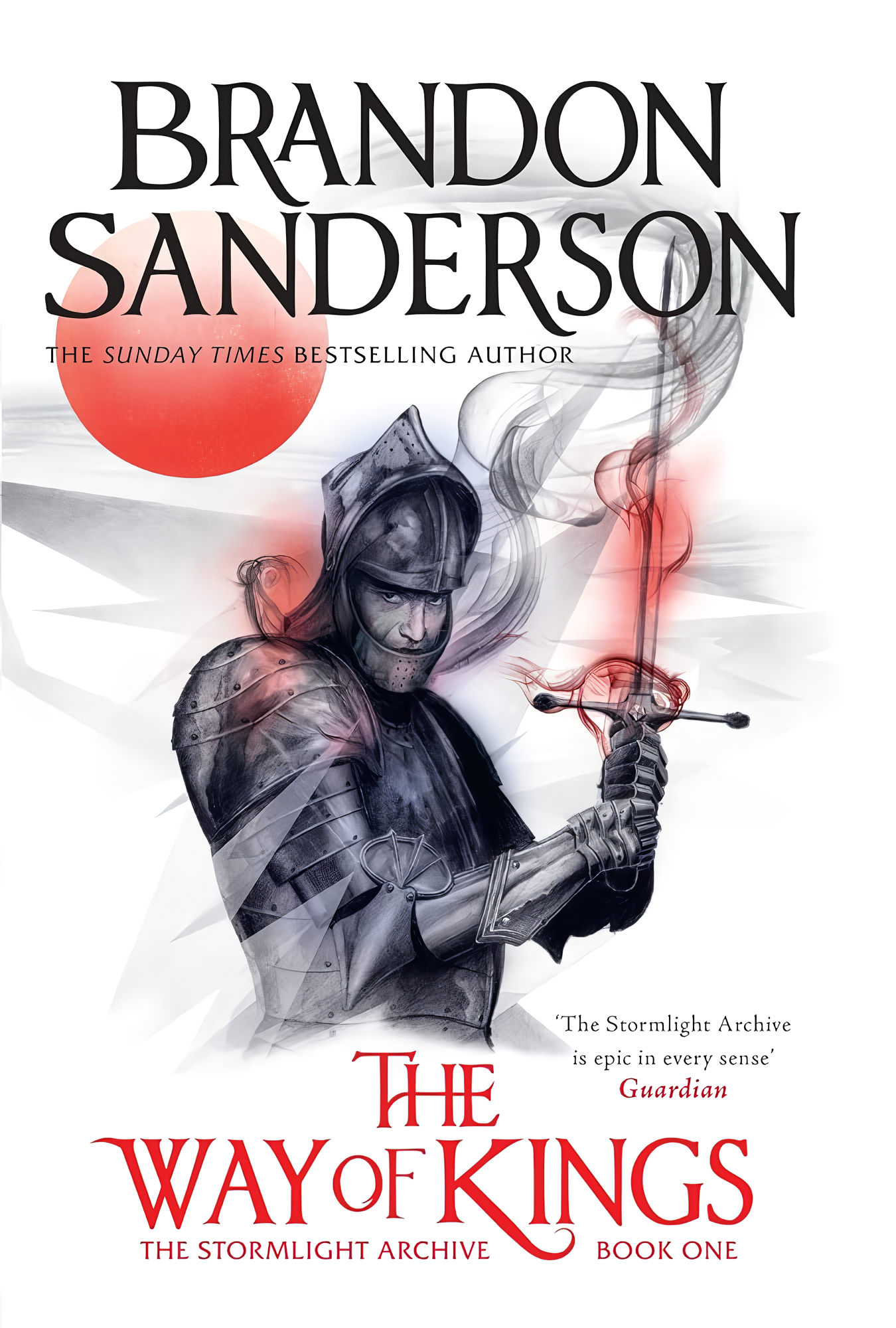
The Way of Kings is the biggest bet of Brandon Sanderson's career, and it pays off so completely that it has come to define what maximalist epic fantasy looks like in the twenty-first century.
The bet is structural. This is a thousand-page novel in which the three lead characters never share a scene until the final act. Its most beloved protagonist spends the entire book as a slave in a labor crew whose job is to run, unarmored, into arrow fire. Its second lead spends most of his page count worrying he is going insane. Its third is a teenage girl trying to steal a magical device from a scholar in a library, and her plot resolves almost entirely through conversations about philosophy and poisoned bread. Between the main sections, Sanderson repeatedly abandons all of them for Interlude chapters about fishermen, merchants, and spren-cataloguing immortals the reader will never see again. On paper, none of this should work at commercial scale. In practice, it produced the most beloved epic fantasy series of its generation.
The reason it works is Kaladin. The Bridge Four arc is one of the great extended sequences in modern fantasy — a depressed, suicidal slave rebuilding thirty broken men into a brotherhood through stew, discipline, and the sheer stubborn refusal to let anyone else die. Sanderson writes Kaladin's depression with unusual precision for the genre: not as a mood to be dispelled by plot, but as a permanent wound that leadership gives him a reason to carry without ever healing. The Honor Chasm scene, where a spren stops a man from suicide with a poisonous leaf and a question, is quietly one of the best-known scenes Sanderson has written, and the arc's climax at the Tower — a bridge crew turning back from freedom to save the army of the man who enslaved them — is the emotional payoff the entire thousand pages exist to fund. When Kaladin speaks the Second Ideal mid-battle, the moment lands with a force very few books at any length achieve.
Dalinar's arc is the book's other pillar, and it is doing subtler work. An aging warlord haunted by highstorm visions, clinging to an ancient book of ethics while an entire aristocracy sneers at him, is Sanderson's meditation on whether honor is a strategy or a luxury — and the book is honest enough to make the honorable path lose, repeatedly, until the final chapters. The Sadeas betrayal at the Tower is signposted for attentive readers and still devastates, because Sanderson spends three hundred pages making the alliance feel like the political healing the kingdom needs. And Dalinar's response — trading a Shardblade worth a kingdom for twenty-six hundred slaves — is the single best character beat in the novel, a decision that reframes everything the book has said about worth, power, and what the old Codes were actually for.
Shallan's thread is the one readers most often rank third, and it is fair to say it moves the slowest — a wardship, a theft, and a lot of scholarship in a distant city while armies clash on the Plains. But it is quietly carrying the series' biggest revelations: Jasnah's fabrial-free Soulcasting, Shadesmar, the Cryptics, and the closing bombshell that the docile parshmen serving in every household on Roshar are a dormant invasion. On reread, the Shallan chapters are where the series' deepest machinery is being assembled. Her final confession — four words that recontextualize her entire narration — is, I think, the most efficient character twist Sanderson has ever pulled off.
The worldbuilding deserves its reputation. Roshar is not a repainted medieval Europe; it is an alien ecology built from first principles around the highstorms — crustacean megafauna, retracting grass, stormward architecture, an economy running on charged gemstones — rendered with in-world illustrations that make the hardcover feel like an artifact. The spren, the safehand, the ardentia, the lighteyes hierarchy: it is the densest, most fully imagined setting Sanderson has built, and the book trusts the reader to assemble it from immersion rather than exposition.
Now, the reservations. This is a slow book, and it does not pretend otherwise — readers who need the plot moving by page 200 will struggle, because Sanderson is spending that capital on the Tower and the final two hundred pages. The Interludes, essential to the series' architecture, read as speed bumps on a first pass. Sanderson's prose remains functional rather than beautiful, and at this length the functional sentences accumulate. And the book is unapologetically an opening volume: it answers almost none of the questions it raises, and its full weight only lands across the sequels. Words of Radiance, the second volume, is widely and correctly regarded as even better.
None of that moves the rating. As a single volume, The Way of Kings contains the best extended character arc Sanderson has written, one of the genre's great betrayals, one of its great climaxes, and the most original secondary world of its decade. As a foundation, it launched the series that now anchors modern epic fantasy the way The Wheel of Time anchored the nineties. Five stars — and the strongest possible recommendation to keep going, because the series only climbs from here.