The Book in Brief
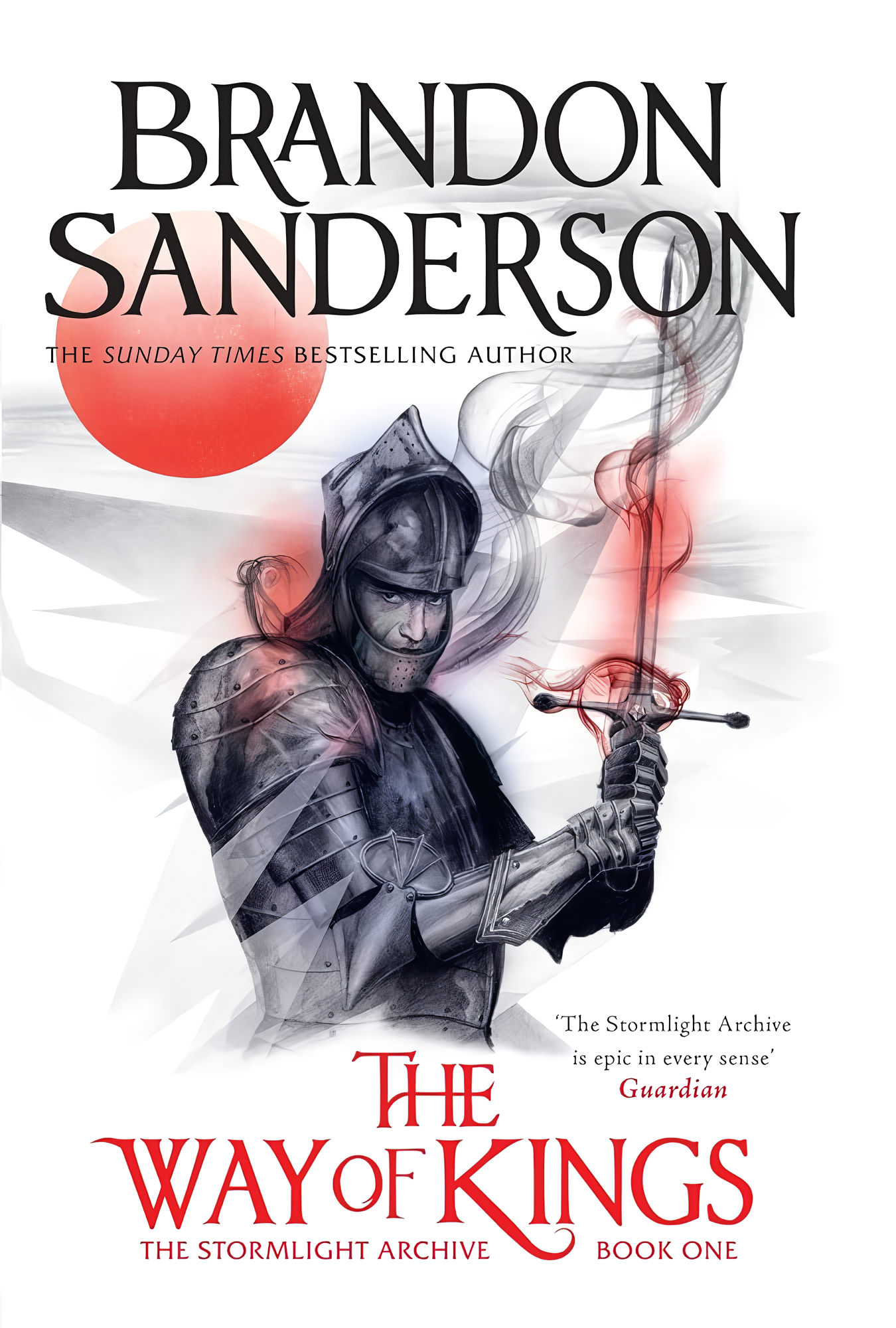
The Way of Kings is the first volume of The Stormlight Archive, Brandon Sanderson's planned ten-book epic and the flagship series of his interconnected Cosmere universe. At just over a thousand pages in hardcover and roughly 384,000 words, it is one of the longest and most intricately built modern fantasy novels — and, for many readers, the true entry point to Sanderson at full scale. It won the David Gemmell Legend Award in 2011 and debuted in the top ten of the New York Times hardcover fiction list.
The book is structured unlike almost anything else in commercial fantasy: a Prelude set thousands of years in the past, a Prologue set six years before the main story, five titled Parts whose names form a ketek (a palindromic Rosharan poem), sets of Interlude chapters between the Parts that leave the main cast entirely to widen the world, an Epilogue, and epigraphs opening most chapters — many of them the enigmatic "death rattles" collected from the dying.
The World: Roshar
Roshar is a world of stone and storm. Continent-spanning tempests called highstorms sweep from east to west on a rolling schedule, battering everything in their path. Life has adapted: plants retract into the ground or withdraw behind shells when touched, grass pulls into the soil, and the dominant animals are crustacean-like. Cities present reinforced walls to the stormward side. The storms are not merely destructive — they charge gemstones with Stormlight, the energy that powers the world's magic and its economy.
The primary setting is the kingdom of Alethkar and the Shattered Plains — a vast plateau system carved into a maze of chasms, where the Alethi have waged the six-year War of Reckoning against the Parshendi, a proud people with marbled red-and-black skin, in vengeance for the Parshendi assassination of the Alethi king Gavilar. The war has degenerated into a competitive gemheart-hunting campaign among ten rival highprinces.
Roshar is also full of spren — spirits drawn to emotions, forces, and phenomena. Fearspren, flamespren, gloryspren, painspren, windspren, and rarer, more intelligent varieties whose true nature is central to everything.
The Magic Systems
Stormlight is light captured in gemstones during highstorms. Certain rare people can draw it into their bodies, gaining enhanced healing, strength, and speed while it burns away as glowing luminescence.
Surgebinding is the ancient power of the ten orders of Knights Radiant, each order channeling two fundamental forces called Surges. Radiants gain their power through a bond with a spren, deepened by speaking oaths. Kaladin is manifesting as a Windrunner; Shallan, though she doesn't know it yet, is a Lightweaver.
Shardblades and Shardplate are relics of the lost Radiants. A Shardblade can slice through anything and kills by severing the soul — cut through a limb and it dies; cut through the spine and the victim's eyes burn out. Shardplate makes its wearer superhumanly strong. Men trade kingdoms for Shards.
Soulcasting transmutes one form of matter into another — stone to smoke, air to grain — usually via a fabrial, a device powered by a trapped spren.
The Voidbringers are the legendary ancient enemies of humanity, whose cyclical returns — the Desolations — the Knights Radiant once fought. They have long been dismissed as myth.
The Point-of-View Characters
Kaladin is a gifted former soldier and surgeon's son, now a branded slave sold into a bridge crew on the Shattered Plains. His flashbacks form the emotional spine of the book. He is haunted by everyone he has failed to save, including his younger brother Tien.
Dalinar Kholin, called the Blackthorn, is a Highprince, brother of the murdered King Gavilar, and uncle to the young king Elhokar. He experiences visions during highstorms and follows the teachings of an ancient book, The Way of Kings — and half the warcamps think he is going mad.
Shallan Davar is a young noblewoman from a ruined house who becomes the ward of the brilliant, heretical scholar Jasnah Kholin, secretly intending to steal Jasnah's Soulcaster to save her family.
Szeth-son-son-Vallano, the Assassin in White, is a Shin "Truthless" bound to obey whoever holds his Oathstone. He killed Gavilar, and he possesses Surgebinding powers the world believes extinct.
Adolin Kholin is Dalinar's older son and an honorable duelist, one of the book's supporting viewpoints.
Renarin Kholin is Dalinar's younger son, sickly and barred from battle.
Navani Kholin is Gavilar's widow, whom Dalinar has loved for decades; she transcribes his visions and begins a quiet, scandalous courtship with him.
Wit is the king's insult-artist, and much more than he appears.
Eshonai is the Parshendi Shardbearer who carries chapter 68; the book's nine Interludes add other one-off viewpoints around her.
Prelude to the Stormlight Archive
Thousands of years before the main story, the Herald Kalak crosses a battlefield strewn with the dead after a Desolation and finds only Jezrien, leader of the ten Heralds, at the meeting place. The others have already abandoned the Oathpact — the ancient pact that binds the Heralds to endure torture between Desolations to hold back the enemy. Broken by the endless cycle, the surviving Heralds decide to walk away and let humanity believe the war is finally won. They drive their Honorblades into the stone and depart, leaving only Talenel, who died in the battle, still bound to the Oathpact — left to suffer alone. Kalak looks back at the tenth spot and begs forgiveness.
Prologue — To Kill
Roughly 4,500 years later, at a feast celebrating a new peace treaty between the Alethi and the Parshendi, the assassin Szeth kills King Gavilar Kholin. Ordered by his Parshendi masters to wear white so the king can see him coming, Szeth uses Surgebinding — manipulating gravity — to cut through guards and a full Shardbearer. Mortally wounded, Gavilar is confused that the Parshendi sent the assassin. He presses a mysterious black sphere into Szeth's hands, telling him they must not get it, and asks him to tell his brother Dalinar to find the most important words a man can say. Szeth writes the message in Gavilar's blood and flees. Gavilar's son Elhokar declares war on the Parshendi.
Part One — Above Silence
Overview
The opening act establishes the book's two dominant present-day threads — Kaladin's descent into slavery and Shallan's arrival in Kharbranth — while beginning Kaladin's childhood flashbacks.
Kaladin's thread. Chapter 1 opens through the eyes of a terrified young recruit named Cenn, whom Kaladin — then a respected squad leader in Brightlord Amaram's army — fights to protect during a battle. In the present, eight months later, Kaladin is a slave in a caravan, hollowed out and suicidal. A windspren in the shape of a young woman begins speaking to him — far too intelligent for an ordinary spren. She gives her name: Sylphrena. Syl. Kaladin arrives at the Shattered Plains and is condemned to Bridge Four, the most expendable of the bridge crews under Highprince Sadeas. Bridgemen carry massive wooden bridges at a run into Parshendi arrow fire so soldiers can cross the chasms; they are deliberately unarmored bait, and the average bridgeman survives a handful of runs. Kaladin survives his first catastrophic run as the only man left standing in the front row. Weeks of grinding death follow. Kaladin walks to the Honor Chasm — where bridgemen go to end their lives — and Syl stops him with a leaf of blackbane and a question. He chooses instead to save Bridge Four, and blackmails the bridge sergeant Gaz into making him bridgeleader.
Kaladin's flashbacks. Young "Kal" apprentices as a surgeon under his father Lirin, torn between healing and soldiering — the tension that will define his whole life.
Shallan's thread. Shallan Davar reaches Kharbranth, the City of Bells, chasing the scholar Jasnah Kholin to petition for a wardship. Jasnah — a famous atheist and one of the only Soulcasters outside the ardentia — initially rejects her, then relents after witnessing Shallan's self-taught brilliance and persistence. Shallan meets the young ardent Kabsal, who visits often, ostensibly hoping to convert Jasnah to Vorinism. Shallan's true purpose is revealed to the reader: swap Jasnah's Soulcaster for her family's broken one. Her father is dead, her house is ruined, and the theft is the only thing that can save her brothers.
Interludes. A Purelake fisherman is quizzed by three foreign "worldhoppers" hunting a man named Hoid — the first open Cosmere signal in the book. One of Shallan's brothers reveals the depth of the Davar family crisis. And Szeth, now owned by a petty entertainer, passes from master to master until someone begins to grasp exactly what he has acquired.
Part Two — The Illuminating Storms
Overview
The Kholin family enters the story, Dalinar's crisis of faith and sanity takes center stage, Kaladin rebuilds Bridge Four, and Shallan's mission gets complicated.
Dalinar and Adolin. On a chasmfiend hunt with King Elhokar and Highprince Sadeas, Dalinar's growing detachment from the war worries his son Adolin. Dalinar has been having visions during every highstorm — living through scenes of the ancient past, watching the Knights Radiant in action, hearing a voice command him to unite them. He fears he is going mad and considers abdicating. He is guided by the ancient book The Way of Kings, written by the legendary king Nohadon — the book his brother Gavilar was obsessed with before his death — and he insists his warcamp follow the old Alethi Codes of War, costing him respect among highprinces who think him weak or broken. The court's Wit needles the lighteyes and quietly reassures Dalinar.
Kaladin. Kaladin drills Bridge Four in secret, using his surgeon's skills and scavenged knobweed sap to treat the wounded, defying orders to let injured men die. He builds a brotherhood around shared stew, discipline, and rediscovered names — Rock, Teft, Moash, Skar, Lopen. He sends men into the chasms on salvage duty and begins quietly planning for something more than survival.
Shallan. Shallan settles into her wardship, genuinely falling in love with the scholarship even as she plans the theft. Jasnah has her copy an image from an old text describing a "Voidbringer" — and Dalinar and Adolin, consulted by spanreed, identify the creature as a chasmfiend. Shallan begins to see disturbing symbol-headed figures in her sketches — figures she did not draw.
Interludes. A Thaylen merchant apprentice visits Shinovar, where warriors are the lowest caste, and her master asks the Shin for another servant like the one given seven years earlier — a reference to Szeth. An immortal Aimian catalogues spren. And Szeth is handed to a new master with a list of powerful men to kill.
Part Three — Dying
Overview
The turning point. Kaladin discovers what he is, and Shallan's plot detonates.
Kaladin. Kaladin teaches Bridge Four a side-carry maneuver — turning the bridge sideways as a shield against arrows. It works, but when other crews imitate it without training, the assault collapses and Sadeas loses the plateau. As punishment, Kaladin is strung up to face a highstorm's full fury — a death sentence. He survives. During the storm he glimpses the vast face of the Stormfather, and afterward the sphere clutched in his hand is inexplicably drained of Stormlight. The bridgeman Teft — who knows more about the old stories than he admits — realizes Kaladin has been unconsciously drawing in Stormlight, and quietly concludes he may be watching a Knight Radiant being reborn. Kaladin's flashbacks reveal the wound underneath everything: his younger brother Tien was conscripted out of spite by the citylord Roshone, Kaladin enlisted to protect him, and Tien died anyway — the failure that drives every man Kaladin has tried to save since.
Shallan. Jasnah delivers a brutal philosophy lesson: she deliberately walks a dangerous alley at night, lures four footpads into attacking, and Soulcasts them to death — then demands Shallan debate the morality of it. Pressured by her brothers' increasingly desperate messages, Shallan finally swaps the Soulcasters. The theft immediately unravels. Haunted by the symbol-headed figures, Shallan accidentally slips into Shadesmar — the Cognitive Realm, an ocean of dark glass beads — and Soulcasts a goblet into blood without wearing any fabrial at all. She cuts herself to disguise the evidence and lands in a hospital. Then Kabsal is revealed as an assassin: he has been slowly poisoning Jasnah with backbreaker powder baked into bread, carrying the antidote in a jar of jam. The plan inverts fatally — Jasnah has been Soulcasting her food as she eats, and the antidote in the jam had been neutralized — so Kabsal and Shallan take the poison instead. Kabsal dies. Jasnah Soulcasts Shallan's blood clean to save her. And when Jasnah discovers the Soulcaster swap, she sends Shallan away in disgrace.
Interludes. A servant helps a mysterious woman deface sacred art across a foreign city. An ardent on a remote island discovers that measuring a flamespren freezes its properties in place — observation shaping reality, one of the series' quiet load-bearing ideas. And Szeth, killing his way down his master's list, becomes a legend of terror the world calls the Assassin in White.
Part Four — Storm's Illumination
Overview
The longest movement builds to the Battle of the Tower and the betrayal that reshapes the series.
Dalinar. With Navani — Gavilar's widow, whom Dalinar has loved for decades — he tests the visions scientifically: Navani transcribes the gibberish he speaks while inside them, and identifies it as the Dawnchant, an ancient language no living scholar can speak, proving the visions cannot be products of his own mind. Dalinar and Navani begin a quiet, scandalous courtship. Dalinar forges a working alliance with Sadeas: Sadeas's fast bridge crews will seize plateaus and Dalinar's heavy troops will crush the Parshendi. The alliance appears to heal the rift in the kingdom. It is bait.
Kaladin. Kaladin comes to terms with his powers, experimenting with Stormlight — drawing arrows toward his shield, sticking stone to stone. Wit tells him the parable of Derethil and the Wandersail: a king who sailed beyond the edge of the map to find the Voidbringers' homeland, and found instead a people committing atrocities in the name of a long-dead emperor — a story about the moment a person stops being able to blame someone else for what they do. Teft confirms what Kaladin is. Bridge Four scavenges Parshendi carapace to build armor and shields, preparing for a run no one has ever survived: escape.
The Battle of the Tower. Dalinar and Sadeas jointly assault the Tower, the largest plateau on the Plains. Mid-battle, a second Parshendi army appears — and Sadeas withdraws every bridge and retreats, abandoning Dalinar's entire army to be annihilated. The betrayal was the point of the alliance all along. Dalinar and Adolin resolve to die fighting. Kaladin and Bridge Four, positioned to slip away in the chaos toward the freedom he has been planning all book, instead turn back — because Syl, who now remembers what she is (an honorspren), cannot bear it, and because neither can he. Recrossing the chasm under a killing volley, drawing the arrows into his shield with Stormlight, Kaladin speaks the Second Ideal of the Windrunners — I will protect those who cannot protect themselves — and detonates with power. Bridge Four plants a lone bridge and holds it against wave after wave. Kaladin disables the Parshendi Shardbearer to clear the escape route, and Dalinar's army crosses to safety. As the Alethi retreat, the Parshendi do something inexplicable: they salute.
Justice. Back in the warcamps, Dalinar confronts Sadeas, who freely admits the betrayal was policy, not passion. Rather than ignite a civil war the kingdom cannot survive, Dalinar makes a different trade: he offers to buy Bridge Four. When Sadeas sneers, Dalinar hands over his priceless Shardblade — Oathbringer — for every bridgeman in Sadeas's camp. Twenty-six hundred slaves for the most valuable object in Alethkar. Then he walks into the palace, physically overpowers King Elhokar inside his own Shardplate, and forces out the truth: Elhokar faked the cut saddle girth from the earlier "assassination attempt" because no one believed anyone was trying to kill him. Dalinar chooses to keep protecting him anyway.
Part Five — The Silence Above (Chapters 70–75) and Epilogue
Overview
The revelations land in rapid succession, and every storyline turns toward the larger war.
Shallan. Recovering in Kharbranth, Shallan works out what the poisoned bread means: Jasnah should be dead — unless Jasnah, like Shallan, can Soulcast without any fabrial at all. The famous Soulcaster is a decoy. Jasnah's power comes from a spren bond — the same kind of bond Shallan is forming. To prove she understands, Shallan answers one of the symbol-headed creatures (a Cryptic) with a truth: "I killed my father." She falls into Shadesmar, and Jasnah pulls her out. Jasnah takes her back as ward — under strict honesty — and shares the research that has consumed her: the Voidbringers of legend are the Parshendi. And by extension the docile parshmen who serve as slave labor in every kitchen and field on Roshar — a dormant invasion, distributed into every household in the world, waiting for a trigger. Kabsal's tattoo ties him to a secret society called the Ghostbloods, the same symbol connected to Shallan's dead father. Jasnah and Shallan set sail for the Shattered Plains.
Szeth. Szeth reaches Kharbranth to kill the final name on his list: the beloved, seemingly simple King Taravangian. But Taravangian reveals himself as Szeth's hidden master — he placed his own name on the list to deflect suspicion. He shows Szeth his secret hospital, where the dying are bled to harvest their prophetic death rattles — the epigraphs the reader has been seeing all book. Calling himself the monster who will save the world, Taravangian gives Szeth a new target, to be killed openly and brutally: Dalinar Kholin.
Dalinar. A final highstorm vision changes everything. Dalinar realizes the visions were never a conversation — they are a recording, left for whoever might someday receive them. The voice identifies itself: it is the Almighty — the god called Honor — and he is dead. Odium killed him. The old victories were lies. The Everstorm and a True Desolation are coming. The Knights Radiant must stand again. Dalinar resolves to unite Alethkar as Highprince of War and refound the Radiants. He gives his Shardplate to Renarin and makes Kaladin — a darkeyed slave two days earlier — captain of his personal guard, in command of a thousand freed bridgemen.
Epilogue
Wit waits at the gates of Kholinar. A ragged, half-mad man staggers up to the city carrying a Shardblade and names himself Talenel'Elin, Herald of the Almighty — the tenth Herald, the one left behind to bear the Oathpact alone for four and a half thousand years. He announces that the Desolation has come, and collapses. Wit observes, dryly, that the warning has arrived too late.
What the Book Is About
The Way of Kings is a meditation on honor versus expedience in a world that rewards cruelty.
Dalinar's insistence on the Codes, and his trade of a priceless Shardblade for twenty-six hundred slaves, stand against Sadeas's efficient ruthlessness — and the book refuses to pretend the honorable path is the winning one. Dalinar loses standing, loses his Blade, and nearly loses his army for following the old ways. What he gains is harder to see and takes the whole series to pay off.
The book is also about oaths — the idea that words, spoken and meant, change what a person is. Surgebinders literally grow in power by speaking Ideals they mean. The Prelude's broken Oathpact and Szeth's perverse bondage to his Oathstone are dark mirrors of the same mechanism: words with, and without, genuine choice behind them. The most important words a man can say — Gavilar's dying message — is a question the entire ten-book series exists to answer.
It is, unusually for epic fantasy at this scale, a serious study of depression. Kaladin's suicidal despair, his survivor's guilt, the way leadership becomes his reason to stay alive without ever curing the wound underneath — Sanderson writes it with a specificity that has made Kaladin a touchstone character for many readers. Shallan's dissociation from her father's death and Dalinar's terror of his own mind belong to the same project.
And it is a story about unity against a returning darkness. The Shattered Plains literalize a fractured people. The single bridge crew that runs back embodies the book's whole thesis: strength is built by choosing to carry one another's weight. Life before death. Strength before weakness. Journey before destination.
Ending Explained
How does The Way of Kings end?: The climax comes at the Battle of the Tower, where Sadeas pulls his bridges out mid-battle and abandons Dalinar's army to the Parshendi, and Kaladin and Bridge Four turn back from their planned escape to save it. Afterward Dalinar trades his Shardblade Oathbringer to Sadeas to free every bridgeman in his camp, then learns from a final vision that the Almighty is dead and a True Desolation is coming. He resolves to refound the Knights Radiant and makes Kaladin captain of his guard. In the Epilogue, the long-lost Herald Talenel staggers into Kholinar announcing that the Desolation has arrived.
Why does Sadeas betray Dalinar in The Way of Kings?: Sadeas built his alliance with Dalinar as bait from the start. At the Tower, when a second Parshendi army appears, he withdraws his bridge crews and retreats, leaving Dalinar's forces to be wiped out; confronted later, he calmly admits the betrayal was policy rather than passion. Dalinar refuses to ignite a civil war and instead answers by handing over his priceless Shardblade, Oathbringer, to buy the freedom of twenty-six hundred bridgemen.
Does Kaladin become a Knight Radiant in The Way of Kings?: Kaladin spends the book unconsciously drawing in Stormlight, even surviving the highstorm he is strung up to face as punishment. At the Battle of the Tower he speaks the Second Ideal of the Windrunners, a vow to protect those who cannot protect themselves, and erupts with power as his bond with Syl, now revealed to be an honorspren, deepens. Teft, who knows the old stories, concludes he is watching a Knight Radiant being reborn. Kaladin, a slave two days earlier, ends the book as captain of Dalinar's personal guard, commanding a thousand freed bridgemen.
What does Dalinar's final vision reveal in The Way of Kings?: In his last highstorm vision, Dalinar understands that the visions were never a dialogue at all but a recording left behind for whoever might one day receive it. The voice identifies itself as the Almighty, the god called Honor, and reveals that he was killed by Odium, and that the celebrated victories of the past were false, and the Everstorm and a True Desolation are on their way. The Knights Radiant must stand again, so Dalinar claims the role of Highprince of War, determined to unify Alethkar and restore the Radiants.
Who is Szeth's true master in The Way of Kings?: Szeth travels to Kharbranth to murder the last name on his list, the beloved King Taravangian — who reveals that he himself is Szeth's hidden master and put his own name there to deflect suspicion. Taravangian shows off a secret hospital where the dying are bled for their prophetic death rattles and calls himself a monster who will save the world. He then gives Szeth a new mission with orders to carry it out openly and brutally — the assassination of Dalinar Kholin.
What does Shallan discover about Jasnah at the end of The Way of Kings?: Recovering in Kharbranth, Shallan works out that Jasnah survived Kabsal's poisoned bread because she can Soulcast with no fabrial at all — the famous Soulcaster is just a decoy, and Jasnah's ability comes from a spren bond like the one Shallan is forming. Shallan proves her own bond by speaking a truth to a Cryptic, admitting she killed her father, and Jasnah restores her wardship under strict honesty. Jasnah also shares her great discovery, that the Parshendi are the Voidbringers of legend and the docile parshmen a dormant invasion, and the two set out for the Shattered Plains.
About the Book
The Way of Kings was published on August 31, 2010 by Tor Books. The first US hardcover runs 1,007 pages — roughly 384,000 words — with interior illustrations by Isaac Stewart and Ben McSweeney presented as in-world documents: Shallan's sketchbook pages, Navani's notebooks, maps of Roshar. Michael Kramer and Kate Reading narrate the audiobook. The novel won the 2011 David Gemmell Legend Award and debuted at number seven on the New York Times hardcover fiction list.
It is Book One of The Stormlight Archive, planned as ten volumes in two five-book arcs separated by an in-world time gap. The series continues with Words of Radiance (2014), Oathbringer (2017), Rhythm of War (2020), and Wind and Truth (2024), which concludes the first arc. The novellas Edgedancer and Dawnshard slot between the later volumes. Five more books are planned.
The Stormlight Archive is the flagship of Sanderson's Cosmere — the shared universe that also contains Mistborn, Elantris, and Warbreaker, linked by the recurring worldhopper Hoid, who appears throughout this book as the King's Wit. In January 2026, Apple TV+ acquired rights to the entire Cosmere, with The Stormlight Archive in development as a streaming series.
Go in knowing this is a slow-burn thousand-page opener with a deliberately fragmented structure — the Interludes leave the main cast entirely, the three leads never share a scene until late in the book, and the payoff is structured across a series, not a volume. The final two hundred pages are widely considered among the best sustained climaxes in modern epic fantasy.