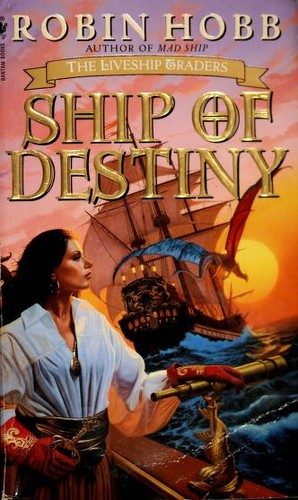
Ship of Destiny brings Robin Hobb’s sprawling maritime trilogy to a conclusion without pretending that convergence is the same thing as simplicity. Bingtown’s civil conflict, Kennit’s pirate kingdom, the Vestrit family’s divided liveships, Malta and Reyn’s search for one another, and the serpents’ desperate migration finally occupy the same political and mythic map. The result is an ambitious finale—sometimes untidy, often painful, and extraordinarily satisfying in the way it reveals that nearly every private wound has public consequences.
Bingtown has inherited wealth, contracts and prejudices it no longer knows how to defend.
The novel’s central concern is inheritance. Bingtown has inherited wealth, contracts and prejudices it no longer knows how to defend. Vivacia and Paragon inherit generations of human memory alongside the remains of dragons whose transformations were interrupted. Malta and Wintrow inherit a family name while rejecting the roles that name assigned them. Kennit inherits the damage inflicted by Igrot and turns it into a political legend in which he can be savior rather than victim. Hobb’s characters do not get to choose whether the past enters them. They choose, with mixed success, what to do after it arrives.
Paragon is the book’s finest expression of that idea. His apparent madness has always been a battle among memory, shame and identities forced into one body. When Kennit finally returns to the figurehead he mutilated, the meeting is not a neat reconciliation. Paragon receives the memories Kennit amputated from himself, including the truth of Igrot’s abuse. The ship becomes more whole, but wholeness means carrying pain rather than erasing it. It also means that Kennit’s public myth can no longer completely bury the frightened child beneath it.
That revelation explains Kennit; it does not excuse him. This distinction matters because Ship of Destiny contains his worst act. After isolating and deceiving Althea, Kennit rapes her. He then manipulates the people and liveship around her into doubting what happened. Hobb understands how charisma creates accomplices: Wintrow, Etta and Vivacia have genuine reasons to love the man who freed slaves, gave them purpose and seemed to recognize their worth. Their dependence makes it easier for him to convert Althea’s truth into an inconvenience.
The treatment is emotionally perceptive but not beyond criticism. Althea’s terror, dissociation and fury are convincing, as is the secondary violation of not being believed. The later recognition she receives from Paragon is meaningful because the ship carries Kennit’s memories and can confirm her reality. Yet that device can also feel too convenient. The final movement gives more narrative space to Kennit’s death, legacy and hidden suffering than to Althea’s long recovery, and the suggestion that a magical sharing of pain helps restore her risks compressing trauma that the novel otherwise depicts with unusual seriousness.
Malta’s transformation remains one of the trilogy’s great achievements. She began as a vain child who mistook desirability for power. Here she is scarred, exhausted and still capable of using courtly performance—but now she understands its price. She keeps the Satrap alive, negotiates with Kennit, reads political danger and speaks to a dragon without surrendering either courage or tact. Hobb does not replace the old Malta with a more virtuous person. She turns the same intelligence and theatrical instinct outward, from self-display toward survival and diplomacy.
Wintrow’s growth is quieter and more morally complicated. His priestly ideals have survived slavery, mutilation and piracy, but purity has not. He loves Vivacia and is indebted to Kennit even while recognizing the pirate’s evasions. When command finally comes to him, it is not a reward for remaining innocent. It is the consequence of learning to act amid compromised loyalties. His future beside Etta similarly resists a conventional romantic resolution; their bond is political, familial and intimate without simply replacing Kennit’s role.
Tintaglia supplies grandeur and comic arrogance in equal measure. She is not a benevolent guardian awakened to save humanity. She protects Bingtown because she needs human labor to preserve her species, and she regards most people as clever animals. Her bargain with the Traders forces both sides into interdependence. Humans must acknowledge the lives they destroyed to create wizardwood, while the dragon must accept that power alone cannot guide starving serpents through a changed river.
The political resolution is correspondingly practical. Old Traders, New Traders, former slaves, Rain Wilders and pirates do not discover that they share the same values. They discover that none can survive the Jamaillian and Chalcedean threat alone. Treaties, hostages and recognition create a workable future before affection does. Serilla’s role is especially sharp: Ronica and Keffria have to build a freer Bingtown around her, because her own priority remains her hold on power. Survival gave her control; the city’s recovery takes it away again. Survival gave her control; recovery requires living without controlling everyone around her.
Hobb’s enormous cast remains both strength and liability. The rapid switches among Bingtown politics, the Pirate Isles, dragon flights, serpent migration and two liveship crews can reduce climactic events to a few pages. Some reconciliations arrive faster than the injuries preceding them. Readers hoping for a clean reckoning in which every villain is exposed and every victim publicly vindicated may find the ending morally frustrating.
That frustration is partly the point. Kennit dies a hero to people who never knew the whole man. Etta builds a nation from the legend while Paragon carries the truth. Althea regains a life, not universal belief. Bingtown wins independence without becoming innocent. The novel asks whether a useful future can be built from contaminated stories and refuses the comfort of saying that justice and historical memory always coincide.
As a trilogy finale, Ship of Destiny rewards the patience required by the first two books. Its battles matter because ships are people; its treaties matter because households have been broken by the same systems; its dragons matter because wonder is inseparable from exploitation. The conclusion is not flawless, particularly in how it allocates attention after Althea’s assault, but it is thematically exact. Destiny in this book is neither prophecy nor inevitability. It is what characters make from the lives, bodies and memories handed to them.