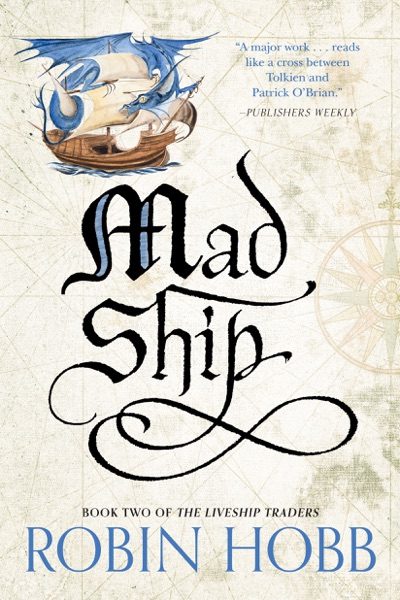
The Mad Ship takes every conflict established in Ship of Magic and removes the boundaries that kept it manageable. A family debt becomes a rescue expedition. A pirate raid becomes a campaign for kingship. A trade dispute becomes civil war. A girl’s courtship becomes a journey into a buried city, and the strange sea-serpent interludes become the key to understanding every liveship in Bingtown. Robin Hobb’s second volume is expansive, patient and frequently devastating.
The book’s most impressive achievement is its treatment of identity. Vivacia has awakened from Vestrit memory, yet she is fascinated by Kennit and willing to reinvent herself as a pirate ship. Paragon has been treated as insane because he carries memories nobody wants to hear. The serpents are losing their names. Malta performs the version of womanhood she thinks will give her power, while Althea disguises herself to gain the freedom denied to women. Hobb does not treat identity as a secret inner truth waiting to be revealed. It is memory, body, social expectation and chosen loyalty in constant conflict.
Kennit remains the trilogy’s most disturbing character. He frees slaves, brings order to the Pirate Isles and treats Vivacia with a consideration Kyle never offered. Those acts are materially good. They are also inseparable from vanity, manipulation and a childhood trauma he refuses to face. Hobb lets readers see why Wintrow, Etta and Vivacia love the public Kennit while preserving access to the private man who regards their devotion as something to exploit.
Malta’s development is the novel’s great surprise. Her vanity and manipulation do not disappear; they become tools she can use under pressure. The Summer Ball and its aftermath expose the childish assumptions beneath her flirtation, but Hobb avoids punishing her into passivity. Malta begins learning that charm without judgment leaves her vulnerable, while courage means acting after the performance fails.
The Vestrit women’s decision to recover Vivacia gives the family plot its needed direction. Ronica, Keffria, Althea and Malta have spent much of the first book blaming one another. Here, financial collapse and Kyle’s absence force them to recognize one another’s competence. Purchasing and relaunching Paragon is both a practical plan and a declaration that the family will trust the ship Bingtown has defined as irredeemable.
Amber and Paragon form the emotional center of that plan. Amber’s patience is not soft indulgence. She protects Paragon, argues with him and insists that being wounded does not excuse endangering a crew. Brashen’s authority develops through a similar balance of empathy and limits. The salvage chapters are slow by adventure standards but deeply satisfying because making a ship seaworthy becomes equivalent to making relationship possible.
Serilla’s storyline is the hardest to read. Her belief in Jamaillian civilization and her expertise concerning Bingtown offer no protection when men decide her body is available to them. Hobb depicts the aftermath of sexual violence through dissociation, rage and a desperate attempt to recover power. Serilla’s coercion of the Satrap is understandable without being presented as uncomplicated healing; control becomes the instrument she reaches for after control has been taken from her.
The Rain Wild material gradually changes the trilogy’s genre. Reyn’s attraction to Malta is linked to a sleeping dragon beneath the buried Elderling city. Tintaglia’s emergence turns an archaeological mystery into a living political force. The revelation that wizardwood logs are dragon cocoons also recasts Bingtown prosperity. Liveships are not simply magical family vessels. They are sentient lives created through the interruption of another species’ transformation.
The main weakness is structural sprawl. More than a dozen viewpoint characters move among ships, cities, rivers and courts. Several chapters advance three plots by only a few steps, and the novel often cuts away at the moment one thread becomes urgent. Readers who want the momentum of a sea chase may be frustrated by pages of trade law, courtship ritual or serpent memory.
That patience produces extraordinary cumulative force. When the Summer Ball collapses into assassination, kidnapping and invasion, the disaster matters because Hobb has spent hundreds of pages establishing which customs, alliances and resentments are breaking. Bingtown’s fall is not an interruption of the social story. It is the social story becoming war.
The Mad Ship is a bridge novel that refuses to behave like connective tissue. It deepens character, overturns the mythology of liveships and ends with nearly every faction transformed. It is less self-contained than Ship of Magic and deliberately postpones its largest confrontations, but it is also the volume in which the trilogy’s family drama, maritime adventure and dragon history lock into one design.