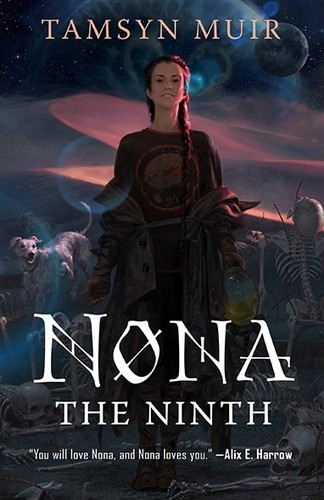
Nona the Ninth changes scale without lowering the stakes: six months in the life of a cheerful young woman who loves her school friends and dogs — inside a besieged city, in a borrowed body, six months old. The ordinary routine is what makes the occupation and the planetary collapse around it land so hard.
Muir turns the identity mystery into an ethical question: does the temporary person called Nona matter, even if her body and soul belong to someone else?
Nona’s innocence is not ignorance. She reads bodies and languages with impossible accuracy, and her delight in people coexists with flashes of something planetary and ancient. Muir turns the identity mystery into an ethical question: does the temporary person called Nona matter, even if her body and soul belong to someone else?
The John interludes — the Emperor narrating, in fragments, how a necromancer ended Earth — are the trilogy’s buried origin story finally surfacing, and they recontextualize everything while Nona walks dogs and goes to school.
The climax is dense even by Locked Tomb standards: Blood of Eden factions, devils, the River, Kiriona Gaia and several identities converging on the Ninth House at once.
Its strongest payoff is emotional rather than explanatory. Camilla and Palamedes consent to become Paul; Nona chooses to save others knowing it ends Nona; and Alecto — the soul of Earth, awake at last — swears herself to Harrow and turns toward John. The gain is real, and so is the grief.