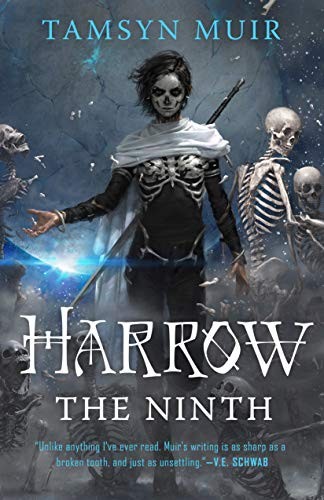
Harrow the Ninth is a puzzle built from grief — second-person narration, false flashbacks and a missing name, all because Harrow has made her own mind difficult to enter. It is difficult by design, and it does not offer the immediate pleasures of Gideon the Ninth; it offers stranger ones.
Harrow’s refusal to remember Gideon becomes an extreme portrait of mourning: love survives as an absence that reorganizes language, perception and history.
Muir uses the disorientation for more than a late twist. Harrow’s refusal to remember Gideon becomes an extreme portrait of mourning: love survives as an absence that reorganizes language, perception and history. Every wrong detail in the false Canaan House is a wound with a shape.
Around the broken memory runs a comedy of cosmic dysfunction: an incomplete Lyctor serving God aboard the Mithraeum, learning from immortal saints who despise her, while someone keeps trying to murder her and a Resurrection Beast swims closer. The soup is famous for a reason.
The final third pays off the structural gamble in a dense convergence — Resurrection Beast, Lyctoral rebellion, Commander Wake’s possession, and Gideon’s voice suddenly, devastatingly back. Some machinery stays deliberately provisional even then.
What is exact is the emotional logic. The reveal that perfect Lyctorhood could have spared every cavalier reframes ten thousand years of sacrifice as manipulated grief, and Harrow’s last retreat into a mental Locked Tomb — protecting Gideon by refusing to return — is the book’s thesis in a single act of love.