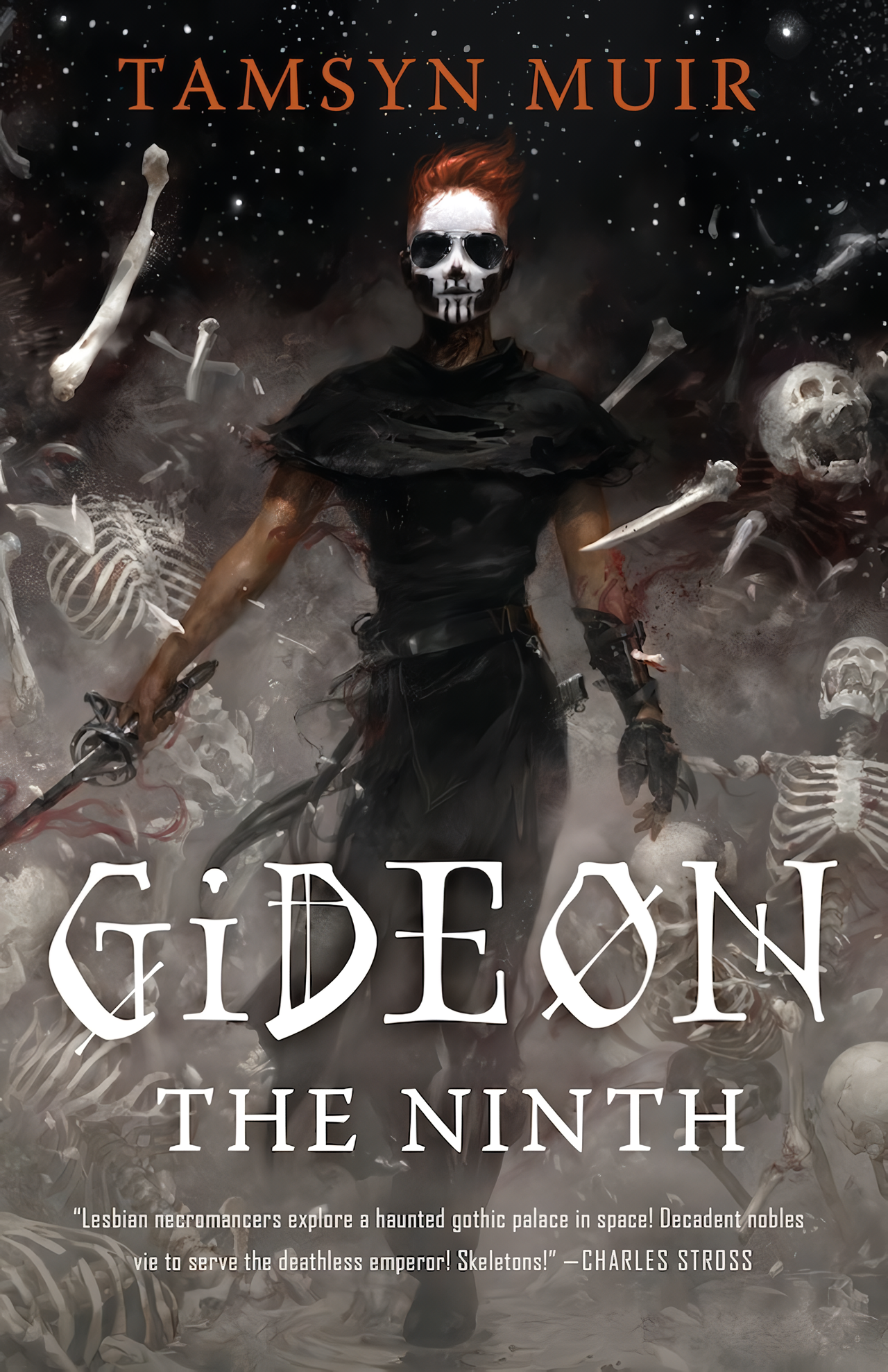
Gideon the Ninth arrives wearing several incompatible costumes and refuses to remove any of them. It is a locked-house murder mystery in a decaying palace, a space opera governed by necromantic dynasties, a gothic romance whose principals insist they hate one another, and a comedy narrated through the attention span of an angry teenager with a sword and a collection of dirty magazines. Tamsyn Muir does not smooth those modes together. The collisions are the style.
Gideon Nav has spent her life trying to escape the Ninth House, a death cult inside a frozen planetary installation. Harrowhark Nonagesimus, its teenage Reverend Daughter, has spent almost as long preventing her. When the Emperor summons the heirs of the Nine Houses to compete for Lyctorhood, Harrow needs a cavalier. Gideon agrees to serve because the arrangement may finally buy her freedom. Their partnership begins as extortion with face paint.
Canaan House supplies the novel's great piece of architecture. It is palace, laboratory, mausoleum, and abandoned research complex, inhabited by skeleton servants and maintained by priests who understand less than they claim. The heirs arrive expecting instruction and receive keys, locked doors, partial rules, and the warning that the building must not be opened indiscriminately. The mystery develops from institutional neglect: a civilization has turned a catastrophic research program into sacred history without preserving an honest account of what happened.
The necromancy is gratifyingly physical. Harrow builds with bone, Palamedes reads matter, Silas siphons another person's soul, Ianthe works through flesh, and Abigail studies spirits. Each discipline reveals a different theory of personhood. The trials beneath Canaan House are not tests of abstract magical power. They are experiments in how completely a necromancer can use a cavalier's body, senses, energy, and death.
That makes the cavalier system the book's moral center. Publicly, cavalier and necromancer form a noble pair summarized by "one flesh, one end." In practice, Lyctorhood requires the necromancer to consume the cavalier's soul and convert intimacy into permanent fuel. The phrase sounds romantic until the machinery beneath it is exposed. Muir builds an entire imperial order around the question of whether love can survive being structured as use.
Gideon and Harrow answer that question badly, movingly, and never cleanly. Their childhood is full of cruelty, guilt, and mutual isolation. Harrow has real power over Gideon's future; Gideon has learned to turn contempt into armor. Their slow cooperation does not erase what Harrow has done. Instead, the pool confession lets both characters reveal the dead children standing invisibly between them and make a promise with no safe way to fulfill it.
The supporting cast is deliberately overwhelming. Eight houses arrive with paired names, colors, disciplines, alliances, and hidden relationships. Readers are meant to feel Gideon's impatience with the social map, but that choice produces genuine confusion. The reward comes when early comic impressions acquire tragic specificity: Magnus's warmth, Abigail's curiosity, Isaac and Jeannemary's youth, Camilla's competence, Palamedes's decency, and Dulcinea's apparent fragility all matter once bodies begin accumulating.
The voice will divide readers, and I came down hard on its side. Gideon's language is contemporary, irreverent, lustful, and full of jokes that can sound imported from an internet centuries older than the setting. That anachronism is not an accidental crack in the world; later revelations suggest the civilization itself is built from damaged survivals of ours. Even so, humor sometimes interrupts horror before it has settled. The book asks the reader to accept a pun and a corpse in the same breath.
Its mystery is more effective as atmosphere and character pressure than as a fair-play puzzle. Cytherea's impersonation depends on information the reader cannot fully interpret, Lyctoral powers break the scale established for the heirs, and important rules arrive near the moment they become necessary. Yet the solution belongs to the novel's themes. The murderer is not merely one bad guest. She is a survivor of the institution everyone else hopes to join.
The climax converts Gideon's worst fear and greatest desire into the same act. She chooses a death that makes Harrow a Lyctor, giving herself to the person who once controlled her while also taking control of the terms. The sacrifice is heroic, loving, furious, and ethically compromised. Muir does not resolve that contradiction. Harrow's new power is proof of their bond and evidence of the system that devoured it.
Gideon the Ninth is messy in ways that feel inseparable from its ambition. It wants bones to be frightening and funny, theology to behave like laboratory science, and two damaged girls to express devotion through insults, swordplay, confession, and catastrophe. Beneath the sunglasses and skeletons is a severe novel about inherited guilt: what the dead are owed, what the living consume, and how an empire turns sacrifice into a job description.