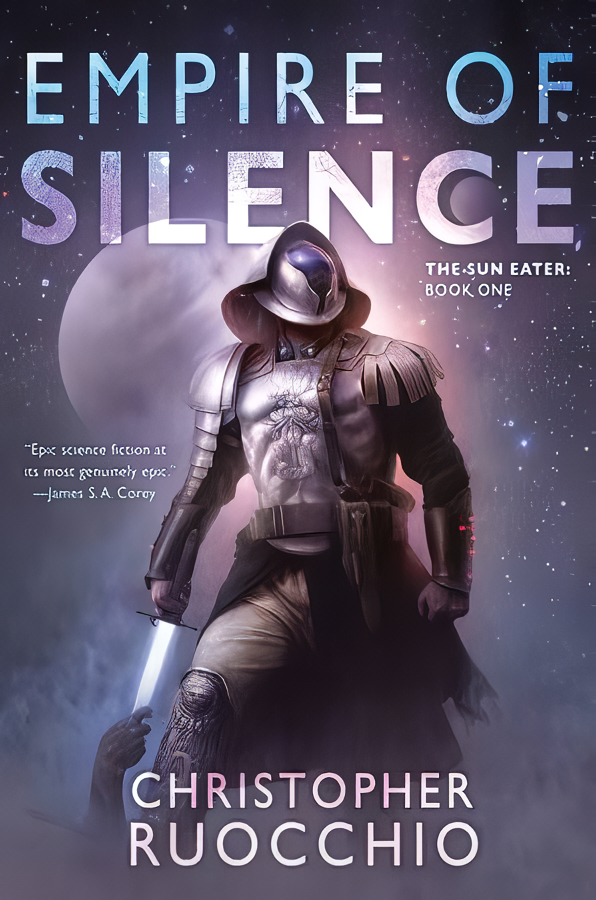
Christopher Ruocchio begins Empire of Silence with the ending of a much larger story. Hadrian Marlowe is already the Sun Eater, already the man blamed for killing billions when he destroyed a star, and already old enough to understand how legends flatten the people trapped inside them. The novel is his attempt to recover the young man who existed before the title. That choice makes every escape feel like a step toward a fate the narrator cannot escape.
Young Hadrian is the eldest son of Alistair Marlowe, Archon of Meidua on the planet Delos. He has been engineered, educated, and preserved to inherit a dynasty built on uranium and fear. He does not want it. His preferred future is among the Scholiasts, the wandering scholars who preserve knowledge outside the worst dogmas of empire. His father instead plans to deliver him to the Chantry, the religious institution that controls doctrine through ritual, censorship, and violence.
The early Delos chapters are the book's most direct expression of aristocratic imprisonment. Hadrian possesses wealth, servants, medical advantages, and the legal status to command almost anyone he meets. He is also a reproductive asset owned by his family. His father can determine his profession, marriage, exile, and replacement. Ruocchio never asks the reader to mistake this for the suffering of the poor, but he uses it to show that hierarchy deforms even the people it elevates.
The resulting flight gives the novel its first great irony. Hadrian imagines escape as an act of authorship. He will choose the Scholiasts, choose his destination, and choose the man he becomes. Space travel turns that confidence into a joke. A voyage in fugue sleep consumes decades, his plan fails, and he awakens on Emesh with no money or protection. In an interstellar civilization, changing worlds can take longer than a human life. Freedom is never instantaneous; it arrives with missing years.
On Emesh, Empire of Silence abandons the expected prince-in-exile adventure. Hadrian does not immediately command a rebellion or reveal secret greatness. He begs, steals, lies, and depends on people his upbringing trained him not to see. His friendship with Cat gives this section its emotional center. She knows survival as practice rather than romance, and her death during a plague destroys Hadrian's remaining belief that pain becomes meaningful simply because a noble narrator witnesses it.
The Colosso arena offers another form of storytelling. Hadrian becomes a myrmidon and survives by performing violence for a crowd. The sequence recalls gladiatorial fiction, but its purpose is less to prove that he is a warrior than to strip his education down to something bodily. Friends such as Switch, Pallino, Elara, Siran and Ghen become his first chosen company. They judge him by whether he stands beside them, not by the genetic record hidden beneath his skin.
When Hadrian is forced to out himself — and learns that Count Balian Mataro had known all along — the novel returns him to nobility without returning him home. The count sees a marriage alliance and a useful highborn guest. Hadrian receives comfort, yet comfort is again a political enclosure. Ruocchio is strongest when showing how different social spaces make the same claim on him: son, priest, thief, gladiator, marriage prospect, imperial subject. Hadrian's defining habit is not merely running away. It is resisting every noun other people use as a cage.
Valka Onderra gives that resistance an intellectual partner. She is a Tavrosi xenologist with technological implants forbidden by Sollan orthodoxy and a willingness to treat alien civilizations as subjects rather than heresies. Her work among the native Umandh and the ruins associated with the vanished Quiet introduces the larger mysteries of the series. Hadrian is fascinated by her because she embodies a freedom his romantic imagination has not yet learned to distinguish from a person.
That distinction matters. The memoir admits Hadrian can be vain, melodramatic, and convinced of his own exceptional sensitivity. He often condemns imperial prejudice while relying on aristocratic reflexes. He wants peace with the Cielcin partly from compassion and partly because becoming the man who achieves it would complete his preferred image of himself. The older narrator recognizes this performance, but recognition does not always prevent the prose from indulging it.
The Cielcin arrival changes the book from social exile to historical threshold. Humanity has fought the alien species for centuries and largely treats extermination as the only imaginable policy. When a Cielcin pilgrim vessel forces its way toward the ancient ruins, Hadrian helps capture survivors and then insists on the radical possibility of communication. The Chantry's torture of a prisoner exposes an empire more committed to confirming its theology than acquiring knowledge.
The novel's central strength is this conflict between interpretation and silence. The Quiet left ruins but no explanation. The Cielcin speak, but human institutions prefer screaming to translation. Hadrian narrates from a future in which his own actions have been reduced to titles. Everyone is surrounded by evidence, and everyone chooses the story that protects existing power.
Ruocchio's influences are visible. The feudal houses, engineered aristocracy, forbidden machines, priestly authority, and desert-toned solemnity invite comparison with Dune. The memoir of an infamous man, archaic vocabulary, and unreliable distance from remembered youth recall The Book of the New Sun. There are echoes of The Name of the Wind in the famous narrator explaining how he became a legend. The book does not hide these inheritances, and at times the familiarity can make its world feel assembled before it feels lived in.
What distinguishes it is scale experienced as time. A failed escape costs thirty-five years. Political messages, voyages, and reinforcements cannot move at the speed of plot. Nobles live for centuries while ordinary people age and die. Hadrian's privilege is therefore chronological as well as financial: his engineered lifespan allows him to keep becoming someone new after entire communities disappear.
The prose is formal, reflective, and frequently beautiful. It is also patient to the point of self-obstruction. Hadrian can turn a doorway into a meditation on empire and a conversation into a trial of his younger self. Readers wanting immediate war with the Cielcin may find the Delos and Emesh arcs excessively long. Yet the slowness is not accidental. This first volume is about building the moral vocabulary that the future Sun Eater will use to judge what he has done.
The ending succeeds by offering departure rather than victory. Hadrian persuades imperial authorities to let him accompany the Cielcin captives in search of peace and the legendary Vorgossos. Sir Olorin gives him a highmatter sword, his future companions gather around him, and the story finally assumes the outline of a grand expedition. We already know peace will not prevent the destruction announced on the first pages. Hope matters because it is doomed, not because it is foolish.
Empire of Silence is therefore an origin story that refuses the clean efficiency of origins. Hadrian's identity accumulates through failed roles, lost years, and people who cannot accompany him forever. The book is derivative in surface architecture and distinctive in emotional duration. Its hero is not yet the Sun Eater. He is a young man trying to speak into an empire that has mistaken silence for order.