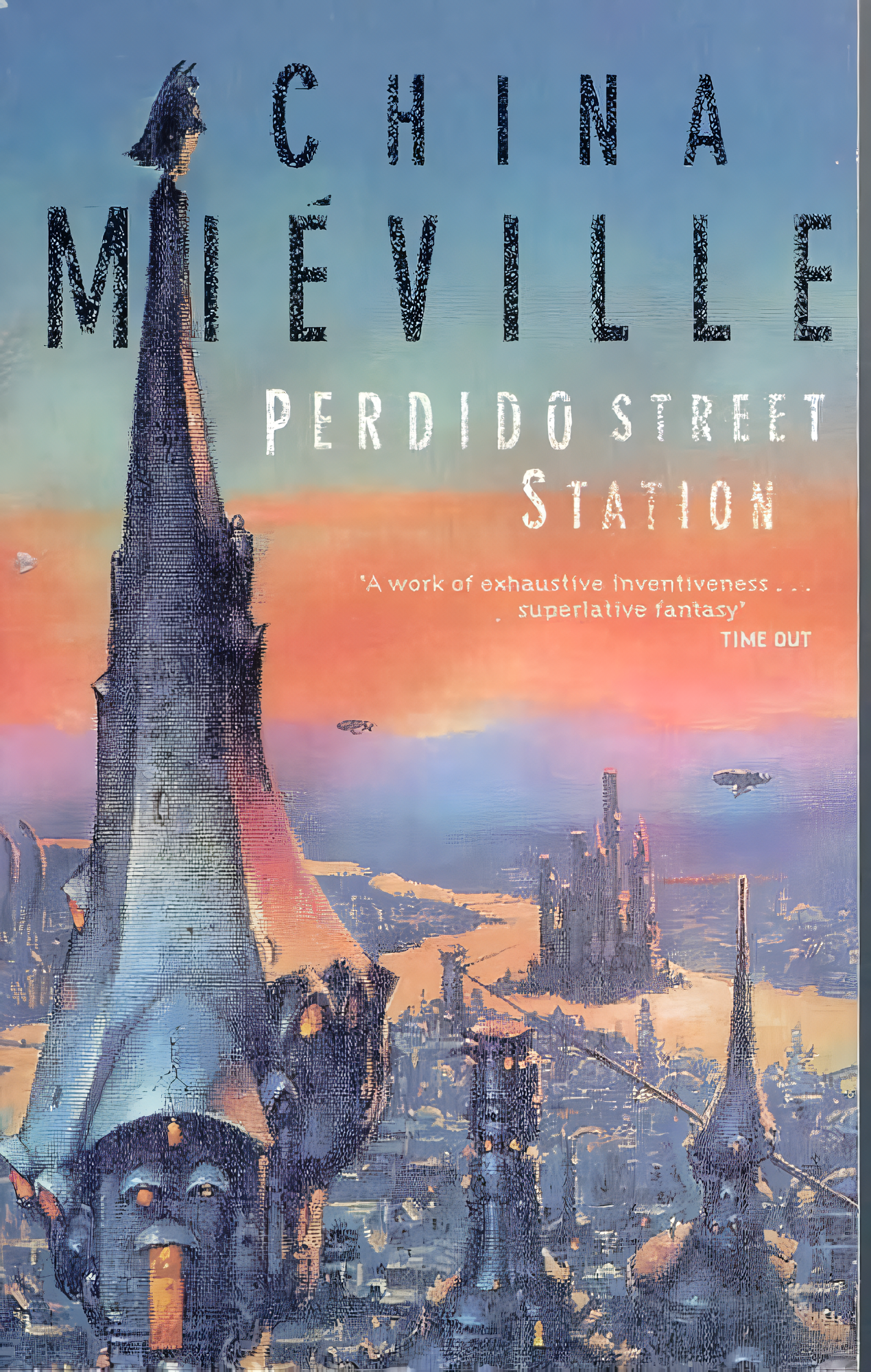
New Crobuzon does not welcome the reader so much as digest them. China Miéville introduces the city through heat, sewage, industry, meat, smoke, crowds, and the enormous ribs of a creature dead before its streets were built. Railways pass over neighborhoods divided by species and class. Magic is an applied science, science behaves like obsession, and punishment can mean having one's body remade into a public record of the crime. The city is not a backdrop to Perdido Street Station. It is the novel's most excessive organism.
Inside that organism, Isaac Dan der Grimnebulin works as a freelance scientist with more curiosity than institutional discipline. His lover Lin is a khepri sculptor: a human-shaped woman whose head is a scarab, who speaks with her hands and creates art from colored khepri-spit. Their relationship gives the novel an intimate version of its central question. New Crobuzon celebrates mixture as spectacle while punishing people who cross the wrong boundaries in private.
The plot begins when Yagharek, a wingless garuda, asks Isaac to restore his flight. His feathers remain, but his wings were cut away by his own people as punishment for a crime he will not translate. Isaac accepts the problem as a scientific challenge and begins studying every form of flight he can obtain. The commission is generous, difficult, and flattering. It is also the first in a chain of choices by which intellectual appetite becomes public disaster.
Among the specimens delivered to Isaac's laboratory is a vividly colored caterpillar out of the state's own moth programme — sold on to Mr Motley by the researcher Montague Vermishank, and lifted from that criminal chain by Lucky Gazid. It will eat only dreamshit, a hallucinogenic drug produced from the milk of adult slake-moths. Fed generously, it pupates and emerges as one of those creatures. The moth's wings hypnotize sentient minds; its feeding leaves bodies alive and consciousness hollowed out. It escapes, frees four more from the criminal Mr Motley's collection, and turns the city into a hunting ground.
The slake-moths are excellent monsters because they are both extravagantly alien and inseparable from New Crobuzon's economy. The government imported them for research. Motley keeps them to produce a profitable narcotic. Isaac raises one through curiosity and black-market access. No single institution intends the plague, but every institution contributes to it. The creatures' appetite resembles the systems around them: extract consciousness, leave the used body, move toward the next source of value.
Miéville builds the response as an unstable coalition. Isaac works with Yagharek, the fixer Lemuel Pigeon, dissident journalist Derkhan Blueday, the emerging artificial intelligence known as the Construct Council, and the transdimensional Weaver. Each participant wants something different. The Council sees expansion, the Weaver sees beauty in the worldweb, Derkhan wants to save Lin and oppose the state, and Isaac wants to repair the catastrophe he caused. Cooperation becomes possible without purity of motive.
The novel's politics are rarely hidden. Mayor Rudgutter governs through surveillance, militia violence, deals with organized crime, and literal negotiation with Hell. The newspaper The Runagate Rampant documents what respectable institutions suppress. A dock strike reveals collective power, then the militia and Remade vigilante Jack Half-a-Prayer demonstrate the different forms violence can take. Miéville's sympathies are clear, but the city refuses the comfort of a single revolutionary solution.
The prose is baroque, tactile, and committed to nouns. Miéville will spend a paragraph making a wall sweat, a street rot, or a creature become biologically offensive. The density creates a world unlike the clean maps of conventional secondary fantasy. It also makes the book longer than its central chase requires. Some readers will find the accumulation intoxicating; others will feel the narrative periodically disappear under its own vocabulary.
Lin suffers most from that imbalance. Her art, her estrangement from khepri tradition, and her relationship with Isaac make her one of the book's most interesting figures. Once Motley imprisons her, however, she becomes the captive body toward which the male rescue plot moves. The ending does not grant a miraculous recovery. That refusal is honest and devastating, but it cannot erase how much of her late story is experienced through what others do to her.
Yagharek's final revelation is even more deliberately destabilizing. The crime he could not translate was rape. Isaac's plan to restore his flight would reverse a sentence without knowing the victim or the moral world that imposed it. Yagharek has been companion, client, outsider, and brave ally; none of those facts cancels the harm. The novel denies both easy rehabilitation and the fantasy that a person's worst act is the only truth about them.
This is why the conclusion feels harsher than the defeat of the moths suggests. New Crobuzon is saved without becoming just. The government remains, Motley survives, labor has been crushed, Lin is permanently injured, and the fellowship dissolves. Perdido Street Station offers solidarity as necessary but temporary, powerful but unable to purify the systems in which it acts. The city continues because cities do. That is the triumph and the horror.