Fantasy
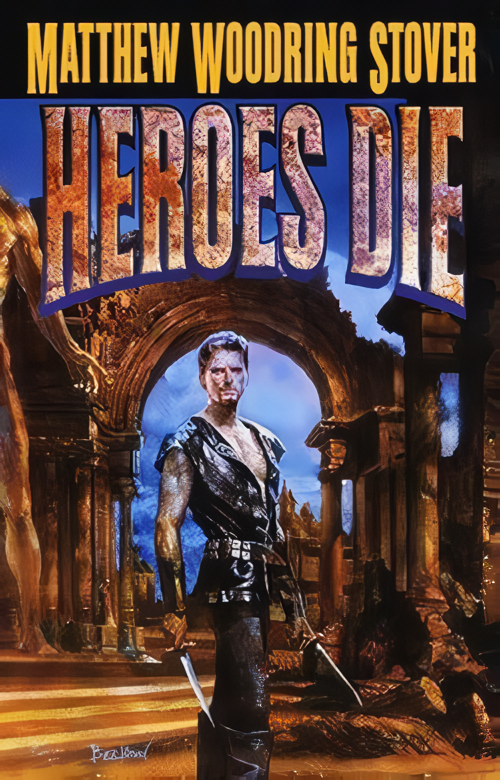
Matthew Woodring Stover builds Heroes Die around a wonderfully vicious contradiction. It is a novel of extravagant, bone-breaking action that regards the consumption of extravagant, bone-breaking action with deep suspicion. Every time Caine performs some impossible feat of violence, the reader receives the thrill and the indictment at once. Somewhere on a future Earth, an audience is enjoying the same experience through his senses. The blood is real in Overworld, but it becomes content the instant it reaches the Studio.
The premise joins dystopian science fiction to portal fantasy without allowing either half to remain comfortable. Earth is overcrowded, corporate, and divided into rigid castes. Overworld is a parallel reality of magic, gods, monsters, and feudal kingdoms. Specially trained Actors cross between them, adopt fantasy identities, and transmit their adventures through implants. Wealthy viewers experience the Acts directly; everyone else buys packaged versions. It is reality television with colonial access to an actual world, and its subjects are rarely told they are performing.
Hari Michaelson is the greatest performer the system has produced, and I have never read a fantasy protagonist quite like him. On Overworld he becomes Caine, a feared assassin whose contempt, agility, and talent for improvisational murder have made him a global celebrity. Hari insists that Caine is only a role, but the distinction is already collapsing when the book begins. Caine gives Hari permission to express rage that caste society has taught him to contain. Hari gives Caine a wife to rescue and a corporation to hate. The character's power comes from watching the two identities stop pretending they can be separated.
The rescue is the plot's emotional engine. Hari's estranged wife Shanna, known on Overworld as the sorceress Pallas Ril, has vanished inside Ankhana. The Studio offers Hari a final Act: return as Caine, recover Pallas, and assassinate the apparently divine Emperor Ma'elKoth. Administrator Kollberg presents this as opportunity while structuring it as coercion. A successful rescue is entertainment. Caine's death is entertainment. Pallas's death is entertainment. Corporate power does not need to predict the result when it owns every possible version of the story.
Ma'elKoth is the crucial complication. He begins as the fantasy despot the contract requires Caine to kill, yet he is too intelligent, charismatic, and metaphysically strange to remain a quest marker. He has brought peace to Ankhana, which makes him bad for the Studio's ratings, while imposing that peace through terror, religious authority, and persecution. Stover refuses the easy moral arrangement in which modern technology belongs to cynics and magic belongs to innocents. Earth and Overworld have different instruments of domination, not different appetites.
Count Berne supplies a more intimate form of menace. He is a killer capable of meeting Caine on the level of appetite rather than ideology. Their rivalry gives the novel some of its most ferocious scenes, but Berne also reflects what the audience wants Caine to be: violence without doubt, exhaustion, or consequence. Caine's anger is frequently monstrous. What separates him from Berne is not purity. It is the fact that he can still be disgusted by what he does.
That disgust never absolves him. Caine will endanger strangers, manipulate allies, and treat lives as pieces on the way to Shanna. Stover makes romantic devotion both noble and terrifying. Hari's love resists the Studio's attempt to reduce Shanna to leverage, yet it also gives him a reason to reproduce the Studio's logic: every casualty becomes acceptable if the person at the center of his private story survives. The novel keeps asking whether a hero is defined by whom he saves or by whom he is willing to spend.
The prose changes with the performance. Hari's life on Earth and several Overworld viewpoints are told in hard third-person narration. Caine's transmitted experience often arrives in first person, with clipped sentences, profanity, sudden explanation, and direct awareness of the viewers riding behind his eyes. This is more than a stylistic trick. It makes narration part of the machinery of exploitation. Caine is not merely fighting; he is packaging his consciousness while he fights.
Stover's action writing is exceptionally clear. Bodies have weight, fatigue matters, and cleverness grows from physical limits rather than replacing them. The violence is graphic, sometimes punishingly so, but the best sequences reveal character through tactical choice. Caine survives because he reads the emotional shape of a room faster than other people read the weapons in it. His great talent is not killing. It is understanding which belief will make someone move.
The book is less effortless when it pauses to explain its machinery. Earth caste terminology, Studio politics, Overworld factions, and metaphysics arrive quickly, and some secondary figures are defined primarily by their relationship to Hari's mission. The gender politics also carry the stamp of a late-1990s action novel: Shanna is capable and consequential, but the plot still turns her capture into the pressure that returns its male hero to violence.
Even those limitations feed the novel's abrasive energy. Heroes Die does not want to be elegant high fantasy. It wants mud in the circuitry. It wants a god-emperor to confront an entertainer, a corporate executive to monetize a marriage, and an audience to discover that being addressed by its hero is not the same as being respected by him.
The conclusion pays off the double-world structure instead of treating Earth as a framing device. Hari cannot win merely by defeating Overworld's strongest men, because the Studio has built a story in which his struggle generates profit. He must attack authorship itself: the contract, the transmission, and the institution deciding what his pain means. His final victory is real but costly, and the physical damage he carries home prevents the ending from becoming a clean fantasy of rebellion.
As an opening volume, Heroes Die is remarkably complete. It resolves the rescue and the central confrontation while leaving Hari trapped inside altered forms of power. The sequels have room to expand because the first novel understands that overthrowing a villain does not overthrow the appetite that created him. The cameras remain. The audience remains. Caine remains, even when Hari would rather he did not.