The Book in Brief
Hari Michaelson lives on a future Earth organized by inherited and professional caste. He is an Actor, one of the trained operatives sent through technological transfer to Overworld, a parallel world where magic and legendary creatures are real. Actors carry thoughtmitters that allow audiences on Earth to share their perceptions. Hari's Overworld identity, Caine, has become the Studio's most famous assassin and one of the planet's greatest entertainment properties.
Years earlier, Caine accepted a contract to kill the Regent of Ankhana. The Regent's success at stabilizing the empire threatened the conflict on which the Studio's adventure programming depends. The assassination goes wrong, and Caine is forced into a spectacular escape through the palace. He kills far more people than intended and is nearly mortally wounded. Earth executives authorize an emergency return because an unseen death would waste their valuable star. The resulting Act, A Servant of Empire, becomes a sensation, but Hari is sickened by it and refuses to return.
Ankhana later falls under Ma'elKoth — and both halves of that sentence are Caine's doing. The assassination of Toa-Phelathon shattered Ankhana's feudal order and opened the succession war that made an emperor necessary; and Ma'elKoth himself was a minor necromancer called Hannto the Scythe until an earlier Adventure, in which Caine delivered him the Crown that made him a living god. His peace is enforced through religious supremacy, secret power, and fear of "Aktiri," the supposed alien agents he blames for opposition. The Studio wants turmoil restored. Earlier attempts to infiltrate armed Actors into the palace fail, and transmissions cannot penetrate Ma'elKoth's defenses.
Shanna, Hari's estranged wife, is active in Ankhana as Pallas Ril. Under the alias Simon Jester, she rescues people accused of being Aktiri and frustrates the emperor's campaign against the resistance. A powerful spell causes observers to forget the protected rebels, allowing her movement to survive but making coherent organization difficult. She is betrayed by Lamorak — the Actor Karl Shanks, her fellow Actor and lover — who breaks under Berne and gives up everything, including the existence of the Actors themselves. Captured, she is left exposed to torture and execution.
Administrator Kollberg uses the crisis to bring Hari back. The Studio proposes an Act built around Caine's attempt to save Pallas. The contract secretly requires him to kill Ma'elKoth and to draw the emperor outside the palace so the confrontation can be broadcast. Kollberg's plan profits from almost every outcome: Caine can rescue Pallas, die heroically, kill the emperor, or be killed by Count Berne, Ma'elKoth's terrifying champion.
Hari accepts because refusing would abandon Shanna. Once returned to Overworld, he searches Ankhana while attempting to reconnect with the resistance hidden by the forgetting spell. His mission requires him to navigate people who cannot retain ordinary knowledge of one another and a city in which Ma'elKoth has turned fear of Actors into political religion. Caine's movements are simultaneously rescue attempt, assassination plot, and live production.
Shanna's captivity reveals that Ma'elKoth is not simply a deluded tyrant. His power is real, and his interest in Actors extends beyond propaganda. He understands that Earth has been treating Overworld as a stage and recognizes the threat posed by beings who arrive with advanced weapons, hidden purposes, and audiences in another reality. His campaign is cruel, but the Studio's interventions give his paranoia a factual foundation.
Count Berne hunts Caine with an enthusiasm that makes their conflict personal. Berne embraces killing as identity, while Caine's performance depends on an unstable mixture of skill, rage, disgust, and care. Their encounters strip away the civilized language used by both empire and corporation. Each institution ultimately relies on men who can turn other bodies into messages.
Caine locates the network around Simon Jester and moves toward Pallas. He makes alliances, spends lives, and uses the expectations attached to his celebrity identity. The Studio continues to shape the mission from Earth, withholding information and treating danger as a production variable. Hari increasingly directs his thoughts toward the viewers, making them conscious participants rather than invisible consumers.
The rescue and assassination plots converge around Ma'elKoth's seat of power. Caine confronts Berne and survives the brutal contest, but defeating the champion does not solve the larger trap. Ma'elKoth cannot be reduced to another physical opponent, and Kollberg still controls the mechanisms that can strand or kill the Actors. Hari must play the emperor's ambitions against the Studio's certainty that it owns the ending.
In the final struggle Pallas takes hold of Chambaraya, the river god, and becomes its avatar — that transformation, not a rescue, is what breaks the confrontation — while Ma'elKoth is displaced from Overworld to Earth through the same larger system that joins the worlds. There he survives in altered form as Tan'elKoth, a consequence rather than a cleanly slain villain. Hari also turns the Studio's live spectacle against its managers, refusing the role Kollberg wrote for him and making the corporate manipulation visible.
Hari and Shanna survive and reunite, but the victory destroys any fantasy of restoration. Hari takes Kosall through the spine and returns to Earth paraplegic. The fallout topples Arturo Kollberg and blackens the Studio's reputation, and Hari is handed Kollberg's Chairmanship — and upcasting to Administration — as a public-relations exercise, transforming rebellion into another useful relationship. He has saved Shanna and beaten the immediate plot, yet Caine's fame, Ma'elKoth's survival, and the corporate system all continue in changed form.
Important Characters
Hari Michaelson / Caine: Earth's most famous Actor and Overworld's legendary assassin. Hari treats Caine as a role, but the novel steadily reveals that performance has become the place where his anger and agency live.
Shanna / Pallas Ril / Simon Jester: Hari's estranged wife, an Actor and sorceress who protects Ankhana's persecuted resistance. Her capture supplies the Studio's leverage, but her work has already disrupted Ma'elKoth's rule before Caine arrives.
Ma'elKoth: God-emperor of Ankhana. He brings order through domination and possesses genuine supernatural power, making him both tyrant and a serious answer to Earth's secret exploitation of Overworld.
Count Berne: Ma'elKoth's champion and Caine's most direct physical rival. His joy in violence presents the version of Caine that audiences consume when they ignore Hari's doubt.
Administrator Kollberg: Studio executive whose career is tied to Caine's success. He designs the rescue as a contract with profitable outcomes on every branch and mistakes control of the production for control of Hari.
Duncan Michaelson: Hari's father, a former libertarian academic whose broken condition embodies what Earth's political order does to dissent. His beliefs remain a moral irritation inside Hari's compromises.
The Ankhana Resistance: The persecuted network aided by Simon Jester. A forgetting spell protects its members from discovery while also making trust, memory, and coordinated resistance precarious.
The Studio Audience: Not an individual character, but an active moral presence. Viewers borrow Caine's pain as entertainment, and his awareness of them changes the meaning of every first-person action scene.
Spoiler Warning: The summary below reveals the rescue, the fate of Ma'elKoth, and Hari's injuries. The original trade edition is organized as a Prologue, seven numbered "Days" containing short numbered sections, and an Epilogue. Because digital editions can break those short sections differently, they are grouped here in consecutive narrative movements within each Day rather than given invented titles.
Prologue
Caine enters the palace of Ankhana to assassinate its Regent on behalf of interests that prefer profitable instability to peace. The assignment collapses into a mass-casualty escape. Caine reaches a hiding place mortally wounded, and the Studio returns him to Earth because his unseen death would be commercially useless. The footage becomes a legendary Act, while Hari's disgust drives him away from Overworld.
Day One
Years later, Hari is wealthy enough to refuse new work but not powerful enough to escape the system that made him famous. The Studio explains that Ma'elKoth now rules Ankhana as emperor and god, that previous infiltrators have disappeared, and that Shanna has been captured while operating as Pallas Ril.
Kollberg offers Hari the rescue story the audience wants. The private contract requires Caine to assassinate Ma'elKoth and draw him beyond the palace's broadcast barrier. Hari recognizes the trap but accepts because the alternative is to leave Shanna to die.
Day Two
Hari crosses into Overworld and resumes the body, instincts, and public voice of Caine. The change in narration signals that his interior life is again a performance transmitted to Earth. He surveys a city transformed by Ma'elKoth's order and by the terror attached to alleged Aktiri.
Caine begins tracing Simon Jester's activity. The resistance is difficult to locate because a spell makes people forget its members and connections. The protection that kept Shanna's allies alive also makes them unable to function like an ordinary conspiracy.
Day Three
The novel broadens beyond Caine's mission to show Ma'elKoth's rule and Shanna's captivity. The emperor's human-supremacist religion turns Actors and political enemies into a single category of contaminating outsiders. His supernatural authority is not a Studio illusion.
Caine reconnects fragments of the resistance and learns how Shanna used the Simon Jester identity to rescue the accused. Each alliance carries a risk: anyone he recruits can become a casualty, a betrayer, or material for the broadcast.
Day Four
Count Berne takes a greater role in the pursuit. His violence lacks Caine's moral recoil, making him a physical threat and an accusation. Caine has built a career from killing men like Berne while allowing viewers to enjoy the resemblance.
On Earth, Kollberg's managers monitor the Act and adjust their expectations. They are satisfied by danger itself because danger improves the story. Hari begins using the first-person performance to speak more deliberately to the audience behind his eyes.
Day Five
Caine pushes deeper into the resistance and toward Pallas's prison. The forgetting spell produces gaps in planning and loyalty, but it also prevents Ma'elKoth from erasing the movement completely. Memory becomes a battlefield shared by magic and media.
Shanna resists captivity while the emperor studies what she represents. Ma'elKoth understands that Actors are not fantasy heroes but agents of a technologically superior world. His fear of Earth is rational even when his punishments are not.
Day Six
The rescue operation becomes open conflict. Caine's allies pay for the speed and ruthlessness of his plan, and he accepts risks he would never accept for Shanna herself. The contradiction between saving one person and sacrificing many reaches its sharpest point.
Caine and Berne meet in the novel's decisive physical contest, part of the same climactic sequence as the confrontation with Ma'elKoth rather than a separate movement before it. Caine kills Berne by understanding the man inside the violence better than Berne understands him — and takes Berne's enchanted sword Kosall through the spine doing it.
Day Seven
Pallas's rescue converges with the contract to kill Ma'elKoth. Caine discovers that the emperor cannot be handled as a conventional target, while Ma'elKoth discovers that the Studio's control of transfer and transmission is a route to power beyond Overworld.
Hari refuses Kollberg's planned ending and turns the live Act into evidence against its producers. The conflict crosses the boundary between worlds: Ma'elKoth is removed from Ankhana and transferred to Earth rather than simply killed. Shanna escapes, but Hari's body is catastrophically damaged.
Epilogue
Hari returns to Earth alive and paraplegic. He and Shanna are reunited, and the immediate coercive plot is broken. Yet the Studio survives, Hari is drawn into its executive structure, and Ma'elKoth remains on Earth as Tan'elKoth. The ending closes the rescue while refusing to pretend that either world has been liberated.
Ending Explained
The climax works because victory occurs on three levels. Caine defeats the bodily threat represented by Berne. Shanna survives by becoming Chambaraya's avatar, defeating the emotional leverage Kollberg used against Hari. He then attacks the story itself, using the broadcast to expose manipulation and denying the Studio the ending it contracted him to perform.
Ma'elKoth's displacement to Earth prevents the assassination from becoming a simple meeting of hero and villain. The emperor has spent the novel identifying Actors as invaders from another reality. By crossing into their world, he becomes proof that the border can be breached in both directions. His new identity as Tan'elKoth leaves the metaphysical conflict open for later books.
Hari's paralysis is the price that keeps the ending honest. Caine's adventures have been sold as pain without lasting consequence because the Actor can return to Earth. Now Hari carries the damage home. He wins control over the moment but loses the bodily freedom on which Caine's legend was built.
Unresolved Questions
What exactly is Ma'elKoth, and what can he become on Earth as Tan'elKoth?
Can Hari retain any control over the Studio once it turns his rebellion into employment?
What remains of Caine when Hari can no longer use his body in the same way?
Can Hari and Shanna rebuild a marriage shaped by secrecy, performance, and coercion?
Will the people of Overworld ever learn that their wars have been manufactured for another world's entertainment?
Does an audience become responsible once Caine speaks directly to it and reveals the machinery behind the Act?
About the Book
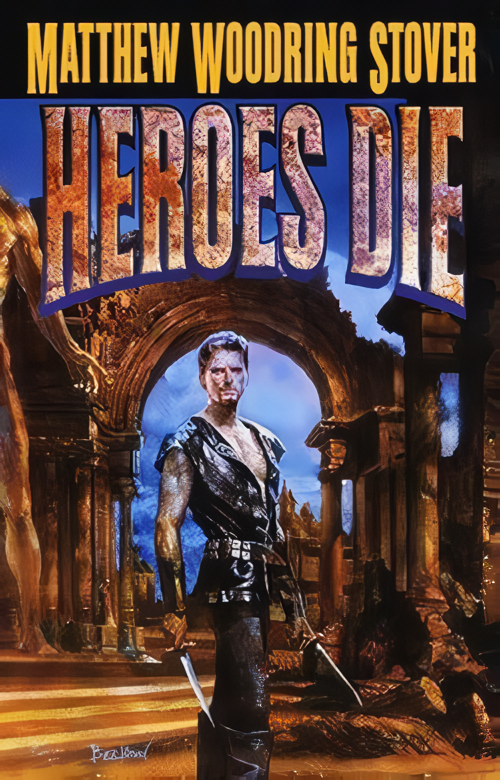
Del Rey published Heroes Die on July 21, 1998. The first trade paperback is 563 pages and is arranged as a Prologue, seven "Days" divided into short numbered sections, and an Epilogue. It is the first novel in The Acts of Caine, followed by Blade of Tyshalle, Caine Black Knife, and Caine's Law.
The novel blends dystopian corporate science fiction, portal fantasy, martial action, and media satire. Its alternating first- and third-person modes make Caine's transmitted awareness part of the plot rather than merely a narrative choice.