The Book in Brief
An elderly Hadrian Marlowe writes his account from Colchis after the wars that made him infamous. History calls him the Sun Eater and remembers that he destroyed a star and killed billions, including the last great host of the Cielcin. He insists that he did not begin as a conqueror. He was born Hadrian Anaxander Marlowe, eldest heir to one of the ruling families of Delos.
Hadrian's father, Alistair Marlowe, is Archon of Meidua and lord of Devil's Rest. The family's wealth and authority rest on uranium production, genetic privilege, and service to the Sollan Empire. Hadrian receives the education expected of a palatine heir: weapons training from Sir Felix Martyn, classical instruction, court discipline, and lessons from the Scholiast Tor Gibson, who is flogged and exiled afterwards for helping him flee. His younger brother Crispin is more comfortable with the brutality expected of their house.
Hadrian dreams of surrendering his inheritance and becoming a Scholiast. Alistair regards scholarship as weakness and plans to send him to the Chantry, where Hadrian's life will be subordinated to the empire's religious hierarchy. The Chantry polices technological and doctrinal boundaries and treats deviation as heresy. With Gibson's help, Hadrian arranges to flee before his father's plan can be completed.
The escape does not carry him to the life he imagined. Interstellar travel requires fugue sleep, and mistakes, betrayals, and the indifference of distance strand him on the planet Emesh after thirty-five years have passed. His money and credentials are gone or useless. The heir of Meidua enters the city as an unprotected stranger.
Hadrian lives in the streets for several years, surviving through theft and improvisation. He becomes close to Cat, a homeless young woman whose practical knowledge keeps him alive. Their companionship punctures his inherited assumptions, but it cannot protect them from the city's larger indifference. When plague strikes, Cat dies. Hadrian is left with grief he cannot convert into a noble lesson.
To escape the streets, Hadrian enters the Colosso and becomes a myrmidon. He fights for public entertainment and joins a group that includes Switch, Pallino, Elara, Siran and Ghen. The arena gives him food, purpose, and chosen loyalty while threatening death as spectacle. His education and enhanced palatine body make him effective, but survival depends on the other fighters as much as his hidden advantages.
Hadrian's aristocratic identity is eventually exposed — by his own hand, when only a palatine's right to duel can save him after he strikes a Chantry prior. Count Balian Mataro, ruler of Emesh, reveals that he had known all along, and that Hadrian's father has disowned him. Mataro forces a betrothal to his daughter Anaïs to bring palatine genes into his house. Hadrian has regained status, yet he is again treated as a piece in another noble design.
At Mataro's court, Hadrian meets Valka Onderra Vhad Edda, a Tavrosi xenologist. Valka uses implants condemned by the Sollan Chantry and openly criticizes imperial assumptions. She studies the native Umandh and ancient ruins attributed to the Quiet, a vanished or transcendent civilization whose traces challenge the empire's accepted history. Hadrian becomes fascinated by her work and by her refusal to defer to his rank.
The ruins pull the novel's mysteries together. The empire distrusts alien knowledge, the Chantry suppresses forbidden interpretation, and Valka sees evidence that humanity's official story is incomplete. Hadrian, trained by Gibson to value lost texts and alternative explanations, recognizes in the Quiet a question larger than his private escape.
A Cielcin pilgrim ship forces its way toward Emesh and the ancient site. Humanity has been at war with the Cielcin for centuries, and imperial culture imagines them primarily as predatory xenobites. The attack and pursuit bring the conflict directly to the planet. Hadrian uses his training and position to help resist the incursion, and several Cielcin are captured alive.
Hadrian believes the captives create an opportunity for communication. The Chantry instead tortures their captain, Uvanari, treating pain as both interrogation and religious demonstration. It does produce one decisive fact — that the Cielcin have dealt with the obscure human world of Vorgossos — and, when the broken prisoner begs for death, Hadrian has Valka cut the prison's power and kills Uvanari himself. Hadrian's horror is sharpened by the realization that imperial institutions may prefer an enemy they can condemn to one they must understand.
Working with Valka and Emesh's authorities, Hadrian argues that the prisoners should be used to pursue contact rather than execution. His proposal is idealistic and politically dangerous: travel with the captives, seek the legendary world of Vorgossos, and attempt to reach a Cielcin power capable of negotiation. It proceeds, but not on his terms: Knight-Tribune Raine Smythe conscripts him into Imperial service — which dissolves the betrothal to Anaïs — gives him a ship and lets him pick a crew, then places Lieutenant Bassander Lin in command over him.
Hadrian gathers companions from the life he has made on Emesh. The expedition offers his myrmidon friends a future beyond the arena and gives Valka a path toward the alien knowledge she has been seeking. Sir Olorin, a mysterious traveler from Jadd, entrusts Hadrian with a highmatter sword, a weapon whose significance reaches far beyond its immediate use.
The book ends as Hadrian departs with the captives in search of Vorgossos and peace. The older narrator has already told the reader that he will become the destroyer of the Cielcin and of a sun. The young man leaves Emesh believing understanding may interrupt the war; the memoir preserves that belief while placing catastrophe around it like a frame.
Important Characters
Hadrian Anaxander Marlowe: Eldest son of House Marlowe and future Sun Eater. Intelligent, theatrical, compassionate, vain, and restless, he repeatedly escapes roles only to discover how much of them he carries with him.
Alistair Marlowe: Archon of Meidua and Hadrian's father. He values dynasty, control, and imperial orthodoxy, treating his sons as instruments for extending the house.
Crispin Marlowe: Hadrian's younger brother. More suited to Alistair's model of masculine aristocratic power, he is both rival and potential replacement.
Tor Gibson: An elderly Scholiast assigned as Hadrian's tutor. His love of forbidden history and independent thought shapes Hadrian's ambitions, and his assistance makes the flight from Delos possible.
Sir Felix Martyn: Hadrian's weapons instructor. His lessons help the young heir survive long after the courtly purpose of his training has disappeared.
Cat: Hadrian's closest companion during his years on the streets of Emesh. Her practicality keeps him alive, and her death during the plague marks the end of his romantic view of poverty.
Valka Onderra Vhad Edda: Tavrosi xenologist studying the Umandh and the Quiet ruins. Her implants and intellectual independence violate Sollan norms, while her evidence expands the series beyond imperial history.
Count Balian Mataro: Ruler of Emesh. He knows who Hadrian is long before Hadrian admits it, and moves at once to bind the Marlowe heir to his own house through a forced betrothal to his daughter Anaïs.
Switch / William of Danu: A myrmidon and one of Hadrian's closest companions on Emesh. His loyalty emerges from shared danger rather than inherited obligation.
Pallino, Elara, Siran and Ghen: Fellow myrmidons whose company becomes Hadrian's first chosen household. They connect the future expedition to the years he spent outside aristocratic protection.
Sir Olorin: An enigmatic knight from Jadd who gives Hadrian a highmatter sword. His generosity suggests that other powers have recognized importance in Hadrian before Hadrian understands it himself.
The Cielcin Captives: Living representatives of the species humanity treats as an absolute enemy. Their capture forces the question of whether communication is possible or whether empire requires permanent war.
Spoiler Warning: The summaries below reveal every major development in Hadrian's flight from Delos and his years on Emesh. Standard English editions contain 78 numbered chapters. Each chapter carries its own title (Chapter 1 is "Hadrian"; Chapter 78 is "Quality"), but rather than list all seventy-eight we group them here into consecutive ranges under our own descriptive labels, preserving the complete sequence.
Chapters 1–6 — The Sun Eater Remembers
An old Hadrian introduces himself through the crimes attached to his legend. He writes from Colchis and tells the reader that he destroyed a sun and ended the Cielcin threat, but insists that motives and consequences have been erased by history. The narrative returns to his childhood at Devil's Rest on Delos.
Young Hadrian is established as Alistair Marlowe's eldest son and legal heir. He receives the best education the empire permits while learning that privilege does not include the right to choose his own life.
Chapters 7–12 — House Marlowe
The Marlowe household reveals its internal hierarchy. Crispin competes more naturally for their father's approval, while Hadrian's mother, tutors, servants, and retainers occupy constrained positions around the archon. Hadrian's unease with cruelty separates him from the ideal heir without freeing him from the benefits of being one.
Tor Gibson's lessons expose Hadrian to histories and possibilities outside official doctrine. The Scholiasts become his imagined alternative to inheritance: a life defined by knowledge and travel rather than extraction and rule.
Chapters 13–18 — The Chantry's Claim
Alistair rejects Hadrian's scholarly ambition and arranges to send him into the Chantry. For Hadrian, this is not a religious calling but a controlled disappearance that preserves the family while removing a disappointing heir.
Hadrian and Gibson prepare an escape. Their plan depends on forged expectations, careful timing, and the fact that everyone around Hadrian assumes a pampered noble cannot truly abandon his name.
Chapters 19–24 — Flight and Lost Years
Hadrian leaves Delos believing he has chosen his future. The journey immediately escapes his control. He does not reach the Scholiast life he intended, and fugue travel carries him across thirty-five years before he awakens on Emesh.
His wealth, family authority, and plans are inaccessible. The scale of space turns a youthful rebellion into irreversible exile; everyone he knew has continued living while he slept.
Chapters 25–30 — The Streets of Emesh
Hadrian enters the lower city without protection and learns to steal, beg, hide, and negotiate for food. His palatine education is useful only when translated into the immediate requirements of survival.
He meets Cat, whose understanding of the streets is better than his dramatic instincts. Their companionship becomes the most stable part of his new life and forces him to see poverty as a system rather than an adventurous disguise.
Chapters 31–36 — Plague and the Colosso
Years pass. A plague moves through the poor quarters, where treatment and protection follow status. Cat dies, leaving Hadrian alone and furious at the ease with which the city forgets people like her.
He seeks a way out through the Colosso. Becoming a myrmidon converts danger into employment and lets him use the physical advantages engineered into his body, but it also makes his pain entertainment for the same society that ignored him on the street.
Chapters 37–42 — A Chosen Company
Hadrian fights beside Switch, Pallino, Elara, Siran, and the other myrmidons. Trust develops through training, shared risk, and the knowledge that the arena can kill any of them for spectacle.
His courtly past remains hidden, though his speech, education, and abilities make complete concealment difficult. The friendships matter precisely because they form before his companions know the rank attached to his birth.
Chapters 43–48 — Valka and the Quiet
Hadrian meets Valka Onderra, a Tavrosi xenologist whose implants, manners, and arguments offend Sollan orthodoxy. She studies the native Umandh rather than assuming the empire has nothing to learn from them.
Valka shows Hadrian evidence connected to the ancient Quiet. The ruins contain no simple explanation, but their existence undermines accepted human history. Hadrian's education under Gibson makes him receptive to questions the Chantry would rather suppress.
Chapters 49–54 — The Heir Reveals Himself
The Chantry prior Gilliam Vas insults Valka and Hadrian strikes him — then saves himself by declaring the blow a formal duel challenge, which is lawful only if he is palatine. He has outed himself. In the scandal that follows, Count Balian Mataro reveals that he knew who Hadrian was all along, and that Alistair Marlowe had formally disowned him. Hadrian kills Gilliam in the duel, having intended only first blood.
Mataro forces Hadrian into a betrothal with his daughter Anaïs, wanting palatine genes for his house. Fine rooms and formal meals restore comfort while recreating the dynastic enclosure Hadrian fled on Delos.
Chapters 55–60 — The Pilgrim Ship
A Cielcin vessel forces its way toward Emesh and the ancient site. The distant war becomes immediate as local forces confront an enemy the empire has taught its citizens to regard as irredeemably alien.
Hadrian joins the response. His aristocratic training and experience in the arena converge, and several Cielcin survive to be taken prisoner. Captivity creates a possibility the battlefield normally removes: time to listen.
Chapters 61–66 — The Chantry's Answer
Imperial and Chantry authorities argue over the prisoners and the meaning of their pilgrimage. Hadrian wants translation and context; the Chantry approaches the alien as a theological offense.
The Chantry tortures the Cielcin captain Uvanari, and the one thing it extracts is the name Vorgossos. Hadrian later kills Uvanari as a mercy, with Valka's help. The episode convinces him that the empire's certainty is a form of chosen ignorance. Violence preserves the official story more effectively than it discovers truth.
Chapters 67–72 — A Proposal for Peace
Hadrian uses his name, his role in the crisis, and his access to Mataro's court to press for a different response. He proposes accompanying the captives and searching for a Cielcin authority willing to negotiate.
The legendary world Vorgossos becomes the expedition's uncertain destination. Valka's scholarship and Hadrian's idealism align, but Hadrian leaves Emesh conscripted into Smythe's service and subordinate to Bassander Lin, not as the author of his own voyage.
Chapters 73–78 — Departure from Emesh
Hadrian's myrmidon companions prepare to leave the arena behind and join the voyage. The group that forms is neither the family he inherited nor the anonymous street life he lost, but a company built from the different selves he has been on Emesh.
Sir Olorin gives Hadrian a highmatter sword, marking him for a larger role without explaining it. Hadrian departs with the Cielcin prisoners in search of Vorgossos and peace. The older narrator's opening confession turns the hopeful mission into tragic irony: this is the first step toward the future in which Hadrian will be remembered for annihilation.
Ending Explained
Hadrian's proposal matters because it rejects the empire's preferred categories. The Cielcin are enemies, the Chantry is truth, and a noble's duty is obedience. By treating prisoners as possible speakers and ruins as possible evidence, he makes interpretation an act of political rebellion.
The journey to Vorgossos also repeats Hadrian's original escape in a more mature form. He again leaves a powerful household for an uncertain destination, but this time he does not travel alone and does not imagine departure itself will solve his identity. His companions come from the arena, the court, and Valka's scholarship. The voyage carries the accumulated consequences of Emesh with it.
Sir Olorin's highmatter sword is both weapon and recognition. Hadrian has not yet earned the grand titles announced by the memoir, but someone connected to powers beyond the immediate imperial court has judged him worth investing in. The gift pulls his private story into galactic politics.
Most importantly, the reader knows the peace mission cannot prevent the catastrophe. Hadrian will become the Sun Eater. The point is not that his hope is naïve; it is that the man later capable of annihilation once risked everything on communication. The distance between those two choices is the story the rest of the series must explain.
Unresolved Questions
What are the Quiet, and why did they leave ruins without an accessible history?
Why were the Cielcin pilgrims drawn to the site on Emesh?
Does Vorgossos exist, and who controls access to it?
Can Hadrian find a Cielcin faction capable of negotiating peace?
What does Sir Olorin know about Hadrian, and why entrust him with a highmatter sword?
Will Valka's research survive the attention of the Chantry?
Can Hadrian's arena companions remain his equals once imperial politics recognizes his rank?
How does a would-be peacemaker become the man who destroys a star and billions of lives?
How reliable is the older Hadrian when the entire memoir is also an argument about his guilt?
About the Book
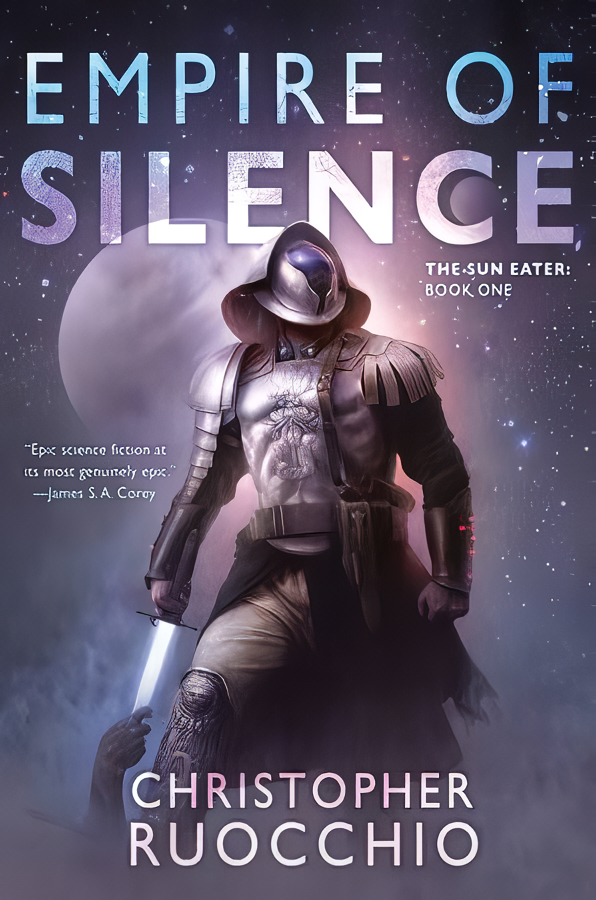
DAW published Empire of Silence on July 3, 2018. It is Christopher Ruocchio's debut novel and the first volume of The Sun Eater. The main sequence continues with Howling Dark and expands Hadrian's memoir across a centuries-long war.
The standard English text contains 78 numbered chapters. The novel combines space opera, feudal science fiction, memoir, planetary romance, and religious dystopia. Its first volume follows Hadrian from Delos through decades of displacement to his departure from Emesh.