The Book in Brief
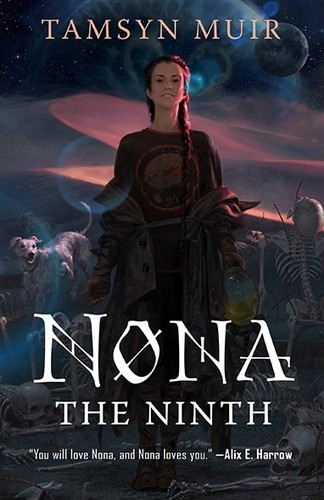
Nona lives in Harrow’s body with Camilla, Palamedes and Pyrrha in a city under Blood of Eden occupation, working at the local school as a teacher's aide and hiding her rapid healing, universal comprehension and unknown identity. Judith’s link to the Resurrection Beast Varun deepens the planetary crisis while John’s interludes reveal how a human necromancer destroyed Earth and became the Emperor. Kiriona Gaia — Gideon’s preserved body — arrives; as the planet collapses, Camilla and Palamedes merge into Paul, and the survivors cross the River to the Ninth House. Nona recognizes herself as Earth’s soul, returns to Alecto’s body so Harrow can reclaim her own — and Alecto wakes, swears service to Harrow, and confronts John.
Important Characters
Nona: A loving, short-lived identity in Harrow’s body whose true soul is Alecto, the Earth.
Camilla Hect and Palamedes Sextus: Cavalier and necromancer sharing Camilla’s body until they become Paul.
Pyrrha Dve: The adult caregiver of Nona’s household and a survivor from the first Lyctor generation.
Kiriona Gaia: Gideon’s preserved, wounded body serving as John’s imperial daughter.
Crown: Coronabeth’s Blood of Eden identity, caught between loyalty, performance, and genuine attachment.
We Suffer: A Blood of Eden commander trying to use the Sixth House crisis strategically.
Alecto: The embodied soul of Earth, whose return resolves Nona’s identity while opening the next conflict.
What to Remember from the Previous Book
Harrow erased Gideon from her memory to keep Gideon’s soul intact. During the Mithraeum disaster, Gideon controlled Harrow’s body, John’s original Lyctors rebelled, and Pyrrha emerged from Gideon the First’s body. Harrow withdrew into a mental Locked Tomb. The epilogue introduced an unnamed young woman living with Camilla’s group.
Day One
Chapter 1
Nona wakes in the apartment she shares with Camilla, Palamedes and Pyrrha and prepares for an ordinary day assisting at the school.
Chapter 2
Her family monitors the unexplained limits of her memory, healing, and ability to understand every spoken language.
Chapter 3
At school, Hot Sauce and the gang give Nona a belonging untouched by imperial or Blood of Eden strategy.
John 20:8
John recalls his life before the Resurrection and the cryogenic project that first put him in conflict with governments and investors.
Chapter 4
Nona’s love of bodies, faces, and dogs reveals perception that is both childlike and impossibly precise.
Chapter 5
Camilla’s physical strain shows the cost of housing Palamedes while the adults conceal how little time remains.
Chapter 6
The household learns that political and planetary conditions are deteriorating faster than their plans.
John 5:20
When the project is shut down, John’s grief and anger coincide with his discovery that he can preserve dead bodies from decay.
Day Two
Chapter 7
Blood of Eden pressures Camilla’s group for cooperation while treating Nona as a possible weapon or hostage.
Chapter 8
Judith’s strange speech connects her to the blue Resurrection Beast Varun hanging over the planet.
John 15:23
John’s closest collaborators stay with him as his new powers attract public attention and political fear.
Chapter 9
Crown moves between intimacy and performance, making it difficult to tell which loyalties are chosen.
Chapter 10
A school crisis exposes how occupation has normalized violence for Nona’s friends.
John 5:18
He experiments with necromancy and turns scientific exclusion into a story in which only his group can save humanity.
Day Three
Chapter 11
Nona attempts to preserve her routine even as the adults prepare for forced movement and possible betrayal.
Chapter 12
Palamedes studies Nona’s identity and concludes that the body, soul, and remembered person do not align normally.
Chapter 13
We Suffer reveals more of Blood of Eden’s plan for the Sixth House and the political value of Nona’s companions.
John 8:1
A viral confrontation and a grotesque wall of flesh transform John from ignored researcher into global threat.
Chapter 14
Varun’s influence intensifies, and Nona responds in a language that suggests recognition older than her life.
Chapter 15
Nona’s friendships become endangered by a conflict she cannot explain without exposing herself.
John 19:18
John discovers the secret faster-than-light evacuation plan and decides that stopping it matters more than preserving institutions.
Day Four
Chapter 16
The household’s negotiations collapse toward open confrontation among Blood of Eden factions and imperial forces.
Chapter 17
Day Four opens with the Angel's encounter with Palamedes spiralling into violence, and Pash and Camilla moving to shield their charges.
John 5:1
He moves toward nuclear coercion while presenting escalation as the only answer left to him.
Chapter 18
In the classroom clean-up afterwards, Aim accuses Palamedes of being a Lyctor.
Chapter 19
Nona realizes that leaving may protect the people she loves while ending the life she understands.
John 3:20
Political failure hardens John’s inner circle into a cult of trust organized around his grievance and power.
Day Five
Chapter 20
Kiriona Gaia appears and is recognizable as Gideon, although John’s preservation has left her body altered and emotionally armored.
Chapter 21
Gideon’s reunion with Camilla, Palamedes, and Pyrrha is tense because affection survives beneath new titles and loyalties.
Chapter 22
The crew finally comes face to face with Ianthe, puppeting Naberius's corpse as "Prince Ianthe Naberius."
Chapter 23
Corona and Ianthe circle each other, and Camilla at last gets to use her weapons.
Chapter 24
The planet’s collapse forces the group to abandon any plan based on negotiation or gradual escape.
John 9:22
The standoff becomes irreversible when John kills those sent against him and absorbs the violence into his justification.
Chapter 25
Camilla and Palamedes decide that neither can continue alone without destroying the other.
Chapter 26
Their fusion creates Paul, a new person formed by consent rather than the consumption model of Lyctorhood.
Chapter 27
The survivors enter the River, where the Tower and pursuing forces make the journey physically and spiritually unstable.
Chapter 28
Nona understands that she is Alecto’s soul and that remaining Nona will prevent Harrow and Alecto from being restored.
John 1:20
John destroys Earth, consumes its soul imperfectly, and remakes his companions after a catastrophe he caused.
Chapter 29
At the Ninth House, devils have infected the dead and living, turning homecoming into another siege.
Chapter 30
Ianthe blockades the Tomb while Paul, Pyrrha, and the others work to complete the soul exchange.
Chapter 31
Nona says goodbye through action rather than explanation and returns to the body made for Earth’s soul.
Chapter 32
Harrow returns to herself as Alecto wakes, ending Nona’s six-month life but preserving what her love changed.
John 5:4
John explains the Resurrection to Harrow, but his confession still evades full responsibility as she turns toward the Tower.
Epilogue
Alecto wakes, recognizes Harrow as the person who opened the Tomb, swears herself to Harrow, and then stabs John in fulfillment of an older bond and command.
Ending Explained
Nona is neither Harrow without memories nor Gideon in the wrong body: she is Alecto, the soul of Earth, living temporarily in Harrow’s flesh and building a genuine six-month identity out of love and ordinary days. Paul is the book’s alternative to John’s Lyctorhood — Camilla and Palamedes consent to become a new person rather than one consuming the other, a real gain paid for with real grief. And Alecto’s awakening restores the central body-soul arrangement while opening the endgame: her oath places Harrow, not the Emperor, at the center of her loyalty, and her first act is to confront John.
Themes and Analysis
Personhood without permanence. Nona matters because she lives and loves, not because she is destined to remain stable.
Chosen family under occupation. Domestic routines provide moral structure when institutions reduce people to assets.
Consent and transformation. Paul’s creation contrasts with the coercion and concealment behind John’s Lyctor system.
Ecological grief. Alecto’s identity makes planetary destruction personal rather than abstract.
Content Notes
This book contains war, occupation and shootings, child endangerment, body horror, identity loss, suicide-related discussion, sacrificial transformation, planetary destruction and mass death.