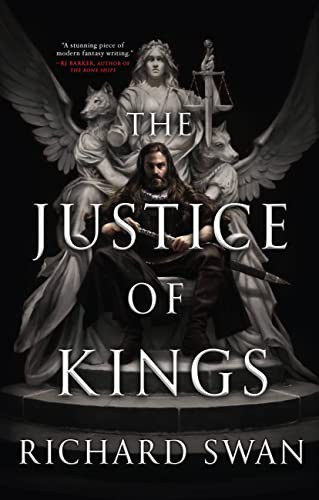
The Book in Brief
Vonvalt, Helena and Bressinger travel from a dispute over heresy in Rill to Galen’s Vale, where Lady Bauer has been murdered. The inquiry reveals religious conflict, local corruption and an organized anti-imperial conspiracy. Assassination attempts and Helena’s impulsive investigation lead to her kidnapping and Matas’s death. Vonvalt secures outside support, conducts a trial and survives armed intervention, but the case proves that legal victory cannot stop the political and religious forces gathering against the Sovan Empire.
Important Characters
Helena Sedanka: Vonvalt’s clerk and retrospective narrator, intelligent, impulsive and still learning the cost of law.
Sir Konrad Vonvalt: Imperial Justice empowered to investigate, judge and execute.
Dubine Bressinger: Vonvalt’s loyal taskman and physical protector.
Patria Claver: zealous priest whose conflict with Vonvalt reflects the struggle between canon and common law.
Matas: Helena’s romantic attachment in Galen’s Vale.
Sir Radomir: ally whose practical loyalty helps the investigation survive political pressure.
Chapter 1
Justice Konrad Vonvalt investigates forbidden Draedist practice in Rill and clashes with zealous Patria Claver over imperial and religious law.
Chapter 2
Vonvalt uses the Emperor’s Voice, showing Helena both the reach and danger of a Justice’s authority.
Chapter 3
The party reaches Galen’s Vale and learns that Lady Natalija Bauer has been murdered in a locked and politically tense town.
Chapter 4
Helena records early testimony while Vonvalt distinguishes rumor, local prejudice and evidence.
Chapter 5
The investigation exposes conflict between Lady Bauer, her husband and the town’s religious and commercial interests.
Chapter 6
Vonvalt’s legal approach threatens officials who expect rank or faith to protect them from scrutiny.
Chapter 7
An attempted nighttime assassination proves that the inquiry reaches beyond an ordinary domestic murder.
Chapter 8
Helena’s attraction to Matas and frustration with Vonvalt create vulnerabilities the conspirators can exploit.
Chapter 9
Evidence connects the Bauer case to monastery figures, local political pressure and growing anti-imperial organization.
Chapter 10
Vonvalt questions witnesses with the Voice but warns that compelled speech does not automatically produce complete truth.
Chapter 11
Claver’s religious certainty hardens into opposition to common law and foreshadows his larger political role.
Chapter 12
The group follows financial and personal links while Galen’s Vale becomes increasingly hostile.
Chapter 13
Helena begins acting independently, eager to prove herself and impatient with Vonvalt’s control.
Chapter 14
A journey toward the kloster places the inquiry inside a space where canon law claims authority.
Chapter 15
The investigators find evidence of organized violence and a conspiracy larger than Lady Bauer’s household.
Chapter 16
Vonvalt speaks with the dead, gaining supernatural testimony whose legal and moral status remains uncertain.
Chapter 17
The resulting revelations implicate powerful local figures but also place Helena and the witnesses in danger.
Chapter 18
Helena’s confidence leads her toward Emilia and a supposed opportunity to help someone trapped inside the conspiracy.
Chapter 19
Matas becomes entangled in Helena’s choices, turning the investigation’s danger into personal consequence.
Chapter 20
Helena enters the kloster despite warning signs and is taken captive.
Chapter 21
Zoran Vogt interrogates and brutalizes Helena, using her as leverage against Vonvalt.
Chapter 22
Matas is killed during the rescue and violence, leaving Helena furious with herself and her mentor.
Chapter 23
Grief nearly removes Helena from the case, but Radomir urges her to help prepare the lawful trial.
Chapter 24
Vonvalt and fellow Justice August assemble testimony while an armed political force approaches Galen’s Vale.
Chapter 25
Vonvalt bargains with Senator Jansen for enough power to hold a trial and resist the margrave’s intervention.
Chapter 26
The accused face judgment as legal procedure competes with immediate military survival.
Chapter 27
Battle reaches the gaol; Bressinger is grievously wounded while protecting Helena and the prisoners.
Chapter 28
Vonvalt’s authority is physically and politically weakened, demonstrating how law depends on institutions willing to enforce it.
Chapter 29
The case reveals a coordinated movement exploiting faith, resentment and corruption against the Empire.
Chapter 30
Judgment is delivered, but the outcome cannot restore Matas or prevent the conspiracy from spreading.
Chapter 31
Older Helena closes the account knowing that Galen’s Vale marked the beginning of the Empire’s collapse and of Vonvalt’s tragic campaign.
Ending Explained
The murderer and local conspirators can be judged, but the novel’s real solution is institutional: Lady Bauer’s death is one expression of a movement joining religious zeal, noble ambition and resentment of imperial rule. Vonvalt’s methods produce a lawful record, yet force and supernatural authority remain embedded in his justice. Helena’s retrospective voice confirms that Galen’s Vale was not an isolated success; it was an early warning of collapse that Vonvalt could identify but not prevent.
Themes and Analysis
Law versus justice. Vonvalt believes in the letter of Sovan law, and the novel keeps testing whether legal correctness and actual justice can survive in the same room.
Common law versus religious authority. The murder inquiry sits on the fault line between the Empire's secular courts and a rising religious movement that answers to a different sovereign.
The limits of compelled truth. Vonvalt's magical ability to force honest answers looks like a shortcut to justice, but the book steadily exposes the coercion buried inside it.
Political collapse seen through a local crime. A single provincial murder turns out to be one symptom of an empire-wide movement joining zeal, ambition and resentment of imperial rule.
Memory, guilt and retrospective narration. Helena tells the story years later, and her hindsight turns every scene into an elegy for institutions she watched fail.
Content Notes
This book contains murder, torture, sexual threat, religious persecution, war violence, death of loved ones and authoritarian coercion.