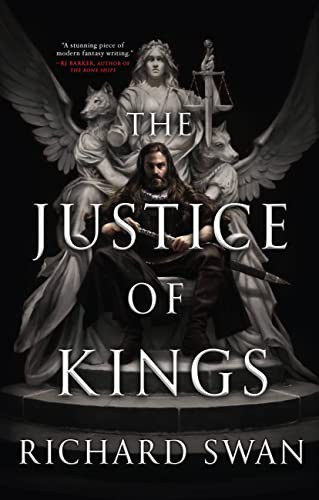
The Book in Brief
Vonvalt, Helena and Bressinger arrive in Sova expecting institutional support and find officials guarding their own positions as religious agitation spreads. The abduction of a politically vital child turns the Justices’ inquiry into a race with national stakes, and the trail leads beyond ordinary conspiracy into Claver’s movement — a fusion of religious power, the afterlife and the empire’s deepest vulnerabilities. Vonvalt leans ever harder on abilities that exact moral and psychological costs, Helena fights to keep evidence distinct from certainty as violence reaches the capital, and the case resolves only inside a larger defeat: Sova fractures, and investigation alone can no longer stop the coming civil war.
Important Characters
Helena Sedanka: The narrator and clerk whose retrospective voice records both her loyalty to Vonvalt and her growing resistance.
Sir Konrad Vonvalt: An Emperor’s Justice whose supernatural authority and anger increasingly threaten his legal principles.
Dubine Bressinger: Vonvalt’s taskman, mortally wounded by a demon during the escape from Keraq — after which Claver puppets his corpse.
Bartholomew Claver: A former priest whose religious movement and supernatural alliances destabilize the empire.
Justice Luitgard Roza: The Justice whose lie to the Emperor about the prince’s death destroys the Magistratum from inside.
The Imperial Family: The dynasty whose vulnerability turns one disappearance into an imperial emergency.
Sova’s officials: Magistrates, soldiers and courtiers who reveal how institutions fail through self-protection.
What to Remember from the Previous Book
The Tyranny of Faith directly follows The Justice of Kings. The new volume assumes the earlier relationships, betrayals and world rules are already familiar. The opening chapters supply context through action, but they do not retell the prior novel in full.
Sova and the Magistratum
Chapters 1–2. Helena introduces the capital’s tension and the political burden following the Justices.
Chapters 3–4. Vonvalt is raised to Master of the Magistratum and Lord Prefect, an authority the court immediately begins undermining.
Chapters 5–6. Claver’s influence appears in rumor, doctrine and the fear of open unrest.
Chapters 7–8. Sparring and the master’s vaults sharpen the sense that the Magistratum’s power rests on paper.
The Abduction Inquiry
Chapters 9–11. The team reconstructs the victim’s last movements and identifies contradictions in the official account.
Chapters 12–13. Witness testimony sends Helena and Bressinger into parts of Sova the court prefers to ignore.
Chapters 14–15. Vonvalt uses supernatural authority to force progress, unsettling Helena with the cost.
Chapters 16–17. A promising lead proves connected to a wider religious network rather than a lone kidnapper.
Faith, Law and the Afterlife
Chapters 18–19. Evidence links the abduction to older religious knowledge and forbidden practices.
Chapters 20–21. Helena compares records and testimony while political pressure narrows the time available.
Chapters 22–23. Vonvalt’s confidence hardens into unilateral judgment as resistance increases.
Chapters 24–25. The investigation crosses from human conspiracy into a supernatural system Claver can exploit.
Chapter 26. A confrontation yields answers but also demonstrates that the capital cannot contain the threat.
South to Keraq
Chapters 27–28. Unrest turns organized, forcing the Justices to investigate while navigating open violence.
Chapters 29–30. Helena recognizes that legal offices are choosing factions instead of preserving common rules.
Chapters 31–32. Vonvalt’s use of power wins an immediate advantage and deepens the danger within him.
Chapters 33–34. The survivors flee the templar fortress of Keraq; the abduction proves to have been a trap, and Prince Kamil turns up alive in Sova.
Ending Explained
Solving the case cannot restore Sova because the abduction was a symptom of a larger seizure of religious and political power — Claver’s movement has learned to exploit genuine belief and institutional weakness at once. Vonvalt ends the book destroyed rather than empowered: he dies at the climax and is restored only because Helena walks into the afterlife to break Claver’s hex, and he emerges framed for judicial murder, his Magistratum disbanded and himself an outlaw. Her retrospective narration confirms what the trilogy is: her account of imperial collapse, with the final volume left to fight over what should replace the empire’s failed law.
Themes and Analysis
Law and Legitimacy. A legal office cannot command trust once the state selectively obeys its own rules.
Faith as Power. Belief can console, organize or authorize violence depending on who controls its interpretation.
The Corruption of Certainty. Vonvalt’s confidence becomes dangerous when he treats moral conviction as sufficient evidence.
Witness and Memory. Older Helena’s narration asks what a truthful record owes to people she loved.
Institutional Collapse. The empire fails through accumulated self-interest before it falls through battle.
Content Notes
This book contains violence, torture and execution, child abduction, religious coercion, body horror, supernatural terror, grief and abuse of authority.