Fantasy likes a throne room, but it usually hurries through the offices behind it. Decrees appear, armies receive supplies, taxes are somehow collected, and treaties arrive ready to sign. The clerk who made three copies has been edited out of the legend.
The books on this list put that missing work back into the story. Their protagonists are caseworkers, secretaries, accountants, investigators, judges, postmasters, and officials inside institutions too large for any one person to control. Some are comic and comforting. Others show administration as the most efficient weapon an empire possesses. What unites them is the understanding that government is not merely a king making speeches. It is a system of forms, incentives, precedents, appointments, and people deciding whether to obey the rule in front of them.
This is not simply a list of political fantasy. Court intrigue qualifies only when the actual labor of governing matters. The ranking considers how central the job is, how convincingly the institution operates, and whether the bureaucracy does more than provide jokes about paperwork.
10

A Marvellous Light
Freya Marske
Job Parliamentary liaison to a hidden magical government
Setting Edwardian England with a secret magical establishment
Best for Readers who want queer historical romance, magical archives, and a conspiracy hidden inside an apparently dull posting.
Know before you start This is the first volume of a completed trilogy, and later books shift to different central couples.
Robin Blyth receives a minor civil-service appointment because someone wants him out of the way. The position sounds harmless. In practice, he becomes the nonmagical liaison to a magical society whose existence the rest of Britain is not supposed to notice. His predecessor has vanished, his new counterpart Edwin Courcey dislikes him, and a curse makes resigning difficult in the most literal sense.
The administrative error is not just a meet-cute. Freya Marske builds the romance around two different forms of institutional vulnerability. Robin has the social confidence expected of his class but no knowledge of magic. Edwin understands the rules and records but lacks power within his own family. Solving the conspiracy requires access, filing, research, and learning which respectable officials have treated public office as private property.
The magical service remains more sketched than fully mapped, and readers seeking the density of an actual Whitehall procedural will find the romance dominant. The book earns its place because it understands how an obscure appointment can make an unimportant person suddenly dangerous. Sometimes the person who inherits the wrong desk also inherits the evidence.
9
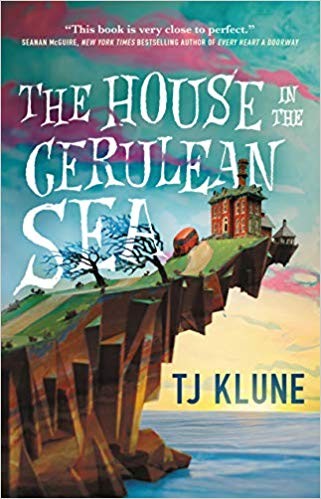
The House in the Cerulean Sea
T. J. Klune
Job Caseworker for the Department in Charge of Magical Youth
Setting A gray administrative state supervising magical orphanages
Best for Readers who prefer found family and moral warmth to cynical government intrigue.
Know before you start The book is emphatically sentimental, and its institutional critique is less complex than its character relationships.
Linus Baker evaluates institutions that house magical children. He follows the manual, observes the residents, and submits reports to managers who know him primarily as an employee number. When Extremely Upper Management sends him to inspect an island orphanage containing six supposedly dangerous children, his professional caution collides with the fact that a tidy file can conceal an ugly policy.
The novel's bureaucracy is deliberately broad. Its departments have satirical names, its supervisors are caricatures, and its social reform arrives through personal affection more readily than legislative struggle. That simplicity will frustrate readers who want a rigorous account of how discriminatory systems reproduce themselves. The treatment is closer to fable than administrative realism.
Yet Linus is an unusually good bureaucratic protagonist because his decency initially expresses itself through compliance. He does not begin as a rebel. He begins as someone who believes careful inspection can protect children, then discovers that neutral procedure is serving a prejudiced institution. His transformation asks a useful question: when does following the manual stop being conscientious work and become an excuse not to see the people in front of you?
8
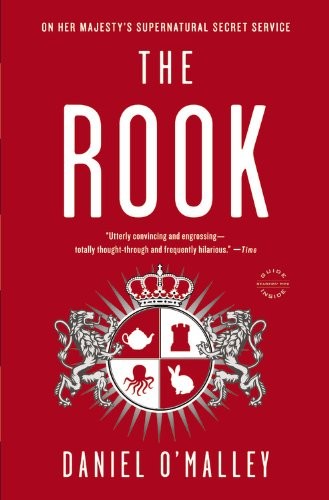
The Rook
Daniel O'Malley
Job Senior administrator in Britain's supernatural security service
Setting Modern London, inside the clandestine Checquy
Best for Readers who want office politics, body horror, secret agencies, and a heroine whose managerial skill matters.
Know before you start The tone swings from gruesome to gleefully absurd, and exposition arrives in substantial files and letters.
A woman wakes in a park surrounded by bodies wearing latex gloves. Letters in her pocket explain that she occupies the body of Myfanwy Thomas, a high-ranking official in a secret government organization, but she no longer has Myfanwy's memories. She can flee or report to work and discover which colleague arranged to erase her.
The clever part is that Myfanwy's greatest asset is not her supernatural ability. It is the previous Myfanwy's administrative preparation. She left binders, personnel assessments, contingency plans, and enough institutional knowledge for her successor to perform competence while investigating treason. The Checquy fights flesh cubes and biological invaders, but it also has budgets, diplomatic problems, internal ranks, and employees whose extraordinary powers do not make them good managers.
Daniel O'Malley sometimes interrupts the present-day thriller with long briefing documents, and his exuberance produces a book larger and baggier than its central mystery requires. Those digressions are also the point. The Rook treats institutional memory as a kind of magic. Amnesia removes identity, but organized records allow a capable stranger to keep the state running.
7

The Atrocity Archives
Charles Stross
Job Information-technology worker drafted into occult field operations
Setting The Laundry, a British agency containing computational demonology
Best for Readers who want Lovecraftian horror filtered through workplace satire and old-school technology culture.
Know before you start The volume combines linked narratives, and the larger series changes considerably in scale and viewpoint.
Bob Howard did not join the civil service to save reality. He experimented with the wrong mathematics and attracted the attention of the Laundry, which prevents occult computation from summoning things humanity cannot survive. His reward is compulsory employment in an office where expense claims, obsolete hardware, bad managers, and cosmic threats occupy the same working day.
Charles Stross makes bureaucracy both joke and containment system. The forms are ridiculous until readers realize that a misplaced laptop may contain an executable route to another dimension. Security classifications hide genuine horrors; procurement failures can become apocalyptic. Bob's irritation is therefore justified and shortsighted at once. He works for an infuriating institution that may be the only thing between ordinary life and extinction.
The early book carries the technical references and gender attitudes of its era, and its parody of espionage fiction can make character feel secondary to concept. Readers indifferent to computing history may not enjoy every riff. At its best, however, the novel understands that secret knowledge creates administrative problems immediately. Once magic can be reproduced, someone has to audit it, restrict it, and explain why the field team cannot claim a forbidden artifact as a travel expense.
6
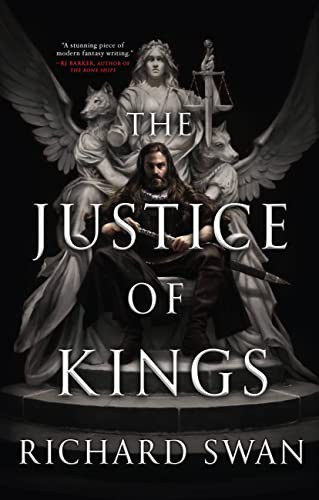
The Justice of Kings
Richard Swan
Job Clerk to an itinerant imperial investigator, judge, and executioner
Setting The Sovan Empire near the end of its legal order
Best for Readers who want a dark legal procedural that expands into the fall of an empire.
Know before you start This begins a completed trilogy, and the series grows more military after its courtroom-and-investigation opening.
Helena Sedanka narrates her years serving Sir Konrad Vonvalt, one of the Emperor's Justices. Vonvalt travels from province to province investigating crimes, interpreting imperial law, issuing judgments, and enforcing them. He carries supernatural tools, including a voice that compels truth, but the real source of his authority is a state whose legitimacy has begun to crack.
This is bureaucracy at the sharp end. A Justice compresses detective, prosecutor, judge, and executioner into one office, a concentration of power that makes swift resolution possible and due process questionable. Helena's clerical position lets her admire Vonvalt's principles while observing the compromises hidden inside them. A murdered noblewoman becomes evidence that local resentment, religious conflict, and elite ambition are stronger than the legal system sent to contain them.
The investigation gradually yields to the trilogy's larger political crisis, and Vonvalt's competence can initially make supporting characters feel like attendants to his legend. Helena's retrospective narration corrects some of that imbalance by emphasizing what the legend cost. The novel belongs here because law is not decorative worldbuilding. It is the mechanism by which the empire claims to be civilized.
We reviewed this: read our full review of The Justice of Kings →
5

The Traitor Baru Cormorant
Seth Dickinson
Job Imperial accountant assigned to a rebellious province
Setting A colonial empire that rules through finance, education, and social policy
Best for Readers who want economic warfare, colonial administration, and tragedy driven by institutional incentives.
Know before you start This is not a triumphant story about a clever accountant outsmarting foolish rulers. Its betrayals are the substance of the novel.
The Masquerade conquers Baru Cormorant's island and promises that talented children can rise within its system. Baru takes the civil-service examinations, becomes Imperial Accountant of Aurdwynn, and plans to acquire enough power to destroy the empire from inside. Her assigned weapon is not a sword. It is monetary policy.
Few fantasy novels make administrative violence this concrete. Baru manipulates currency, credit, taxation, and trade while the Masquerade classifies cultures, criminalizes identities, and converts education into assimilation. Rebellion depends on noble armies, but it also depends on whether harvests can be financed. The book's most frightening officials are persuasive because they can describe coercion as public health, stability, or modernization.
Seth Dickinson demands emotional endurance. The novel contains colonial abuse, homophobia, eugenic thinking, and decisions designed to leave scars rather than provide catharsis. Some readers also find the provincial dukes difficult to distinguish on first reading. The severity is purposeful: Baru believes mastery of the system will protect her from becoming its instrument, and the book tests that belief without mercy.
4

The Tainted Cup
Robert Jackson Bennett
Job Assistant investigator in an imperial civil service
Setting A biologically altered empire defending itself from giant leviathans
Best for Readers who want a fair-play fantasy mystery inside a strange but legible administrative machine.
Know before you start The grotesque murder method appears early, but the book is more procedural than horror novel.
Dinios Kol has been modified to remember scenes perfectly. He serves as the eyes and ears of Ana Dolabra, an eccentric investigator who prefers to remain blindfolded at home while Din inspects a body from which a tree has violently grown. The murder leads into engineering departments, patronage networks, contagion control, and the immense bureaucracy maintaining sea walls against monsters.
The Holmes-and-Watson pleasures are immediate, but the institutional design gives the mystery weight. Every biological augmentation corresponds to a job. Investigators have jurisdiction, engineers have inspection regimes, and officials compete for patronage while knowing a failed wall could erase a district. Corruption is dangerous not because all officials are villains but because safety depends on many specialized people performing unglamorous tasks correctly.
The world occasionally feels built to delight the puzzle more than to sustain ordinary life, and readers wanting the emotional breadth of Bennett's earlier epics may find the focus narrow. As a bureaucratic fantasy, that narrowness is an advantage. Din's career anxiety, examination fraud, reporting duties, and fear of reassignment remain important even while titanic creatures batter the coast.
We reviewed this: read our full review of The Tainted Cup →
3
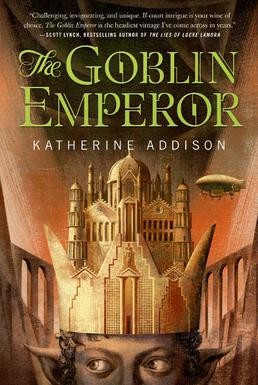
The Goblin Emperor
Katherine Addison
Job Reluctant emperor learning the machinery of court government
Setting An elven empire of rigid etiquette, ministries, and inherited power
Best for Readers who want a fundamentally decent protagonist navigating procedure, prejudice, and court etiquette.
Know before you start The tension is social and administrative more often than martial, and the glossary will be useful.
Maia has lived in exile because his elven father barely acknowledges his goblin mother or their son. An airship disaster kills the emperor and the heirs ahead of Maia, placing an untrained, mixed-race eighteen-year-old on the throne. His first challenge is not conquering an enemy. It is learning which official handles which petition without allowing courtiers to govern through his ignorance.
The novel pays unusual attention to appointments, audiences, titles, marriage negotiations, bridge proposals, household offices, and the difference between possessing authority and knowing how to use it. Maia's kindness matters because institutions translate private temperament into public consequence. Remembering a servant's name or hearing a worker's petition cannot repair the empire alone, but it changes who receives access.
Readers expecting a propulsive plot may find the succession mystery and assassination threats surprisingly quiet. The dense names and honorifics are an intentional barrier, mirroring Maia's disorientation, but intention does not make them effortless. The reward is a fantasy in which learning to chair a meeting honestly can be an act of courage.
2

Going Postal
Terry Pratchett
Job Postmaster General of a collapsed public service
Setting Ankh-Morpork, where the post competes with a private communications monopoly
Best for Readers who want comic fantasy about organizational culture, privatization, and the rehabilitation of a scoundrel.
Know before you start It stands alone comfortably despite taking place deep within the Discworld sequence.
Con man Moist von Lipwig receives a choice from Lord Vetinari: run the dead Ankh-Morpork Post Office or experience the alternative to public employment. The building is clogged with undelivered letters, its remaining staff have adapted to failure, and the commercial clacks network has made physical post seem obsolete. Moist responds as he always has—by inventing a story people want to believe.
Pratchett's comedy understands organizational reform better than many serious novels. Moist cannot restore the service by issuing a noble mission statement. He has to win over employees, make stamps desirable, create visible momentum, and persuade the public that delivery is possible. The institution changes when its workers can imagine competence again. Meanwhile, the clacks company shows how monopoly finance extracts value from a brilliant technology while exhausting the people who operate it.
The plot gives Moist convenient theatrical victories, and his charm sometimes evades a fuller reckoning with the victims of his fraud. That slipperiness is part of his fitness for the job. Public service needs rules, but revival also needs someone who can sell reliability as an adventure.
1

The Hands of the Emperor
Victoria Goddard
Job Personal secretary to the emperor and head of the civil service
Setting A post-cataclysmic world government constrained by sacred protocol
Best for Readers who want a long, warm, intensely character-focused novel about reform, vocation, friendship, and cultural homecoming.
Know before you start This is nearly a thousand pages of conversation, ceremony, policy, and accumulated feeling; its slowness is structural, not accidental.
Cliopher Mdang has spent decades beside the Last Emperor of Astandalas, transforming disaster relief, pensions, and government while remaining unable to address his ruler as an ordinary friend. Then he does something almost unthinkable: he invites the emperor on holiday. That breach of protocol opens a vast novel about work, family, cultural identity, and the loneliness created by office.
No other book on the list takes civil service so seriously as a life. Cliopher's reforms are not background achievements awarded before the plot begins. They shape how his relatives misunderstand him, how colleagues depend on him, and how an empire slowly becomes less cruel. Victoria Goddard gives policy an emotional dimension. Universal income matters as administration, but it also represents decades during which Cliopher learned to express care through systems because ceremony prevented ordinary intimacy.
The length is formidable, the pace is leisurely, and important conversations recur from several emotional angles. Readers who require external conflict will wonder why a holiday and a retirement plan need an epic. The answer is that the book treats a career of competent, uncelebrated service as epic material. Its greatest fantasy is not the god-emperor. It is the possibility that patient administration can improve millions of lives without erasing the person doing it.
Which Office Should You Report To?
Choose The Hands of the Emperor if you want bureaucracy treated with affection and on an epic scale. Choose Going Postal when you want the same interest in institutions compressed into sharp comedy. The Goblin Emperor offers the gentlest court government, while The Tainted Cup supplies the cleanest procedural mystery.
For darker systems, begin with The Traitor Baru Cormorant. It shows administration as conquest without pretending that intelligence provides moral immunity. The Justice of Kings is the choice for law, legitimacy, and imperial decline. Readers who prefer contemporary offices can move between the romantic files of A Marvellous Light, the humane casework of The House in the Cerulean Sea, and the weaponized organizational charts of The Rook and The Atrocity Archives.
The best bureaucratic fantasy does not argue that forms are secretly thrilling. It argues that forms have consequences. A pension arrives or does not. A child remains classified as dangerous. A province loses access to credit. A wall inspection is falsified. The apparent dullness of administration makes it powerful because decisions become routine before they become visible.
The Hands of the Emperor ranks first because it sees both sides of that power. Cliopher changes the world through policy, but the same office that enables him also isolates him from family, culture, and friendship. Government is neither an abstract villain nor a machine awaiting the right genius. It is work performed by people, and people eventually need more than usefulness.