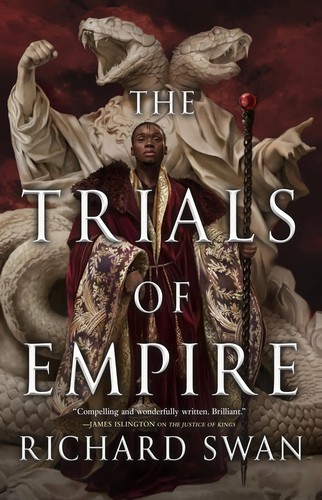
The Trials of Empire is less a courtroom novel than a test of whether law means anything after the court disappears. Richard Swan completes the trilogy by dropping Helena and Vonvalt into the civil war their investigations predicted, with Bressinger already lost and grieved.
Helena’s task is no longer to record Vonvalt’s judgments — it is to decide which parts of his example deserve survival.
Helena fully becomes the center. Helena’s task is no longer to record Vonvalt’s judgments — it is to decide which parts of his example deserve survival, and the older narrator’s sorrow gives the action the shape of testimony.
Vonvalt’s decline hurts because the series made his principles persuasive. His reach for extraordinary power grows from a recognizable fear — that procedure cannot answer apocalypse — and the novel treats that fear as neither absurd nor sufficient. Claver works as the final antagonist because he welds institutional ambition to supernatural certainty; beating him means breaking the whole system of faith, fear and opportunity that raised him.
The campaign structure can feel episodic — travel, alliance-building and battles displace the first book’s forensic precision, and a few factions get functional rather than felt endings.
But the conclusion is coherent and emotionally exact. It closes the war while letting Helena’s written record become the trilogy’s last act of justice: naming what happened after official authority has lost the right to define it.