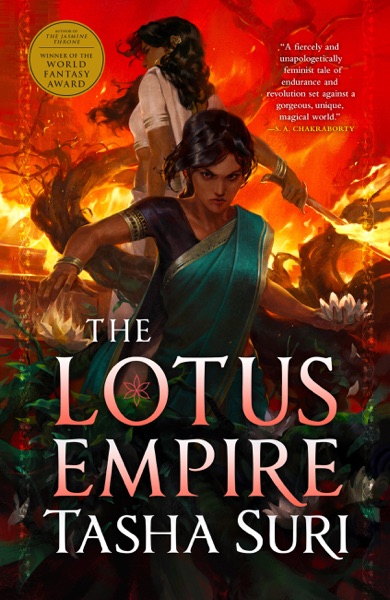
The Lotus Empire ends the trilogy as a negotiation rather than a rematch. Malini holds the throne and a priesthood that still expects her to burn; Priya returns to an Ahiranya being remade by yaksa whose protection would erase human choice. Empire and divinity turn out to be competing forms of possession.
Suri keeps the romance’s intensity without ever pretending that reunion cancels a knife.
Malini and Priya spend most of the book opposed, and the finale’s intelligence is in admitting that neither can face the yaksa and their mother Mani Ara alone. Suri keeps the romance’s intensity without ever pretending that reunion cancels a knife.
Bhumika, living without most of her memory, gets the trilogy’s quietest and best thread — a study of what a person still is when the history is gone — and Rao’s grief for Aditya gives the prophecy plot a human floor.
The ensemble makes the opening slower than the last third, and a few late alliances resolve faster than their setup deserved.
The conclusion satisfies because peace requires institutional and personal surrender from nearly everyone who wanted total victory. Priya’s long transformation cleanses the rot; Malini gives up the version of empire built on endless conquest; and the epilogue’s new river — water once locked inside the Hirana, now running free through the land — is the most hopeful image the trilogy has allowed itself.