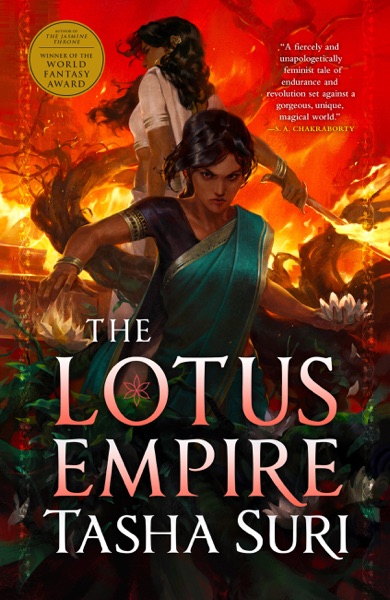
The Book in Brief
Malini rules Parijatdvipa after surviving Priya’s knife, with a priesthood demanding a sacred burning to confirm her reign. Priya returns to Ahiranya as the yaksa prepare the return of Mani Ara — a transformation that would protect the land by ending human freedom. Rao mourns Aditya and looks for a future outside prophecy; Bhumika lives without most of her memory; the rot and the divine conflict spread past every national border. As the older powers reveal empire and yaksa dominion to be rival forms of possession, Malini and Priya reunite both strategically and emotionally to resist Mani Ara and the yaksa — and the final sacrifices separate sacred power from compulsory rule.
Important Characters
Malini: The new empress, trying to keep a throne whose religious foundation demands her death.
Priya: Ahiranya’s powerful elder and the intended instrument of the yaksa’s new age.
Bhumika: A former elder living after the sacrifice of her memories and rebuilding family life.
Rao: A prince of Alor, grieving Aditya and resentful of the god whose prophecy took him.
Sanvi: One of Malini’s own guards, and secretly a zealot who believes the empress must burn.
Arahli Ara: A yaksa whose return complicates the belief that ancient divinity will naturally serve human liberation.
Mani Ara / the mothers of flame: The greater sacred powers threatening to replace mortal empire with divine domination.
What to Remember from the Previous Book
Malini won the war after Aditya voluntarily burned and gave her claim sacred legitimacy. Bhumika traded her memories to a yaksa for the knowledge that could destroy them. Priya, already thrice-born and claimed by the yaksa through those waters, stabbed Malini and fled home to Ahiranya. Malini became empress, but neither the rot nor the conflict between empire and Ahiranya was resolved.
After the Knife
Priya kneels at the foot of the Hirana before the yaksa wearing her brother’s face.
Priya returns to Ahiranya and finds the yaksa treating her as a chosen instrument rather than an equal elder.
Rao mourns Aditya in a court eager to convert grief into a stable official story.
Bhumika builds a family life around absences she can recognize but no longer remember.
The priesthood demands a burning that would complete Malini’s sacred claim and end her life.
Malini searches for a substitute sacrifice without admitting how closely that strategy resembles Chandra’s rule.
Priya learns that Mani Ara’s promised protection would transform Ahiranya beyond human consent.
The rot appears outside its old boundaries, making isolation an impossible national strategy.
Sanvi navigates imperial factions that accepted Malini as a victor but not as an uncontested woman ruler.
Arahli Ara offers knowledge while withholding the part of the yaksa plan that concerns Priya’s body.
Malini dreams of Priya with equal measures of longing, anger, and political calculation.
Rao follows a new thread of prophecy reluctantly, fearing another future purchased with a loved life.
Bhumika reacts to Priya as both sister and stranger when fragments of emotion survive missing memory.
Priya resists yaksa commands and learns the limits of the power she brought back from the waters.
Malini suppresses one court challenge and strengthens the religious demand she hoped to avoid.
News of sacred violence forces empire and Ahiranya to consider communication despite the recent betrayal.
Both rulers prepare envoys while privately assuming the other will use negotiation as delay.
The opening closes with mortal politics already being overtaken by a divine timetable.
The Age of Flowers
The yaksa accelerate Mani Ara’s return and present human loss as restoration of the natural order.
Priya argues that liberation cannot mean exchanging Parijatdvipan rule for divine possession.
Malini sends agents toward Ahiranya while consolidating an empire vulnerable to priestly revolt.
Rao and Sanvi pursue separate clues about the nameless god and the fire demanded by the court.
Bhumika’s remaining instincts reveal information her conscious memory cannot provide.
An imperial delegation meets Ahiranyan leaders under conditions shaped by the knife between Priya and Malini.
Priya and Malini reunite first as adversaries and discover that anger has not ended desire.
The spread of rot proves that neither state can protect itself alone.
Arahli Ara explains enough of the yaksa history to show that their mother’s return will not preserve human choice.
Malini offers cooperation while still framing Parijatdvipa as the power entitled to coordinate it.
Priya refuses subordination but accepts a temporary alliance against the larger threat.
Rao identifies a ritual path that requires sacrifice without guaranteeing who will survive it.
The priesthood moves against Malini during her attention to Ahiranya.
Sanvi holds a political line in the capital and proves that the empire is more than its absent ruler.
Priya’s sacred power changes again as Mani Ara draws nearer.
Bhumika chooses to help despite being unable to recover the former self others expect.
The alliance gathers human and yaksa dissidents around a plan none of them fully trust.
The flowering age begins to break into the ordinary world before the plan is ready.
Gods and Empresses
Mani Ara’s return reshapes land and bodies, making the conflict impossible to contain as a battle.
Priya is pulled toward the role designed for her and fights to preserve a private will inside sacred power.
Malini confronts priests who prefer a dead symbol to a living empress capable of changing doctrine.
Rao uses prophecy as one source of evidence rather than a command, breaking with his earlier obedience.
Bhumika protects civilians through instincts formed before her memory sacrifice.
Sanvi secures the capital against a challenge that would undo Malini’s war victory from within.
Priya and Malini admit that each tried to save a nation by deciding what the other could survive.
Their reconciliation begins as shared accountability rather than immediate forgiveness.
The nameless gods emerge as another power willing to consume worshippers in exchange for order.
The cost of the total return to Ahiranya becomes undeniable to those closest to the yaksa.
Malini gives up a strategic advantage to prevent the sacred conflict from using civilians as fuel.
Priya enters the heart of the rot knowing that return may take years or may never occur.
Rao’s group severs one connection between sacrifice and imperial legitimacy.
The Mother of Flame is opposed through cooperation among people she expected to divide by fear.
Bhumika builds a life around her daughter without waiting for her memories to come back.
Malini refuses the pyre and survives the priesthood’s last attempt to make death the proof of rule.
The allied ritual turns divine power away from compulsory domination.
Victory leaves Priya transformed and absent, while Malini must rule without claiming the loss as possession.
Lives After Empire
The sacred crisis recedes unevenly, leaving damaged land and political structures that still require repair.
Malini begins limiting the imperial practices that made every neighboring kingdom a possession.
Rao chooses work beyond serving a single prophesied ruler.
Sanvi helps turn wartime improvisation into institutions that can outlast personal loyalty.
Ahiranya rebuilds without assuming the yaksa will always share human priorities.
Bhumika raises Padma and accepts affection that does not depend on what she cannot remember.
Arahli Ara leads the surviving yaksa down the mountain to meet their end together.
Malini mourns Priya without using mourning as a reason to reverse the choices they made together.
The rot withdraws slowly as Priya’s long transformation continues beyond public knowledge.
Former enemies reconsider the borders and tribute systems that fed the old empire.
Rao hears of survivors whose futures escaped the prophecy that organized his earlier life.
Malini gives up conquest as the measure of strength, making the throne less absolute and more survivable.
After years of rule, Malini travels to Srunga and follows a pull toward a waterfall.
Malini wades in, and Priya walks up behind her, apologising for how long it took to remember her human shape.
They promise to garland each other and stay together until the green is gone.
The romance closes through chosen life rather than imperial absorption or sacred destiny.
Epilogue
Bhumika’s daughter Padma brings word of a new river and a woman who walked out of it asking for her mother; Priya tells her sister the rot is cleansed, that she has Malini now and Bhumika has her family.
Ending Explained
Priya and Malini survive together only once each gives up the wish to have love validate her political system: reunion becomes possible when neither empire nor sacred destiny gets to define the other woman’s purpose. Bhumika’s arc closes with Arahli Ara returning the memories he took, after she persuades the yaksa that they were never meant to remain — a restoration she had already proved she could live without. The new river makes the trilogy’s ecological politics hopeful instead of merely apocalyptic: water once confined inside the Hirana now moves freely through a land rebuilding its relationship with the sacred.
Themes and Analysis
Freedom from saviors. Both benevolent empire and divine protection become dangerous when the protected have no meaningful consent.
Love after betrayal. Reconciliation requires acknowledging political harm rather than treating desire as an exemption from it.
Memory and continuing selfhood. Bhumika builds a whole life without her memories, so their eventual return is a gift rather than the repair of a deficient person.
Ecological repair. The new river and retreating rot imagine healing as renewed movement rather than return to a pristine past.
Content Notes
This book contains war, execution threats and religious coercion, body horror involving rot, flowers and divine transformation, grief, memory loss and family separation, colonial violence and political betrayal.