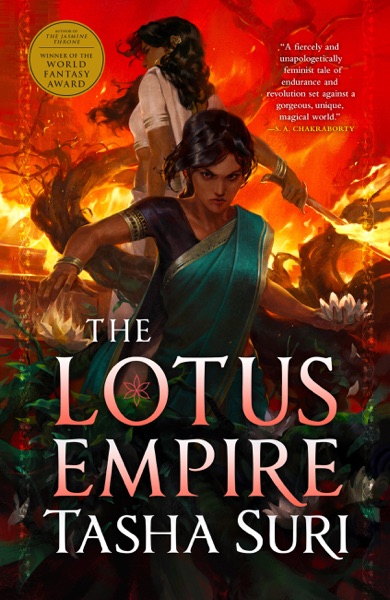
The Book in Brief
Malini leads the rebellion against Chandra and courts Parijatdvipa’s regional rulers, while Priya serves as an Ahiranyan elder beside Bhumika, bringing sacred power to a campaign she does not fully trust. The war exposes famine, religious coercion and the fragility of Malini’s coalition, with Prince Aditya pushed forward by Malini’s generals as the safer claimant. Priya and Malini resume their relationship without resolving anything between empire and Ahiranya. As the yaksa and the rot return in force, Bhumika trades her memories to Ashok for the knowledge that could destroy the yaksa, and Aditya burns willingly to win the Maze Fort — after which Priya, cornered by Mani Ara’s demand that she take back the heart, stabs Malini while deliberately missing it and flees for the Ahiranyan border.
Important Characters
Malini: A rebel princess becoming an emperor through choices that repeatedly subordinate intimacy to rule.
Priya: An Ahiranyan elder whose sacred power and love for Malini pull in opposite political directions.
Bhumika: Ahiranya’s elder and Priya’s sister, protecting her people through a devastating magical sacrifice.
Aditya: Malini’s brother, whose voluntary death in the Mother’s flame wins the Maze Fort at the cost of his life.
Rao: A prophet and strategist carrying knowledge of the price Malini’s rise will demand.
Chandra: The emperor whose cruelty and religious authority continue to shape the rebellion against him.
Kartik: A palace servant in Harsinghar whose overheard glimpse of Chandra and the high priest Hemanth opens the book.
What to Remember from the Previous Book
Priya helped free Malini from the Hirana, while Bhumika’s hidden resistance and Ashok’s uprising broke the regent’s rule. Ashok died; Bhumika became elder of Ahiranya. Malini left to challenge Chandra for the throne, and Priya stayed to protect Ahiranya and contain the rot.
Prologue
Sweeping a courtyard, Kartik overhears Chandra and the high priest Hemanth, establishing the price the Mothers’ faith demands of Malini.
The Rebel Empress
Chapter 1
Malini courts a regional ruler whose support depends on proof that her rebellion can outlast a first defeat.
Chapter 2
Priya governs beside Bhumika and discovers that sacred authority does not make food or policy simple.
Chapter 3
Chandra’s forces use religion and terror to label Malini’s supporters enemies of divine order.
Chapter 4
Rao’s visions provide direction without revealing which loved person will pay for the promised crown.
Chapter 5
Aditya rejoins the political field as both beloved brother and possible rival claimant.
Chapter 6
Ahiranyan fighters enter Malini’s coalition while insisting their service is an alliance, not renewed submission.
Chapter 7
Priya travels toward the war with power that is growing less controllable.
Chapter 8
Bhumika studies signs that the yaksa are returning in a form the temple stories did not prepare them to face.
Chapter 9
Malini wins a negotiation by offering future authority she may not be able to share after victory.
Chapter 10
The rebel army suffers a supply crisis that turns political hesitation into immediate hunger.
Chapter 11
Priya and Malini reunite with desire intact and trust weakened by the roles they now hold.
Chapter 12
A battlefield use of sacred power saves Malini’s forces while alarming allies who prefer controllable miracles.
Chapter 13
Aditya recognizes that his existence can unite people who will never accept Malini without ritual proof.
Chapter 14
Rao conceals part of his knowledge because truth could break the coalition before it reaches Chandra.
Chapter 15
Bhumika warns Priya that loving Malini cannot become permission to decide for Ahiranya alone.
Chapter 16
The coalition advances with every major relationship carrying a private condition.
War and Sacred Return
Chapter 17
Chandra’s army forces Malini into a battle before all promised allies have arrived.
Chapter 18
Priya uses the deathless power on a scale that increases both devotion and fear around her.
Chapter 19
Malini turns a military setback into evidence that neutral rulers must finally choose a side.
Chapter 20
Bhumika confronts a manifestation of the yaksa and realizes the rot is part of a larger return.
Chapter 21
Aditya wins soldiers’ loyalty through kindness that contrasts with Malini’s calculated distance.
Chapter 22
Rao’s attempts to protect Aditya cannot remove the role prophecy assigns him.
Chapter 23
Priya asks Malini what independence will mean after victory and receives affection instead of a binding answer.
Chapter 24
The imperial priesthood offers conditional legitimacy at the price of a body on the pyre.
Chapter 25
Malini refuses the pyre for now while continuing to pursue the authority the ritual grants.
Chapter 26
Ahiranyan commanders resist orders that would spend their forces to protect Parijatdvipan nobles.
Chapter 27
Priya and Malini briefly create a private future neither woman’s public commitments can sustain.
Chapter 28
The rot spreads through land and people, making the war’s human timetable irrelevant to sacred change.
Chapter 29
Bhumika slips away with Jeevan to meet Ashok, now carrying a yaksa, in a tree grove.
Chapter 30
Chandra’s position weakens as former loyalists begin treating Malini’s victory as inevitable.
Chapter 31
Aditya understands that inevitability will remain fragile while he is a competing symbol.
Chapter 32
The campaign reaches the threshold where military victory requires religious transformation.
The Price of the Throne
Chapter 33
Ashok offers Bhumika the yaksa’s knowledge — including how to destroy them — at the price of her memories, and she accepts.
Chapter 34
The campaign asks more of Priya’s gifts than she wants to give, and every draw on the deathless waters pulls her a little further from the person Ahiranya knew.
Chapter 35
Bhumika holds Ahiranya together in Priya’s absence — rot, unrest, and the temple children all pressing on a stewardship whose final cost has not yet been named.
Chapter 36
Malini receives news of Ahiranya’s crisis while remaining focused on the decisive imperial campaign.
Chapter 37
Priya interprets that priority as proof that Malini will always spend Ahiranya for the throne.
Chapter 38
Rao confronts the difference between foreseeing sacrifice and consenting to the person who must make it.
Chapter 39
Aditya offers himself as the willing fire that will deny the priesthood an excuse to reject Malini.
Chapter 40
Malini’s generals press for Aditya to reclaim the throne, treating a male heir as the safer banner.
Chapter 41
Rao and Aditya slip into the Maze Fort and trip an alarm in a room lit by the Mother’s flame.
Chapter 42
Priya asks Malini to choose a future outside the imperial structure and learns that she will not.
Chapter 43
Aditya puts his hand in the flame; because he is of royal blood it turns on the High Prince’s men, and the fort falls.
Chapter 44
Rao loses the person he loved and the future in which prophecy might have been avoided.
Chapter 45
Malini’s claim becomes unassailable at the moment her remaining family is reduced to sacrifice.
Chapter 46
Chandra’s regime collapses under military defeat and the withdrawal of sacred approval.
Chapter 47
Priya prepares to protect Ahiranya from the victorious woman she still loves.
Chapter 48
The coalition enters the capital as a triumph whose deepest costs cannot be spoken publicly.
Knife and Water
Chapter 49
Malini begins converting rebel command into imperial authority before the war’s allies can renegotiate their place.
Chapter 50
Priya sees that Ahiranya’s promised freedom is becoming another matter to be settled later.
Chapter 51
Rao’s grief leaves him unwilling to support a court narrative that makes Aditya’s death uncomplicated.
Chapter 52
Bhumika’s lost memories remove one of the few leaders capable of balancing Priya’s anger and Malini’s power.
Chapter 53
The lovers meet with neither able to separate personal longing from national responsibility.
Chapter 54
Malini insists that a stable empire can protect Ahiranya better than fragmented war.
Chapter 55
Priya understands stability as the language every conqueror uses after winning.
Chapter 56
A final confrontation forces them to admit that love has not produced a shared political future.
Chapter 57
Priya stabs Malini under the yaksa’s coercion, placing the blade to spare her heart.
Chapter 58
Malini survives and interprets the wound as both betrayal and confirmation that Priya remains beyond control.
Chapter 59
Priya flees for Ahiranya rather than attempt to reclaim authority through ordinary politics.
Chapter 60
The yaksa’s claim tightens on the power already moving through her.
Chapter 61
Malini takes the throne on a promise of her own future burning, facing the sacred crisis her victory did not solve.
Chapter 62
Priya reaches the border alive and changed, carrying the coming conflict between yaksa, empire, and Ahiranya into the finale.
Epilogue
Ashok — now a hollow vessel for a yaksa — greets Priya at the border and welcomes her home, love and national duty now openly opposed.
Ending Explained
Aditya’s death buys a battle, not a throne: he burns in the Maze Fort with only Rao to witness it, and the crown comes instead from Malini’s promise to climb the pyre herself one day — the debt that opens the final book. Priya stabs Malini because Mani Ara demands the heart and threatens to take her body and everyone she loves if she refuses — she aims to spare the heart, and the wound is at once a coerced act, a personal betrayal and an anti-imperial border drawn in blood. Bhumika’s memory loss sets up the trilogy’s closing question: whether protecting a people means anything if the protector must give up the relationships and identity that made the protection matter.
Themes and Analysis
Sacrifice and legitimacy. The throne is stabilized by a death that converts private love into public religious authority.
Love versus national duty. Priya and Malini’s intimacy deepens while their obligations become structurally incompatible.
Prophecy and consent. Foreknowledge never removes responsibility from the people who choose to fulfill or use it.
The cost of protection. Bhumika saves Ahiranya through a loss that complicates any easy celebration of martyrdom.
Content Notes
This book contains war, burning and major-character death, body horror involving rot and plant magic, political coercion and religious extremism, stabbing, grief and memory loss.