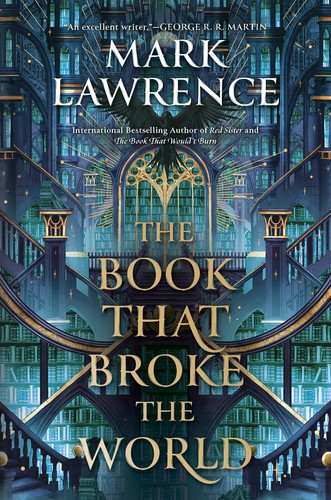
The Book That Broke the World is a sequel about who pays for protected knowledge — and what happens when the people the Library excluded stop asking politely. Mark Lawrence introduces Celcha and Hellet, siblings ground down by forced labor, then folds their story into the Library’s time-bending war.
Knowledge preserved behind walls offers little comfort to the people those walls exclude.
Celcha is a sharp counterweight to Livira. Both are curious and intellectually fearless, but Celcha’s experience of enslavement makes the Library’s claims to neutrality sound very different: knowledge preserved behind walls offers little comfort to the people those walls exclude.
Hellet supplies the book’s most painful moral line — a liberation plan built out of real grievance that kills every soul in the city, with his sister’s help. Meanwhile Livira and Evar stay entangled across eras, and the reader often understands an encounter only after later context. The disorientation is thematic; it also slows the emotional momentum.
This is a darker, less self-contained book than its predecessor. It expands the war and closes on destruction rather than a neatly solved loop; readers attached to the first volume’s romantic center will find this one colder.
Its achievement is making the Library itself the question. Preservation, curation and civilization sound noble until the trilogy asks whose voices were classified as dangerous — and which populations were accepted as collateral damage.