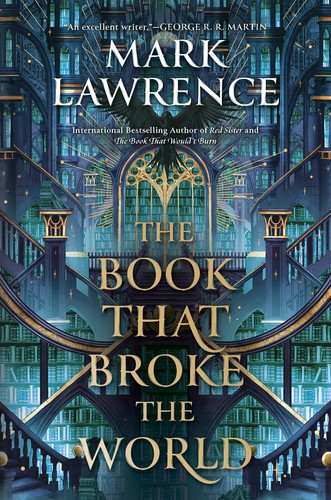
The Book in Brief
Celcha and Hellet are ganar slaves digging out a buried city until Hellet is punished for opening a book; a librarian removes them to the city, where they remain enslaved with a little more freedom and Hellet begins taking instruction from two ghosts. Livira and Evar remain entangled across time as earlier events prove to be moves in a larger conflict of skeer, sabbers and rival visions of preservation. Two hundred years before Livira’s time, Hellet conceives a liberation that will free the ganar by putting their enslavers to sleep, and Celcha agrees to help him carry it out — a plan that kills the entire city instead. The ending leaves the Library fractured in body and in story.
Important Characters
Celcha: A gifted enslaved worker whose encounter with the Library turns curiosity into radical judgment.
Hellet: Celcha’s broken, prophet-like brother, punished for opening a book and guided by two ghosts only he can see.
Livira: A librarian moving through the consequences of the first book’s closed temporal loop.
Evar: A survivor whose connection with Livira crosses the Library’s barriers of time and species.
Yute: A senior librarian whose principles are tested by the institution’s buried compromises.
The Assistant: A guide whose apparently helpful role remains tied to the Library’s larger design.
The skeer and sabbers: Peoples whose histories challenge the Library’s official division between civilization and threat.
What to Remember from the Previous Book
The Book That Broke the World directly follows The Book That Wouldn’t Burn. The new volume assumes the earlier relationships, betrayals and world rules are already familiar. The opening chapters supply context through action, but they do not retell the prior novel in full.
Ending Explained
Celcha’s catastrophic act is both understandable and indefensible — the novel builds the oppression and urgency behind it, then refuses to pretend a just grievance makes indiscriminate destruction just. The book that breaks the world is Livira’s own: Lord Algar discovers that her volume is what is cracking the Library’s foundations, and she must recover it to return to her life. Livira and Evar’s temporal connection remains the trilogy’s possible route to repair — books can carry messages across separation, but preservation alone cannot decide how knowledge should be used.
Themes and Analysis
Knowledge and Exclusion. A universal library is not universal if entry and classification reproduce political hierarchy.
Protection as Control. Hellet’s love becomes ethically complicated when safety requires denying Celcha agency.
Radicalization. The book follows how accumulated exploitation can make catastrophic action appear like the only remaining choice.
History’s Recurrence. Time loops make later generations inherit decisions they did not understand when first made.
Preservation Versus Justice. Saving books and institutions is not identical to saving the people they claim to serve.
Content Notes
This book contains enslavement and forced labor, mass death and destruction, war, imprisonment, coercion, sibling conflict, grief and body horror.