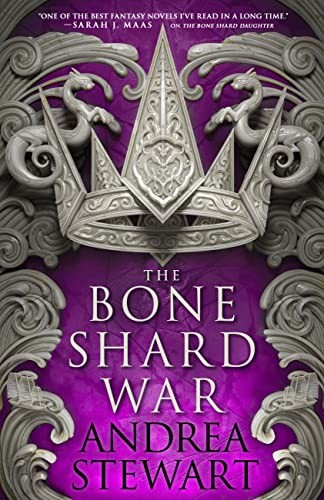
The Bone Shard War makes its heroes choose a political future instead of just defeating another claimant — and the answer, remarkably for an epic fantasy finale, is that the throne itself has to go.
The trilogy has been asking one question throughout: whether safety bought with centralized coercion is safety at all.
The two-year jump is a productive shock. Lin still rules, Jovis is missing, and the institutions apparently rescued in book two have gone on quietly rotting — so the finale opens with its protagonists further from victory than they ended.
Stewart makes it more than a relic hunt. The pale swords, the ossalen, the islands and the Alanga history all converge on the question the trilogy has been asking throughout: whether safety bought with centralized coercion is safety at all. Jovis’s storyline supplies the horror — commands carved into his own flesh, his body used against everyone he loves, with only Mephi holding the line.
The middle is crowded, with too many factions chasing the same seven swords, and it is the weakest stretch in the series.
The last movement pays off the long arcs beautifully. Lin abdicates rather than preserve the Sukai claim, charging Ranami with assembling a ruling Council, Nisong is finally released from an identity she never chose, and Jovis survives without his memories — an inversion of Lin’s opening condition in book one. It ends bittersweet rather than restored, which is the right call.