Babel
R. F. Kuang | An Arcane History of the Oxford Translators' Revolution
the Oxford Translators' Revolution
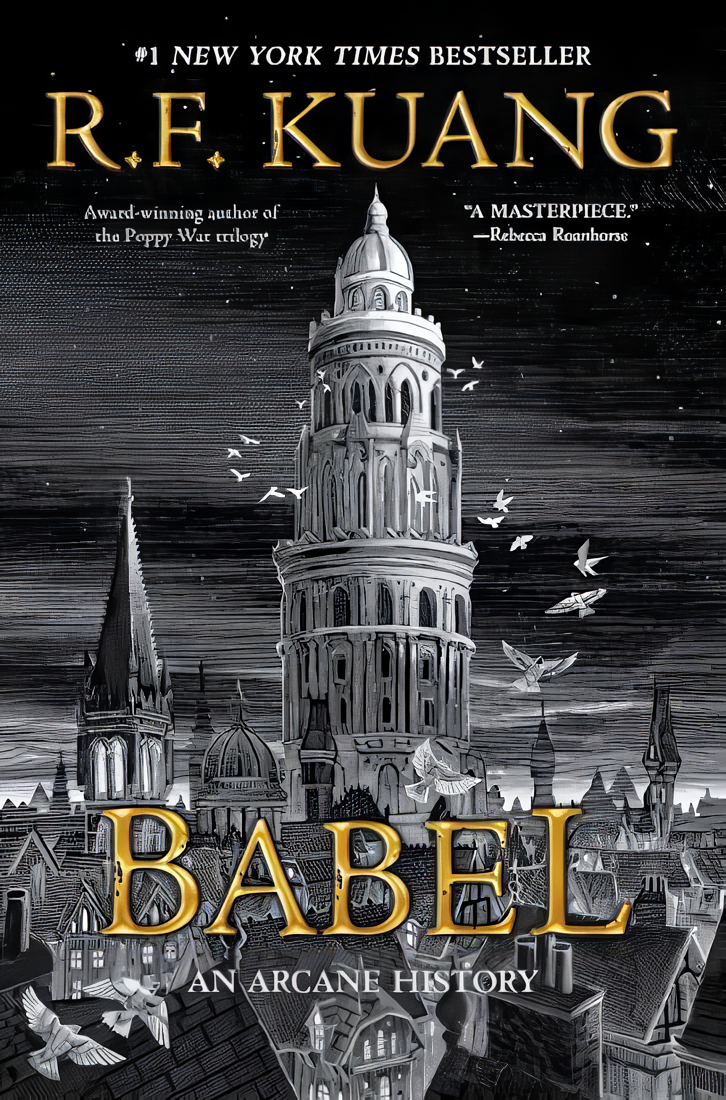
R. F. Kuang's Babel imagines nineteenth-century Britain as an empire powered not only by coal, trade, and conquest but by translation. Silver bars engraved with "match-pairs"---words from different languages that resemble one another without meaning exactly the same thing---capture the meaning lost between those words and turn it into magic. Roads remain smooth, factories become efficient, ships travel faster, and weapons become deadlier. At Oxford's Royal Institute of Translation, language is therefore not an ornament of empire. It is infrastructure.
That idea is the novel's greatest achievement. The magic system does not sit beside the political argument; it embodies it. Britain needs the languages of the people it dominates, yet it treats those people as inferior. Oxford welcomes gifted colonial students because their knowledge is useful, then asks them to be grateful while converting that knowledge into power they will never control. Every miraculous silver bar contains a contradiction: the empire depends upon difference even as it tries to erase or possess it.
The story follows Robin Swift, a Chinese boy taken from Canton by the cold and controlling Professor Richard Lovell. Raised in England and trained for Oxford, Robin enters Babel believing that scholarship may give him safety, friendship, and belonging. The tower seems to justify every humiliation he has endured. It offers beautiful rooms, rare books, intellectual freedom, and three friends---Ramy, Victoire, and Letty---who make Oxford feel like home. Kuang understands that a corrupt institution must be genuinely seductive if complicity is to have any moral weight.
Robin is an effective protagonist because he is neither a born revolutionary nor an uncomplicated victim. He recognizes Britain's racism but wants the rewards Babel offers. He joins the underground Hermes Society, which steals silver for resistance movements, yet repeatedly withdraws when its demands threaten his new life. His hesitation can be frustrating, but it is essential. Robin has been taught that survival means pleasing powerful Englishmen, first Lovell and then the professors of Babel. His political awakening is a painful process of discovering that personal acceptance cannot make an exploitative system just.
The friendship among the four students gives that process its emotional force. Ramiz Rafi Mirza is charming, brilliant, and far more politically committed than Robin initially understands. Victoire Desgraves combines reserve with formidable strength, having learned that both racism and sexism make visibility dangerous. Letitia Price is disadvantaged by Oxford's misogyny but protected by her whiteness and wealth. Their conversations show that shared affection does not erase unequal experience. Letty wants the group's suffering to be comparable because that would let solidarity require no surrender from her; the others know the institution can exclude her and still remain built for people like her.
Kuang's portrayal of Oxford is appropriately divided between wonder and accusation. The pleasures of etymology, libraries, college dinners, and intense friendship are real. So are the locked doors, racist assumptions, stolen knowledge, and professional rewards attached to imperial usefulness. The novel repeatedly asks whether loving a place creates an obligation to preserve it or makes its betrayal more painful. Babel is both a sanctuary and a machine that consumes its students.
The book is unusually explicit about its themes. Characters debate colonial extraction, industrial capitalism, peaceful reform, and revolutionary violence at length. For some readers, this clarity will be a virtue: the novel refuses to disguise structural violence as neutral world-building. For others, the dialogue can sound like a seminar in which characters deliver positions more often than they reveal themselves. The villains are frequently so openly racist that the system's subtler methods of producing consent receive less attention than they might have.
The footnotes create a similar tension. They add jokes, alternative history, etymology, and reminders that every authoritative narrative leaves something outside the main text. They also interrupt scenes and reinforce points the story has already made. This is partly deliberate---Babel wants the form of a scholarly history while challenging who gets to write history---but it occasionally slows a long novel that already devotes substantial space to explanation.
The middle section in Canton is where Robin's divided loyalties become impossible to maintain. The British expedition presents the opium trade as a question of free commerce while deliberately ignoring the suffering required to sustain it. Robin is forced to translate for men who regard his birthplace as both a market and an obstacle. His confrontation with Lovell turns the novel from an academic drama into a revolutionary tragedy, and the consequences ensure that no member of the cohort can return to the innocence of their first Oxford days.
The final act is compelling because it refuses to make resistance clean. Robin and Victoire help seize Babel and call a strike, hoping Britain's dependence on silver will stop the coming war with China. The resulting failures damage bridges, factories, transport, and ordinary lives. Peaceful appeals are ignored, but violence does not remain confined to guilty officials. Kuang's argument is not that destruction is painless or pure. It is that an empire which has made injustice foundational can ensure that dismantling injustice also carries a terrible price.
Robin's increasing attachment to that destruction is deliberately troubling. Grief and guilt push him beyond strategy toward revenge, while Victoire continues to distinguish necessary resistance from the desire to die. Their disagreement prevents the climax from becoming a simple endorsement of martyrdom. The tower's fall may interrupt a war and weaken an empire, but it also ends lives, destroys knowledge, and reveals how completely Robin has come to see himself as expendable.
Babel is most successful when its scholarship, magic, and character drama become one argument. It is less successful when characters explain that argument after the narrative has already demonstrated it. Even with that didactic streak — and I felt it — the novel is ambitious, angry, and emotionally effective. It turns translation into a source of wonder without treating it as politically innocent, and it understands that institutions can be beautiful precisely because beauty helps them secure loyalty. The result is a dark academic fantasy about who creates knowledge, who profits from it, and what oppressed people may owe to a world built from their exploitation.