The Book in Brief
In 1828, Professor Richard Lovell rescues a Chinese boy from a cholera outbreak in Canton using an enchanted silver bar. The boy's mother has already died. Lovell takes him to England, gives him the name Robin Swift, and subjects him to years of intensive training in Mandarin, Greek, and Latin. Lovell is almost certainly Robin's biological father, but he treats him as a replaceable academic investment. Robin eventually earns admission to Oxford's Royal Institute of Translation, known as Babel.
At Babel, Robin meets Ramy, Victoire, and Letty. They learn that Britain's technological dominance depends on silver bars engraved with match-pairs from different languages. The semantic gap between the paired words creates an effect, and Babel's scholars collect foreign languages to produce increasingly powerful bars. Robin loves Oxford, but he also meets Griffin Lovell, his older half-brother and near double. Griffin recruits him into the Hermes Society, an underground group that steals silver and sends it to anti-colonial movements.
Robin helps Hermes but resents the danger and eventually withdraws. Meanwhile, he learns that Babel values its colonial students primarily as sources of linguistic knowledge. Ramy and Victoire secretly join Hermes. When they are caught inside Babel, Robin protects them but betrays Griffin's safe house during interrogation. Lovell then sends the cohort to Canton to assist a British delegation seeking to preserve the opium trade.
In Canton, Robin sees that the British never intended to negotiate in good faith. Commissioner Lin destroys confiscated opium, and the delegation retreats toward England. On the ship, Lovell confronts Robin and speaks contemptuously of both Robin's mother and the Chinese. Robin kills him with an experimental silver bar. Ramy, Victoire, and Letty help conceal the death, but the crime makes their return to ordinary student life impossible.
The students discover correspondence proving that Britain planned to use the opium dispute as a pretext for war. They seek help from Hermes, where Robin reunites with Griffin. The Society tries to build an antiwar coalition, while Griffin argues that only violence can stop the empire. Letty, horrified by the group's methods and unable to accept its analysis of colonial power, betrays them to the police. During the raid she shoots and kills Ramy. Robin and Victoire are captured, but Griffin rescues them and dies during their escape.
With peaceful lobbying defeated, Robin and Victoire seize Babel with sympathetic students and professors. They call a silver-workers' strike, remove the resonance rods that maintain Britain's enchanted infrastructure, and demand an end to the proposed war with China. Workers support them, but Parliament refuses to concede. Bridges fail, factories stop, civilians die, and the army surrounds Oxford. The strike fractures as its costs increase.
Letty offers the remaining strikers amnesty if they surrender. Robin and Victoire refuse, but Victoire also rejects Robin's plan to die destroying the tower. At dawn, she and Yusuf escape with the historical record of the uprising. Robin, Professor Craft, Meghana, Ibrahim, and Juliana remain. They activate the paradoxical "translate" match-pair throughout Babel, causing its silver to destroy itself. The tower collapses, killing them and shattering the network on which British power depends.
In the epilogue, Victoire travels toward a new life and continued resistance. She refuses to let survival be mistaken for cowardice. Babel has fallen, Britain has lost an enormous source of imperial power, and the coming war has at least been disrupted, but neither empire nor revolution has reached a final conclusion.
Important Characters
Robin Swift: A Chinese student taken from Canton and raised by Richard Lovell for service at Babel. His hunger for belonging gradually gives way to anti-colonial resistance, grief, and a willingness to destroy the institution he once loved.
Ramiz "Ramy" Rafi Mirza: Robin's Indian Muslim roommate and closest friend. Witty and sociable, Ramy learned to perform deference under British rule but becomes a committed member of Hermes.
Victoire Desgraves: A Haitian-born student raised in France after being illegally enslaved. She is a gifted translator of French and Kreyòl whose political resolve is matched by a fierce commitment to survival.
Letitia "Letty" Price: A wealthy white English student denied opportunities because she is a woman. She loves her cohort but cannot accept how her racial and national privilege separates her experience from theirs, leading her to betray Hermes.
Professor Richard Lovell: Robin and Griffin's English father, though he refuses to acknowledge them as sons. A Babel professor who collects talented Chinese boys for the empire, he combines intellectual cultivation with racism, neglect, and physical abuse.
Griffin Lovell: Robin's older half-brother and a former Babel student. He works for Hermes, believes imperial violence must be answered with revolutionary violence, and acts as both mentor and warning to Robin.
Anthony Ribben: A Black Babel student and important Hermes organizer. Having survived enslavement and experienced Oxford's conditional welcome, he is committed to building an international anti-colonial movement. He is killed by police in the raid on the Old Library.
Professor Playfair: A leading silver-worker who teaches Robin's cohort. He appreciates linguistic brilliance while treating foreign peoples chiefly as resources for British power.
Professor Chakravarti: An Indian-born Babel scholar who understands the compromises required to work within Oxford. He initially supports the strike but ultimately rejects Robin's increasingly vengeful course.
Professor Craft: A woman teaching at Babel despite Oxford's restrictions on women. She supports the students' seizure of the tower and remains with Robin at the end.
Commissioner Lin Zexu: The Qing official charged with suppressing the opium trade. His destruction of British opium provides the empire with the excuse for war it has been seeking.
Sterling Jones: A former member of Griffin and Evie Brooke's cohort who becomes an agent of the British state. He tortures Robin and represents the path of complete service to the institution.
Evie Brooke: A deceased former Babel student whose research and fate connect Griffin, Sterling, and the earlier failure of their cohort. Her death becomes part of the competing stories Babel and Hermes tell Robin.
Abel: A leader among the Oxford workers who support the strike. He reminds the Babel students that the consequences of silver failure fall heavily on ordinary people.
Ibrahim, Meghana, Juliana, and Yusuf: Students who join the occupation of Babel. Their different decisions at the end emphasize that resistance may require both sacrifice and survival.
Spoiler Warning and Content Note: The summaries below reveal the entire novel, including Ramy's death and the destruction of Babel. The book contains racism and racial slurs, colonial violence, child abuse, drug addiction, torture, murder, suicide, and mass-casualty events.
Book I
Chapters 1–8
Chapter 1. During a cholera outbreak in Canton in 1828, an unnamed boy lies sick beside his dead mother. Professor Richard Lovell heals him by placing an enchanted silver bar on his chest and speaking the Chinese word engraved upon it. The boy's English tutor, Miss Betty Slate, has also died, and Lovell informs him that arrangements were made for this possibility.
Lovell offers to take the boy to England, but first requires him to choose an English name. He combines Robin Goodfellow with the surname of Jonathan Swift to become Robin Swift. On the voyage, Robin is asked to translate during a dispute involving Chinese laborers. He realizes that Lovell knew his family well and probably planned his removal long before the epidemic.
Chapter 2. Lovell installs Robin in his Hampstead house and insists that he is a ward, not a son. Robin begins a punishing education in English, Latin, Greek, and Mandarin. Lovell treats Cantonese as a corrupt dialect, causing Robin gradually to lose the language associated with his mother and childhood.
A visitor's remarks reveal that another Chinese boy lived with Lovell before Robin and strongly imply that Lovell is Robin's biological father. When Robin performs poorly in a lesson, Lovell beats him with a fireplace poker and threatens to send him back to Canton. Robin learns to connect academic success with safety. Years later, Lovell brings him to Oxford.
Chapter 3. At Oxford, Robin meets his roommate, Ramiz Rafi Mirza, at their lodgings on Magpie Lane. The two quickly bond over their status as colonial outsiders, while other students treat them with casual racism. Ramy's humor and confidence make the unfamiliar city feel less hostile.
Robin returns to the Bodleian for Ramy's forgotten notebook and sees intruders stealing silver. One is an older man who looks almost exactly like him. Robin instinctively uses a silver bar engraved with a Chinese match-pair to hide the thieves from the authorities. The stranger tells him to come to the Twisted Root tavern if he wants an explanation.
Chapter 4. Robin and Ramy meet the other members of their Babel cohort: Victoire Desgraves, a reserved Black student from France, and Letty Price, an Englishwoman whose gender bars her from full participation in Oxford life. Anthony Ribben gives them a tour of Babel's eight-story tower, where translators, linguists, and silver-workers serve the empire.
Professor Playfair introduces silver-working. When near-equivalent words from two languages are engraved on silver, the difference between their meanings produces a magical effect. The students give blood to Babel's wards and begin their studies. The four become friends, but Robin keeps his promise to visit the stranger at the Twisted Root.
Book II
Chapter 5. The stranger identifies himself as Griffin Lovell, Robin's older half-brother. Like Robin, Griffin was one of Richard Lovell's unacknowledged sons, taken from China and trained for Babel. Griffin reveals that Lovell also has a legitimate English family and that the professor's colonial children are replaceable tools.
Griffin belongs to the Hermes Society, which steals silver from Babel and distributes it to resistance movements abroad. He argues that Britain's prosperity is built on foreign languages, mined silver, and colonial exploitation. He also suggests that Lovell could have saved Robin's mother but chose not to. Griffin invites Robin to help Hermes from inside the tower.
Chapter 6. The students study competing theories of translation. Playfair imagines an original language in which words perfectly corresponded to things, while other lessons emphasize that translation always changes meaning. Robin asks about Griffin and is told that the former student died, confirming that Babel has erased him.
At dinner, Lovell explains that Britain needs Chinese and Indian languages because familiar European match-pairs are losing effectiveness. Robin asks why Britain hoards the benefits rather than sharing them. When he asks why Lovell did not save his mother, Lovell dismisses her as unimportant. Robin later marks a tree as instructed, signaling that he accepts Griffin's invitation.
Chapter 7. Griffin gives Robin his first assignment: unlock Babel during a rainy night, when the weather will help conceal Hermes's intrusion. Robin allows members into the tower and watches them steal silver. He is frightened by the risk but also exhilarated by acting against the institution that assumes his obedience.
As the term continues, Robin, Ramy, Victoire, and Letty become inseparable. They study, argue, and explore Oxford together. Robin tells none of them about Griffin or Hermes, separating the political part of his life from the friendship and belonging he has found at Babel.
Chapter 8. Griffin warns Robin that committed work with Hermes may eventually require him to fake his death and leave Oxford. Robin cannot imagine surrendering the life he has just gained. Daily discrimination nevertheless exposes the limits of that life: Ramy is denied service, and Letty and Victoire face restrictions imposed on women.
At an Oxford party, the group encounters wealthy students whose intellectual interests sit comfortably beside prejudice. Letty speaks bitterly about her dead brother Lincoln, whose gender gave him opportunities he wasted. In class, Playfair argues that every translation is a betrayal of the original, a claim that also describes Robin's divided loyalties.
Chapters 9–16
Chapter 9. After their first year, the students travel abroad to strengthen their languages: Robin to Malaya, Ramy to Spain, Letty to Germany, and Victoire to France. They return for a second year with broader knowledge and greater confidence. Playfair demonstrates that an especially unstable match-pair involving the concept of translation can make silver implode.
The cohort also learns that Babel exaggerates the cost of maintaining Britain's silver infrastructure to justify its privileges. Anthony explains why the institute needs speakers of non-European languages even while Oxford excludes them socially. The four solve a match-pair problem involving the new daguerreotype and celebrate by having their photograph taken together.
Chapter 10. Griffin describes Britain's trade imbalance with China and argues that imperial expansion will eventually destabilize the system Hermes opposes. He admits that he too lost much of his Chinese fluency after being taken to England. The brothers' shared history brings them closer without eliminating Robin's fear of Griffin's demands.
During another theft, Babel's strengthened wards activate. Robin is grazed by a bullet but escapes and lies to Playfair about the wound. He stitches it himself rather than risk exposure. Griffin then disappears without explanation, leaving Robin angry that he has accepted danger for someone who offers neither security nor affection.
Chapter 11. The students begin independent research. Victoire's adviser pressures her to produce match-pairs from Kreyòl even when translating sacred or culturally specific language would violate its meaning. Letty does not understand why this extraction troubles her. Robin works with Professor Chakravarti and learns that hidden resonance rods connect England's silver bars to Babel.
Anthony is reported missing and presumed dead after a trip to Barbados. Babel responds with institutional indifference, treating the loss as an inconvenience. Victoire's controlled reaction suggests that she knows more than she admits. The cohort's unity begins to strain under secrets, unequal risks, and the demands of their advisers.
Chapter 12. Robin finally confronts Griffin. Britain is experiencing political unrest as mill workers protest poverty and the use of silver to replace labor. Griffin says Hermes is preparing to act against a British campaign in Afghanistan and asks Robin to hide explosives. He stresses that colonial soldiers will be used to conquer other colonized peoples.
Robin, exhausted by secrecy and unconvinced that Hermes's thefts can change the empire, refuses. He accuses the Society of endangering people for gestures without visible results. Griffin allows him to leave but warns that he must remain silent. Robin returns to Babel hoping he can preserve the life he prefers.
Book III
Chapter 13. Griffin cuts off contact, and Robin concentrates on third-year examinations. Research into Babel's records leads the cohort to Evie Brooke, a former student credited with unusually productive match-pairs before her unexplained disappearance. The gaps in her history resemble Babel's erasure of Griffin and Anthony.
During the silver-working examination, Victoire presents a powerful Kreyòl match-pair. The examiners acknowledge its force but dismiss it as having little use for Britain, exposing the institute's claim that scholarship is valuable for its own sake. All four students pass, yet their success confirms that Babel judges knowledge by imperial application.
Chapter 14. At an Oxford ball, a student named Colin mistakes Victoire for a servant. Letty wants Ramy to dance with her, but he knows that public intimacy with a white woman could put him in danger. Later, privileged acquaintances sexually harass Letty and Victoire and direct a racial insult at Robin.
The friends leave together, but the episode exposes their different vulnerabilities. Letty confesses that she is in love with Ramy and is devastated that he does not return her feelings. While investigating Evie Brooke, the students discover her grave, proving that the vague institutional story of her disappearance conceals a death.
Chapter 15. After the examinations, the friends enjoy a brief period of freedom. Robin then sees Ramy and Victoire entering Babel for Hermes. The wards trap them, and Robin uses his access to release them before claiming responsibility. Anthony, secretly alive, has recruited them just as Griffin recruited Robin.
Lovell interrogates Robin. Under pressure, Robin admits that Griffin works for Hermes but minimizes his own involvement. Lovell claims Griffin murdered Evie Brooke and shows Robin a deadly silver bar associated with her death. Offered a choice between Babel and his brother, Robin reveals a Hermes safe house while secretly keeping the bar.
Interlude: Ramy
Ramy grows up in a family diminished by British rule. His father serves Sir Horace Wilson, and Ramy learns that survival requires anticipating English expectations and performing grateful obedience. Wilson recognizes his linguistic ability and takes him to Oxford, presenting patronage as generosity rather than another form of control.
At Babel, Ramy enjoys learning and friendship but never mistakes welcome for equality. Anthony recruits him into Hermes, where anti-colonial work offers a way to act against the system that rewards him. Ramy accepts partly from conviction and partly from guilt that his education is funded by the exploitation of people like his family.
Chapter 16. Lovell sends the cohort to Canton earlier than planned to translate for a British diplomatic and commercial mission. He offers Robin a shallow apology but does not acknowledge the abuse underlying their relationship. Robin confesses his connection to Griffin and his betrayal of the safe house to Ramy and Victoire. Ramy is furious that Robin repeatedly chooses personal safety over resistance.
Letty senses that the others share secrets she does not. The students learn that the delegation's true concern is the opium trade. Lovell openly supports forcing China to accept British demands, while the women must disguise themselves as men to participate. Despite their conflict, Ramy continues to protect Robin.
Chapters 17–24
Chapter 17. In Canton, British merchants demand unrestricted access to a market sustained by addiction. Robin and Ramy visit Robin's old neighborhood and find his childhood home turned into an opium den. Overwhelmed, Robin tries the drug, and Ramy pulls him out before he can disappear into it.
Robin explains how Britain uses opium grown in India to extract silver from China. On a bridge, his despair becomes nearly suicidal. He later meets Commissioner Lin and warns that the delegation does not regard the Chinese as equals, making good-faith negotiation impossible. Lin confiscates and destroys the opium. Lovell orders the British party to retreat.
Chapter 18. On the homeward ship, Lovell confronts Robin about his conduct. Robin accuses him of exploiting China, abandoning Robin's mother, and treating his own children as instruments. Lovell responds with contempt and racial abuse, confirming that no achievement could make Robin his equal.
Robin activates the silver bar taken during his interrogation. Its effect kills Lovell, although the moment combines self-defense, accumulated rage, and deliberate choice. Ramy, Victoire, and Letty enter to find Robin beside the body. Ramy asks the practical question that ends their old life: what will they do now?
Book IV
Chapter 19. The friends hide Lovell's death, dispose of his body at sea, and claim that illness required his burial. Robin is consumed by guilt and repeatedly considers confessing, but Ramy refuses to let him sacrifice himself without helping anyone. Their shared crime binds the cohort together while making trust more fragile.
Back in England, they travel to Lovell's Hampstead house before reporting to Oxford. Robin returns to the place where he was trained and beaten, now without the man who controlled it. The house holds evidence that may explain what Britain intended the Canton mission to accomplish.
Chapter 20. Lovell's correspondence proves that British officials expected Commissioner Lin to resist and planned to use the destroyed opium as a pretext for war. The delegation was never a genuine attempt at compromise. Robin, Ramy, and Victoire decide that stopping the war matters more than preserving their Oxford careers.
Letty overhears them discussing Hermes and demands the truth. The others explain that Babel's silver sustains imperial conquest and that Oxford never offered colonial students the same belonging it offered her. Letty proposes petitions and legal reform. She is disturbed by their willingness to consider coercion but insists that she will remain with her friends.
Chapter 21. The cohort returns to Oxford and pretends that Lovell is ill. Robin quietly says goodbye to Mrs. Piper, the Hampstead housekeeper who showed him limited kindness. Lovell's legitimate English family soon arrives, making it harder to sustain the deception and emphasizing Robin's exclusion from his father's acknowledged life.
At a faculty gathering, Playfair approaches Robin as if he represents Hermes. Robin tests him and realizes the professor is lying on behalf of the authorities. The students flee before they can be detained.
Chapter 22. Anthony leads the friends to the memorial of William Jones and enters a code that opens the tunnel to the Society's hidden base in Oxford's Old Library. He explains that he survived enslavement and later discovered that Oxford valued him only while his knowledge remained profitable. The Old Library contains other students and activists working with Hermes. Griffin returns, forcing Robin to face the brother he betrayed.
Anthony favors an antiwar coalition using public pressure, labor organization, and economic argument. Griffin believes Britain will concede only when resistance threatens its power. He teaches Robin to shoot and explains that Evie Brooke's death emerged from betrayal inside their former cohort. Firing the gun gives Robin a disturbing sense of clarity and control.
Chapter 23. Hermes distributes antiwar pamphlets with a match-pair that rapidly reproduces text. To broaden support, the campaign stresses the economic cost of war alongside the immorality of empire. Newspapers expose Robin, Ramy, and Victoire as fugitives while omitting Letty, demonstrating which members the public instinctively imagines as dangerous. Letty tells the authorities where Hermes is hiding; in the raid that follows she shoots Ramy, and the police kill Anthony.
Letty disappears. Police then raid the Old Library, and she returns carrying a revolver, having betrayed the group in the belief that surrender will save her friends. Victoire burns the contact list. Robin moves toward Letty, and she fires. The bullet kills Ramy. Robin is captured in the chaos.
Chapter 24. Sterling Jones tortures Robin with silver-enhanced restraints and tries to force him to identify Hermes members. He pretends that Victoire has been executed, using Robin's grief and guilt against him. Robin begins to lose hope.
Griffin breaks into the prison and reveals that Victoire is alive. During the escape, Griffin and Sterling confront one another as surviving members of the cohort once shared with Evie. They fire at the same instant. Sterling is killed outright; Griffin takes a bullet too deep in the chest for a healing bar to reach, and dies in Robin's arms. Robin loses his brother almost immediately after choosing his cause, and he and Victoire escape without a functioning organization to join.
Chapters 25–33
Chapter 25. At a temporary refuge, Robin and Victoire assess the destruction of Hermes. Anthony's attempt to build a lawful coalition ended in a raid, while Griffin's armed strategy ended in death. Neither believes that further lobbying will stop the war in time.
Robin says Babel must be made to crumble because Britain cannot wage war without its silver network. Victoire goes further: the institution should burn. Their agreement is born from political analysis but also from Ramy's murder, Griffin's death, and the knowledge that returning to ordinary life is impossible.
Book V
Interlude: Letty
Letty grows up neglected by an admiral father who reserves opportunity for her brother Lincoln. She envies the freedom he wastes and once wishes him dead; when he dies the next day, guilt becomes entangled with her desire to take the education he never valued. She eventually gains a place at Oxford but remains excluded because she is a woman.
That exclusion convinces Letty that she understands her friends' oppression. She cannot accept their claim that race, empire, and class give her a different relationship to Britain. Frightened by Hermes's threats and violence, she informs the authorities while imagining that arrest will restore order. Ramy's death reveals the fatal consequences of treating her own intentions as more important than her friends' judgment.
Chapter 26. Robin and Victoire use Hermes's fire signals and Griffin's remaining resources to organize an occupation of Babel. They expose documents proving the planned war and call upon scholars and workers to strike. Professor Craft supports them, as do several students and eventually Professor Chakravarti.
Playfair confirms the institute's complicity but refuses to surrender it. He raises a gun, and Victoire shoots him. Many occupants leave, but Craft, Chakravarti, Ibrahim, Juliana, Yusuf, Meghana, Robin, and Victoire remain. Their pamphlets combine Anthony's coalition-building with Griffin's willingness to use direct force.
Chapter 27. Parliament ignores the strikers' demands. To demonstrate their power, the occupiers remove resonance rods that maintain silver around Oxford. Magdalen Tower collapses, transport fails, and the city begins to recognize that Babel's apparently invisible labor supports everyday life.
Robin responds aggressively to hostile crowds, but Victoire restrains him and insists that their strategy is coercion, not indiscriminate revenge. News arrives that workers elsewhere are striking in solidarity. The government offers limited amnesty without ending the war and moves troops toward Oxford, turning the occupation into a siege.
Chapter 28. Mill workers led by Abel help barricade Babel, temporarily slowing the army. Across Britain, however, failing silver infrastructure causes accidents and deaths. The pressure proves the strikers' importance, but it also transfers suffering to people with little control over imperial policy.
Victoire accuses Robin of allowing grief to turn strategy into vengeance. The occupiers vote narrowly to continue and threaten to let the enchanted maintenance of Westminster Bridge fail. Professor Chakravarti invokes ahimsa and refuses to participate in a course he believes has abandoned disciplined resistance. He leaves the tower.
Chapter 29. Morale falls as the siege continues. The occupiers issue an ultimatum: Britain must abandon the China war and grant amnesty, or Westminster Bridge will lose the silver support keeping it intact. Parliament still refuses to negotiate seriously.
Robin and Victoire speak about Letty, Ramy, and the different shapes their grief has taken. Ibrahim works to record the uprising so that the state cannot control its history after the survivors are gone. Outside, the barricades weaken, and it becomes clear that the army will eventually reach the tower.
Chapter 30. The deadline passes without government concession. Westminster Bridge collapses, killing at least sixty-three people. The disaster confirms both the immense power of the strike and the indifference of officials willing to let civilians die rather than surrender imperial policy.
For the occupiers, the deaths destroy any remaining illusion that their pressure can be bloodless. Robin treats the catastrophe as a terrible but necessary cost. Others see evidence that the strike is losing both its moral limits and its chance of winning public support.
Chapter 31. Fighting spreads through Oxford as the army prepares to storm Babel. Soldiers fire on civilians, and the workers' defenses begin to break. Robin's language becomes increasingly focused on punishment and sacrifice, alarming even allies who accept the need for resistance.
Abel warns that the army will attack at dawn and offers routes by which some occupiers may escape. A white flag then appears. Letty approaches the tower as an intermediary for the authorities, asking to negotiate with the friends whose trust she destroyed.
Chapter 32. Letty says the army will storm Babel at dawn and that Britain's ruling class will continue allowing poor people to suffer. She offers the survivors amnesty and a return to a reformed version of their old academic lives. Robin and Victoire answer that they were never permitted to belong to Britain on equal terms.
When asked why she killed Ramy, Letty calls it an accident, comparing it to Robin's killing of Lovell. Victoire tells her that they once loved her, making clear how much her betrayal cost. After Letty leaves, Robin reveals his final plan: activating the paradoxical "translate" match-pair throughout the tower can destroy its silver. Victoire rejects his desire for martyrdom and chooses escape.
Chapter 33. Destroying Babel's silver will erase generations of research and collapse Britain's national resonance network, preventing the immediate use of silver to wage war in China. The plan requires several people to activate bars throughout the tower. Professor Craft, Meghana, Ibrahim, and Juliana volunteer to remain with Robin, while Victoire and Yusuf choose life.
Abel carries Ibrahim's record of the uprising to safety. Robin and Victoire say goodbye, accepting that survival and sacrifice are different forms of resistance. As the army advances, Robin activates the "translate" bars. The silver destroys itself in a chain reaction, and Babel collapses. In his final moments, Robin imagines Ramy and hears his mother speak the Chinese name the empire made him forget.
Epilogue: Victoire. Victoire's history is revealed. Born in Haiti in 1820, she moved to France with her mother and was illegally held in slavery after her mother's death. Her intelligence and knowledge eventually created a path to Babel. Anthony taught her to value Haiti, Kreyòl, and the revolutionary tradition that European scholarship treated as inferior.
After escaping Oxford, Victoire travels toward the coast with the hope of reaching Hermes contacts abroad and possibly America. She understands that Letty may pursue her because a living witness threatens Letty's account of the uprising. Victoire nevertheless chooses continued life and struggle, refusing the idea that the only meaningful resistance is death.
Ending Explained
Robin destroys Babel by exploiting a contradiction at the heart of translation. The word "translate" refers both to carrying meaning across languages and to the impossibility of carrying it across without change. Engraved as a match-pair, that contradiction makes silver consume itself. By distributing the bars through the tower, the remaining strikers create a chain reaction that destroys Babel and the resonance system connected to it.
The immediate objective is strategic. Britain depends on Babel's stored silver, scholarship, and resonance rods for transport, industry, communications, weapons, and naval power. Their destruction makes the planned war with China far more difficult and gives colonized nations time to resist. The ending does not promise that Britain will abandon empire. Knowledge survives elsewhere, officials can rebuild, and military power existed before Babel. Robin buys an interruption rather than permanent liberation.
His death is also personal. Robin has come to believe that the institution which shaped him can be defeated only by consuming him with it. He is motivated by genuine political necessity, but also by guilt over Lovell, Ramy, Griffin, the civilians killed during the strike, and his earlier betrayals. Victoire recognizes that distinction. She accepts the need to destroy Babel but refuses Robin's belief that her own life has no claim on her.
That choice makes the epilogue essential. If every revolutionary dies in the tower, the state can reduce the uprising to criminal madness. Ibrahim's account escapes with Abel, while Victoire preserves a living memory of the revolt and remains capable of joining future resistance. Robin's sacrifice removes a weapon from the empire; Victoire's survival protects the meaning of what happened.
The final return of Robin's forgotten Chinese name completes his emotional arc. Lovell renamed him, trained him, and made English achievement the condition of safety. Babel then transformed his multilingual identity into imperial property. At death, the voice of his mother represents a self that existed before those institutions claimed him. The novel deliberately withholds the name from the reader, preserving it from one final act of translation and possession.
Unresolved Questions
Does Babel's destruction stop the Opium War? The strike severely damages Britain's magical infrastructure and likely delays or changes the planned invasion. The novel does not claim that one act permanently ends imperial ambition, especially when Britain retains conventional military, financial, and political power.
Can Britain rebuild silver-working? Some scholars, records, and linguistic knowledge survive outside the tower. Rebuilding is possible, but the loss of Babel's accumulated bars, resonance rods, specialists, and institutional center creates an enormous setback.
What happens to Victoire? She is moving toward a network of international resistance and intends to keep fighting. Her exact destination and future role remain open, emphasizing continuation rather than a neatly completed revolution.
Will Letty pursue Victoire? Victoire believes Letty may need her silenced. A surviving friend contradicts any story in which Letty was merely a rescuer and the Babel occupiers were faceless extremists. The novel does not show whether Letty follows through.
How will the uprising be remembered? Ibrahim's account offers a record from inside the occupation, but the British state controls newspapers, courts, and official history. The struggle over the meaning of Babel may continue long after the physical tower is gone.
Was Robin's final act necessary or suicidal? The novel never completely separates the two. Destroying Babel has clear strategic value, but Robin's willingness to die is intensified by grief and self-hatred. Victoire's choice demonstrates that continued resistance does not require embracing martyrdom.
What replaces Babel's unequal system? The destruction removes a central instrument of imperial extraction but does not create a just way to share silver or linguistic knowledge. That unanswered problem is intentional: dismantling a violent institution is not the same as building its successor.
About the Book
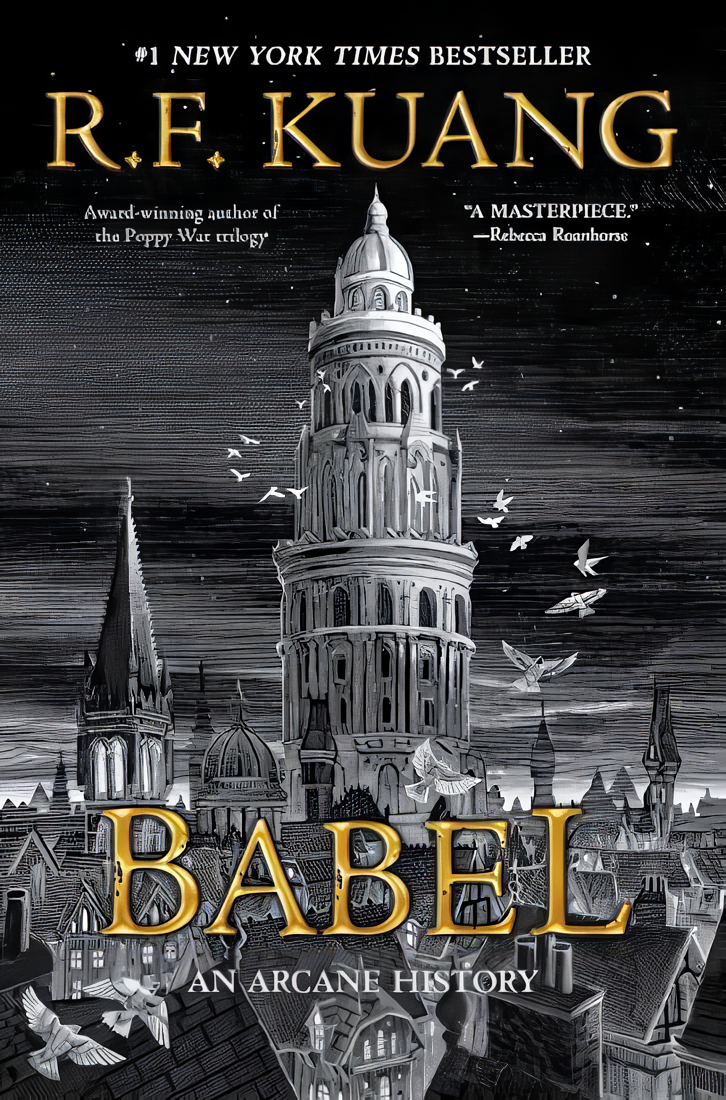
Babel: Or the Necessity of Violence: An Arcane History of the Oxford Translators' Revolution was published by Harper Voyager on August 23, 2022. It is a standalone historical fantasy novel set in an alternate nineteenth century where silver-working, powered by differences between translated words, supports Britain's industrial and imperial dominance.
The novel combines dark academia, alternate history, and anti-colonial political fantasy. It won the Nebula Award for Best Novel and became a major bestseller. Its full subtitle identifies the book as a deliberately constructed historical account, a choice reflected in its academic footnotes, etymological discussions, and attention to who controls the record of revolution.
The English-language audiobook is narrated by Chris Lew Kum Hoi, with footnotes read by Billie Fulford-Brown. Readers should be aware that the story includes racist abuse, colonial violence, child abuse, drug addiction, torture, murder, and suicide.