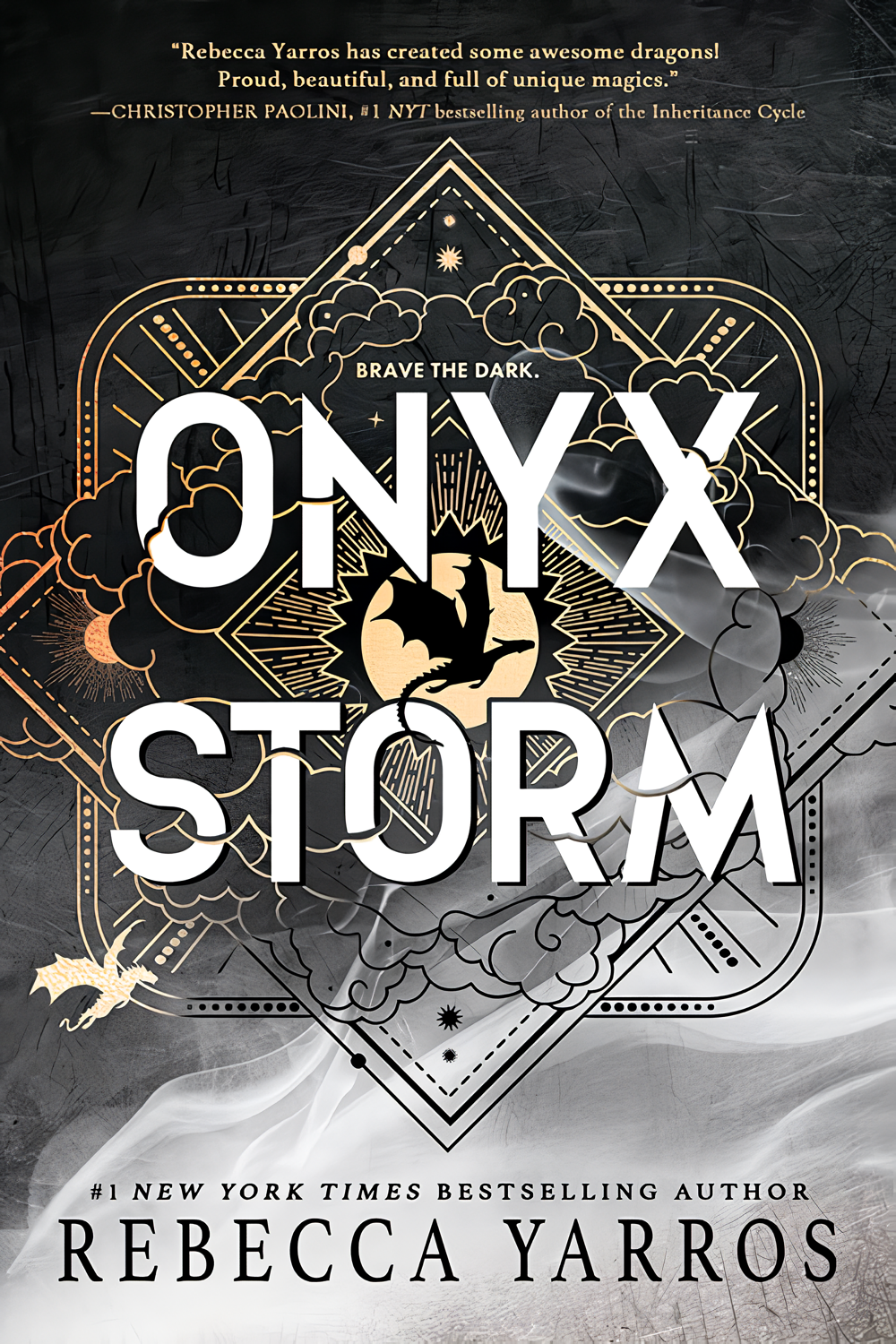
Onyx Storm
Onyx Storm begins where Iron Flame left Violet Sorrengail and Xaden Riorson: together, victorious, and facing a transformation that makes victory almost meaningless. Xaden saved Violet by drawing power directly from the earth, turning venin inside Basgiath's restored wards. Rebecca Yarros uses that secret as the engine of the third Empyrean novel. The question is no longer whether Violet and Xaden love each other. It is whether love can survive addiction, concealment, political war, and the possibility that saving one another is precisely what will destroy them.
The novel answers by making its world much larger. Basgiath and Aretia remain important, but Violet's search for a cure sends her across the continent and through a chain of islands whose cultures, gods, bargains, and magical rules differ from Navarre's. That expansion is welcome. The first two books often described a continent while confining the reader to military institutions. Here, diplomacy becomes as dangerous as combat, and survival sometimes depends on etiquette, poison, marriage law, a card game, or the ability to recognize what another society values.
Violet is well suited to that kind of quest. She remains most convincing when she solves problems through scholarship and improvisation rather than raw power. Her father's coded research, Deverelli's book trade, a royal poison test, and the lost history of the irids all reward the scribe she was trained to become. The story also continues to respect the practical realities of her body. She relies on braces, Tairn's saddle, teamwork, and carefully judged exertion rather than acquiring a magical cure for chronic pain and unstable joints.
The island sequence supplies the book's strongest sustained stretch. Deverelli turns knowledge into currency and exposes Courtlyn's cruelty. Unnbriel tests Violet and Xaden before a queen who demands dragon eggs as the price of military aid. Hedotis turns dinner into mutually assured poisoning. Zehyllna makes diplomacy into a game governed by gifts and chance. Each stop places the same characters under a different moral pressure, and the deaths accumulated along the way prevent the journey from feeling like a picturesque diversion.
The group around Violet is also more interesting than a conventional quest party. Mira, Dain, Ridoc, Cat, Aaric, and Xaden bring conflicting loyalties and histories into every negotiation. Cat continues her evolution from romantic rival into politically useful ally. Dain's archival skill and willingness to follow Violet make his redemption feel earned. Ridoc's humor conceals increasingly serious courage, while Aaric's royal identity and emerging precognition position him as far more than a rebellious prince hiding at Basgiath.
Sawyer's return to dragon flight is one of the book's quieter successes. His prosthetic is not treated as a miraculous restoration of the leg he lost. It requires design, practice, accommodation, and cooperation with Sliseag. Like Violet's saddle, it makes accessibility part of military ingenuity rather than a sentimental lesson. Yarros is at her best when her characters adapt the world around a disabled body instead of demanding that the body become ordinary.
Andarna receives the most important character arc. Her rarity made her a secret weapon in the earlier books, but Onyx Storm asks what that role has cost her. The irids regard her bond with Violet as corruption, and Andarna wants a history and community Violet cannot provide. When she breaks the bond and leaves, the pain matters because neither character is a villain. Violet loves her; Andarna still needs the freedom to decide who she is outside that love. Her eventual return is powerful because it is a choice rather than obedience.
Xaden's venin condition deepens the romance while intensifying its familiar problems. His hunger for power resembles addiction: it can be resisted, rationalized, hidden, and triggered by terror of losing someone. Violet establishes boundaries and searches obsessively for a cure, but their intimacy often operates alongside catastrophic urgency. The sexual scenes express their struggle for control and trust, though their frequency occasionally slows a plot already crowded with deadlines.
The lovers also remain trapped in a pattern of protective secrecy. Xaden withholds the severity of his condition. Violet conceals plans to protect him. Their friends learn the truth in stages, usually because circumstances make concealment impossible. The series rightly criticizes governments and families that deny people informed choice, but it continues to use delayed disclosure as a source of romantic suspense. By the third book, some of those arguments feel less like new conflict than recurrence.
Theophanie is a more evocative antagonist than many of the human officers who preceded her. A venin Maven who commands storms, she functions as a dark reflection of General Lilith Sorrengail and a possible future for Violet. Her former connection to the goddess Dunne gives the final battle religious as well as magical significance. Her interest in Violet and Xaden is threatening because she wants instruction, recruitment, and recognition---not merely their deaths.
The book's greatest weakness is excess. It contains a cure quest, several diplomatic missions, a succession crisis, weakened wards, dragon politics, hidden signets, multiple gods, traitors, a kidnapped sister, an academy evacuation, two major battles, and a mystery about Violet's parents. New proper nouns and magical exceptions arrive faster than many receive development. Signets can also feel increasingly convenient: distance wielding, dream walking, precognition, and possible undisclosed abilities all appear when the plot needs a new route through danger.
Yet Yarros remains exceptionally skilled at the accelerating reveal. Violet's second signet explains the dreams that have crossed apparent boundaries. Her parents' dedication connects family history to Xaden's fate. Theophanie's storm power echoes Lilith's. Panchek's betrayal reframes military failure. And the closing chapters distribute crucial events across Rhiannon, Imogen, Xaden, and Violet, making the final battle feel larger than a single hero's view.
The last chapter is deliberately destabilizing. Violet wakes after twelve missing hours with memories removed at her own request. She is married to Xaden, now Duchess of Tyrrendor, but Xaden and several riders are gone. Dragon eggs have vanished, people have been murdered, and a note orders her not to search for her husband. The device risks frustration because it withholds an event the protagonist apparently experienced. It also creates an effective mystery: Violet has converted her own mind into a locked archive, reproducing in miniature the series' central struggle over who controls history.
Onyx Storm is not the conclusion of a trilogy but the third volume of a planned five-book series, and it behaves like a middle novel. It expands more questions than it answers and ends by dismantling the apparent meaning of its own finale. Its plotting is overfull, its romance repeats old arguments, and its magic grows increasingly elastic. Even so, the island quest, Andarna's independence, the found-family ensemble, and the ferocity of the final revelations make it difficult to put down. It is an untidy bridge with some magnificent views.