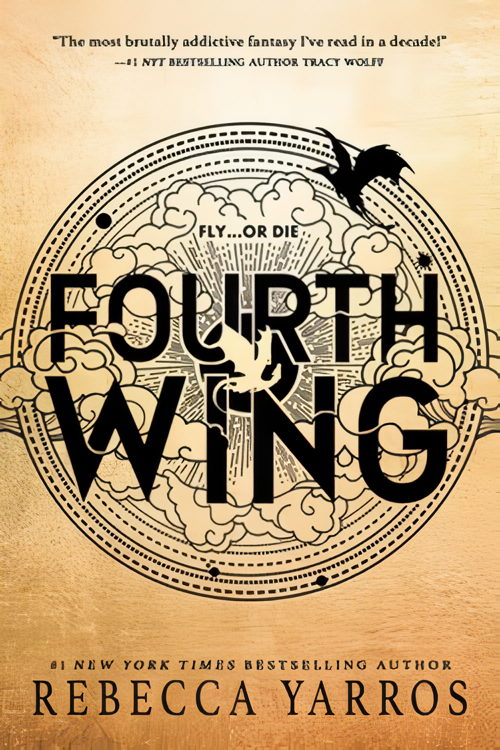
Fourth Wing
Fourth Wing is built from familiar materials: a lethal school, a physically underestimated heroine, dragons, secret rebels, a hostile love interest, and a government whose official history cannot survive serious scrutiny. Rebecca Yarros rarely disguises those ingredients. Her achievement is the speed and confidence with which she combines them. The novel reads less like an attempt to reinvent fantasy than like a machine designed to turn recognizable pleasures into momentum.
Violet Sorrengail is the element that holds the machine together. She has spent her life preparing to become a scribe, but her commanding mother forces her into Basgiath War College's Riders Quadrant. Violet's joints dislocate easily, her bones break more readily than those of other cadets, and almost everyone around her treats those facts as proof that she does not belong. The book's most satisfying choice is to let Violet adapt without curing or erasing her body. She uses braces, poisons, research, leverage, specially made equipment, and the help of people willing to listen. Survival comes from strategy and accommodation as much as endurance.
That makes the Riders Quadrant an effective arena for her. Its traditions are spectacularly cruel: candidates die crossing a parapet, cadets may kill one another in challenges, dragons incinerate people who offend them, and institutional authority treats the resulting death toll as quality control. The worldbuilding does not always withstand practical examination---an army that casually destroys so many recruits is difficult to justify---but the brutality gives every early milestone immediate force. Crossing the parapet, completing the Gauntlet, surviving Presentation, and entering Threshing create a strong sequence of escalating trials.
The dragons arrive late enough to feel earned and then improve nearly every scene. Tairn's dry impatience gives Violet a mentor who respects her intelligence without sentimentalizing her limitations. Andarna supplies wonder and vulnerability, while Sgaeyl's bond with Tairn creates an involuntary connection between Violet and Xaden. The telepathic conversations are efficient, funny, and emotionally revealing. They also complicate the human idea that riders command dragons; the dragons clearly possess their own history, laws, secrets, and priorities.
Xaden Riorson is a polished example of the dangerous romantic rival who turns out to understand the heroine better than her supposed protector. Dain repeatedly tells Violet that love means removing her from danger. Xaden tells her that danger is unavoidable and teaches her how to meet it. That contrast is sometimes too neatly arranged, and Dain's controlling behavior becomes increasingly repetitive, but it explains why Violet's loyalties shift. Xaden sees capability where Dain sees fragility.
The romance succeeds, for me, because attraction grows alongside practical trust. Xaden trains Violet, creates a saddle that accommodates her body, protects Andarna's secret, and entrusts Liam with her safety. Violet, in turn, refuses to inherit her mother's hatred of the rebellion's children. Their sharp dialogue and forbidden telepathic exchanges give the middle of the novel energy even when the academy plot pauses. The explicit scenes are emotionally tied to Violet's demand that physical intimacy cannot substitute for honesty.
Honesty becomes the novel's central problem. Violet has been trained to believe knowledge is sacred, yet the Archives are curated by a state that has erased the venin, Poromiel's true crisis, and the reasons behind the Tyrrish rebellion. Xaden's counter-conspiracy is morally stronger than Navarre's policy, but he repeats the same paternalistic logic when he withholds the truth from Violet. The book understands that a benevolent lie is still a theft of choice.
The supporting cast gives the story warmth. Rhiannon, Ridoc, and Sawyer quickly become a credible squad rather than disposable sidekicks. Liam is especially effective because his gentleness challenges everything Violet has been taught about the marked ones. His death at Resson is painful not simply because he is kind, but because he represents the future the rebellion claims to be fighting for. Mira and General Sorrengail offer two different versions of protective family love, while Brennan's supposed death shapes Violet long before the final reveal.
The novel is less successful when exposition arrives through classroom recitation or when modern dialogue clashes with the setting's military formality. Some antagonists, especially Jack Barlowe, are so openly murderous that the institution's tolerance of them becomes absurd. Basgiath's rules operate primarily to create danger, and the political geography remains thinner than the emotional relationships. The prose favors speed, repetition, and emphatic internal commentary over atmosphere or subtlety.
Those limitations matter less during the final act. The War Games carry Violet beyond the wards and reveal that the academy's manufactured competition has been hiding a real war. The Resson battle transforms folklore into fact, kills Liam, exposes Dain's violation of Violet's memories, and proves that Xaden's secrecy has consequences even when his cause is just. Violet's lightning becomes decisive only after she chooses to defend people Navarre has abandoned.
The ending wisely refuses to repair Violet and Xaden's relationship with one declaration of love. Violet believes the revolution but no longer trusts the people who decided what she was allowed to know. Brennan's return adds one more intimate betrayal to a political revelation. The cliffhanger therefore changes more than the scale of the conflict: it destroys the authority of Violet's education, her government, her dragons, her lover, and her family at the same time.
Fourth Wing is not a subtle novel, but it is a remarkably effective one. Its academy structure is clean, its dragons have personality, its romance has genuine narrative purpose, and its heroine survives through intelligence without being required to become physically invulnerable. Readers who want intricate politics or restrained prose may resist its excesses. Readers willing to accept its rules will understand why it became a phenomenon: it knows exactly when to offer danger, desire, grief, and another secret door.