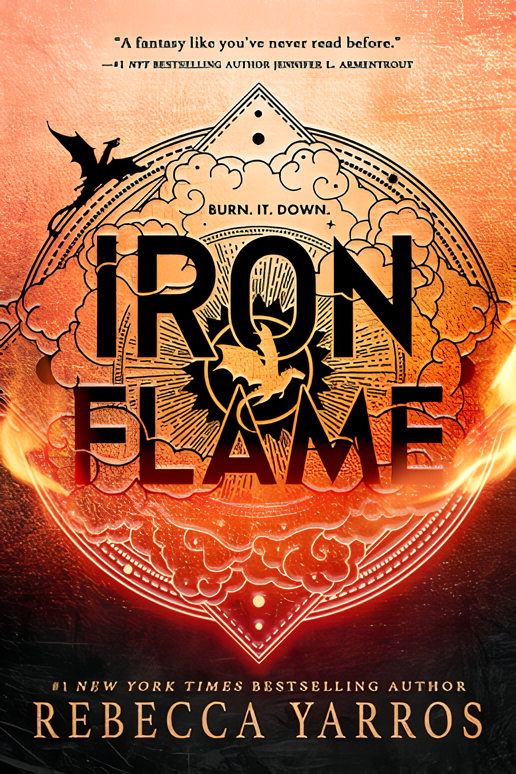
Iron Flame
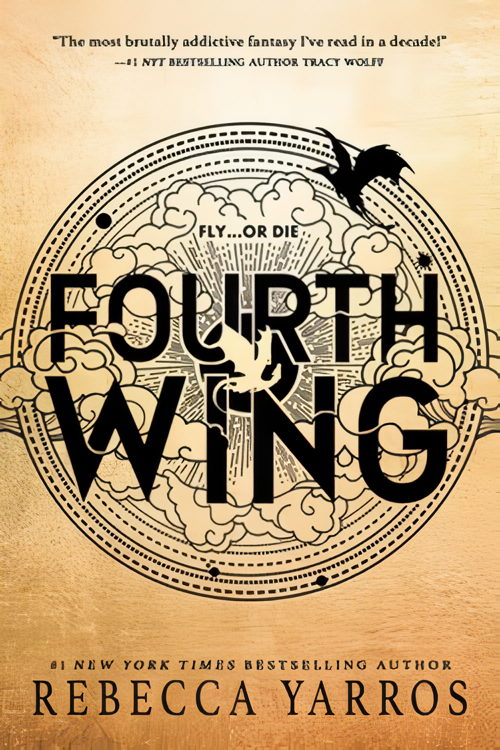
Iron Flame begins with the problem created by Fourth Wing: Violet Sorrengail now knows that nearly every institution responsible for educating and protecting her has lied. Venin are real, Poromiel is being destroyed, Brennan is alive, Xaden arms gryphon fliers, and Navarre's Archives are tools of state power. A smaller sequel might have concentrated on one revelation. Rebecca Yarros instead turns all of them into simultaneous emergencies.
The result is more ambitious and less controlled than the first novel. Basgiath remains a lethal academy, but it now shares the story with Aretia's revolution, a hidden weapons network, a search for the ward ritual, a political alliance with Poromish fliers, the return of Jack Barlowe, and a continent-wide venin advance. There is nearly always something urgent happening. The pace is compulsive, yet the accumulation can make the book feel like two sequels forced together.
That division is literal. Part One returns Violet to Basgiath, where Major Burton Varrish replaces the obvious hostility of rival cadets with institutional torture. He punishes Violet for Andarna's absence, uses signet-blocking serum, weaponizes Dain's memory gift, and attempts to discover the rebellion through her. The academy material works because Violet is no longer naive. She sees false Battle Brief reports, missing archival records, exhausted healers, and targeted murders as parts of the same system.
Violet's central conflict is no longer physical survival but information. She despises Xaden and Brennan for deciding what she can safely know, then reproduces their behavior by distancing herself from Rhiannon, Ridoc, and Sawyer. The irony is productive. Her friends do not ask to be protected by ignorance; they ask to choose their own risk. When Violet finally tells them about venin, the squad immediately becomes more capable. The novel repeatedly argues that consent requires knowledge.
The romance is both thematically relevant and frustratingly repetitive. Violet demands complete disclosure, while Xaden insists she ask the right questions. They circle the same argument through letters, alternate weekends, secrets, reunions, and sex. His reasons are understandable---many answers endanger the marked riders---but his habit of making decisions for Violet echoes Dain's worst behavior. Her refusal to trust without facts suits her character, yet the conflict sometimes feels maintained by deliberately imprecise conversation.
The book improves when other relationships interrupt that loop. Rhiannon's patience, Sawyer's steadiness, and Ridoc's irreverence make the squad feel like Violet's actual home. Jesinia chooses truth over the Archives that trained her. Dain's redemption begins not with an apology but with action: he refuses Varrish, reads the memories Violet intentionally shows him, attacks the torturer, helps steal and translate history, and follows the deserters to Aretia. Sloane's anger over Liam is allowed to be unfair before it becomes trust.
Varrish is an effective immediate villain because he embodies the state's belief that people are instruments. The interrogation sequence is brutal, and Violet's hallucinated conversations with Liam provide emotional continuity with the first book. Xaden's arrival offers catharsis, but Violet insisting on choice for every Basgiath cadet is the more important victory. She refuses to replace one secretive authority with another.
Part Two expands the world and the magic. Aretia becomes a counter-school where suppressed Tyrrish history, rune weaving, and cooperation with fliers replace Basgiath's nationalism. Felix is a better teacher for Violet than Professor Carr because he treats lightning as energy to be directed rather than spectacle to be forced. The ward research also turns translation into action: a mistaken word can decide who is protected, whose magic survives, and whether a city falls.
Catriona's arrival produces some of the sequel's weakest and strongest material. Her history as Xaden's former fiancée is used for familiar jealousy, and her emotion-amplifying gift makes Violet's insecurity physically literal. The rivalry can feel manufactured, especially when the war is so urgent. Yet Cat also becomes a useful political character and eventually an ally. The shift works because the women stop treating Xaden as the only fact that defines their relationship.
Andarna's development is more compelling. She wakes as an adolescent with a damaged wing, a sharp tongue, and scales that never seem to be one fixed color. Her inability to carry Violet prevents the second bond from becoming a convenient solution. When she kills Solas, protects Violet, breathes fire, and finally identifies herself as head of a seventh den, the story reveals that the dragons have hidden history as aggressively as the humans.
The wardstone plot is clever enough to hold the crowded second half together. Warrick's record is deliberately exclusionary; Lyra's preserves a broader truth. The difference between six and seven dens explains both Aretia's flawed wards and Andarna's long waiting. General Sorrengail's final sacrifice supplies the power Violet cannot survive giving and reinterprets her severity as a form of love, though it does not absolve the deaths enabled by her secrecy.
The battle at Basgiath is the novel at its most effective. Jack reveals he has been venin since before Violet struck him. The wards fall, Sawyer loses a leg, Andarna produces fire, and the scattered factions cooperate. The sequence pays off school, revolution, family, dragon, and translation plots without pretending the victory is clean.
Then the final chapter changes the meaning of that victory. Xaden channels from the earth to stop the Sage and protect Violet, becoming venin inside the newly restored wards. The choice fulfills the nightmares that both lovers believed belonged to Violet. It also exposes the flaw running through their relationship: love that refuses every limit can become indistinguishable from self-destruction.
Iron Flame is a difficult middle volume---overloaded, repetitive, and determined to end with a larger crisis than the one it resolves. It lacks the clean trial structure of Fourth Wing, but it deepens the series' best questions about truth, institutional loyalty, disability, and the moral danger of protection without consent. Its strongest scenes turn knowledge into a weapon. Its weakest delay knowledge to keep the romance arguing. The ending nevertheless lands with force because Xaden's secret is not another fact he withheld. It is a transformation neither of them can debate away.