Finding another book exactly like Dune is impossible because Dune is not doing one thing. It is a dynastic tragedy, a planetary ecology, a religious argument, a warning about charismatic leaders, and a space opera in which the most important substance in the universe comes from the life cycle of an animal. Recommend only desert novels and you lose the politics. Recommend only galactic empires and you lose the ecology. Recommend only chosen-one stories and you risk missing that Frank Herbert was suspicious of chosen ones.
This list therefore ranks books by the particular parts of Dune they reproduce or complicate. Some feature engineered aristocrats, forbidden technologies, and sword-bearing houses. Others build politics from climate, anthropology, religion, or a resource that ties one world to an empire. Several are not conventional space opera at all. They belong here because they understand Herbert's central lesson: a convincing speculative world is made from systems pressing against one another.
The ranking measures resemblance, quality, and the likelihood that a Dune reader will find the comparison useful. Number one is the closest overall match in atmosphere and architecture. Lower entries may be less immediately similar while offering the best version of one specific element—ecology, imperial seduction, unreliable prophecy, or technological religion.
None of these books is a substitute for Dune. That is precisely why they are worth reading. The best recommendation should lead away from imitation and toward another writer's equally particular obsession.
10
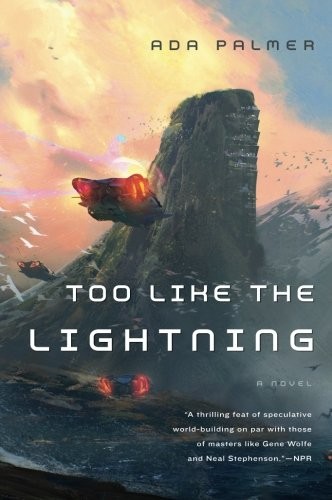
Too Like the Lightning
Ada Palmer · 2016 · Terra Ignota, Book 1
Closest Dune Connection Political philosophy, social engineering,
Main Difference Earth has become fast, interconnected, and almost
unreliable history, and the fragile design of a supposedly stable world order
post-national rather than feudal and planet-bound
Ada Palmer's future has enjoyed centuries of peace by replacing geographic nations with voluntary Hives organized around shared values. The arrangement looks rational, mobile, and humane. It is also held together by invisible labor, carefully distributed influence, suppressed history, and agreements most citizens never need to examine. A minor crime exposes the fault lines beneath the utopia.
That is where Too Like the Lightning resembles Dune. Both novels are fascinated by systems that appear permanent because their violence has been moved out of sight. Both place extraordinary individuals among political structures designed to predict human behavior. Both understand that philosophy becomes dangerous when powerful people treat it as operating software for civilization.
Mycroft Canner, the narrator, is a convicted criminal writing an official history for readers who may not exist yet. He argues, withholds, misgenders, confesses, flatters, and stages objections to his own account. Reading him produces the same useful suspicion inspired by Herbert's epigraphs and prophetic visions: information about the future is never neutral when someone controls its presentation.
The book is demanding. Its eighteenth-century voice, gender practices, invented political vocabulary, huge cast, and deliberate evasions create a steep entrance. The first volume also stops mid-crisis. Readers who liked Dune as a straightforward adventure may find it maddening. Readers who liked watching institutions turn ideas into power will find a future almost indecently rich in arguments.
9
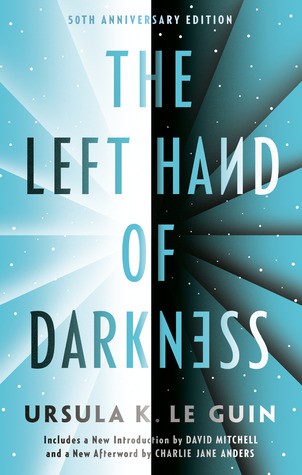
The Left Hand of Darkness
Ursula K. Le Guin · 1969 · The Hainish Cycle; readable as a standalone
Closest Dune Connection Planetary anthropology, climate, diplomacy,
Main Difference It rejects military conquest and heroic destiny in
religion, and the limits of an outsider's understanding
favor of patience, intimacy, and cultural translation
Genly Ai arrives on the frozen planet Gethen as an envoy asking its nations to join the Ekumen. He brings advanced knowledge and a historic invitation, but neither grants him the ability to read the people in front of him. Gethenians are ambisexual, their politics are shaped by rituals and assumptions Genly repeatedly misunderstands, and the planet's cold is an active constraint on every institution.
Le Guin shares Herbert's anthropological instinct. Culture is not decoration placed over a familiar society. Biology, environment, religion, language, and political custom grow together. Gethen's climate determines food, travel, architecture, borders, patience, and risk just as Arrakis makes water discipline inseparable from Fremen belief.
The crucial difference is scale of action. Genly does not become a messiah or conquer the world that resists him. His education comes through dependence on Estraven, the statesman he has misjudged. Their journey across the ice turns diplomatic abstraction into bodily trust. Where Dune shows how an outsider can seize the energy of a culture, The Left Hand of Darkness asks whether an outsider can stop interpreting difference as failure.
The pacing is reflective and the early political movement can feel remote. Le Guin also later reconsidered aspects of the novel's handling of gender, particularly its masculine language. Even with those limitations, this remains the best recommendation for readers who believe Dune's deepest achievement is making a planet's culture feel inseparable from its conditions.
8
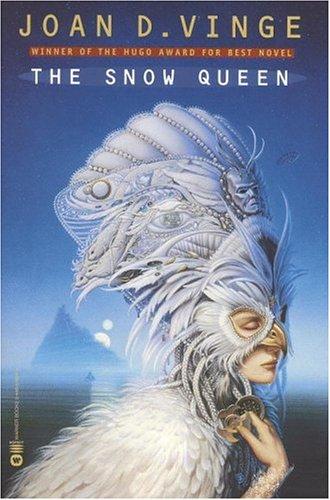
The Snow Queen
Joan D. Vinge · 1980 · The Snow Queen Cycle, Book 1
Closest Dune Connection A remote planet exploited for a unique
Main Difference It filters space opera through fairy tale, romantic
resource, offworld control, ritual succession, and politics shaped by an ecological cycle
doubling, and a mostly oceanic world
Tiamat sits at the edge of an interstellar civilization and possesses a resource the wider Hegemony desperately wants: the water of life taken from the planet's mers. It can extend human life, which makes local ecology a foundation of offworld power. The Hegemony controls access while discouraging technological development that might allow Tiamat to escape dependence.
The resemblance to Arrakis is immediate but not superficial. In both books, imperial wealth depends on a substance whose true origin is entangled with a native life cycle. Offworld rulers understand the commodity more clearly than the world. Local customs that appear picturesque or irrational are political adaptations to repeating environmental conditions.
Vinge organizes the conflict through the alternating reigns of Winter and Summer, the Snow Queen Arienrhod, and Moon, a young sibyl drawn into a struggle over Tiamat's future. Fairy-tale motifs coexist with star gates, longevity science, policing, and colonial economics. The prophetic elements are technologically complicated without losing their mythic charge.
The novel is more romantic and more openly archetypal than Dune. Some turns depend on coincidence and destiny, and the fairy-tale structure can make secondary characters feel arranged around symbolic roles. Yet Tiamat's exploitation is concrete, and the book never forgets that environmental knowledge belongs to the people whose lives the empire treats as scenery.
7
Grass
Sheri S. Tepper · 1989 · The Arbai Trilogy, Book 1
Closest Dune Connection Planetary ecology, aristocratic ritual,
Main Difference It is an ecological investigation and social horror
religious authority, and a biological mystery with civilization-wide consequences
story rather than a dynastic war epic
Grass is the one human world apparently untouched by a plague spreading across inhabited space. Its aristocrats live on vast estates and perform elaborate hunts across beautiful grasslands. The ritual looks like a transplanted country-house tradition until Marjorie Westriding begins to see that the animals, riders, native species, and terrain are participating in something humans have badly misread.
Tepper approaches ecology the way Herbert does: as relationship rather than background. The planet cannot be understood by isolating a useful organism and naming its function. Behavior moves through an entire web, and the ruling class preserves ignorance because its ceremonies make exploitation feel natural. The hunt is leisure, status, violence, and evidence all at once.
Marjorie's mission is entangled with a powerful religion and with family structures that reward obedience. Her investigation becomes a critique of aristocratic entitlement, institutional certainty, and the assumption that a planet exists to be interpreted by its colonists. Readers who appreciated Liet-Kynes or the ecological appendices to Dune may find this book unusually satisfying.
Its arguments can become blunt, and the social divisions are sometimes drawn more starkly than the characters inhabiting them. The opening also withholds its horror patiently. Once the ecological mechanism becomes visible, however, Grass delivers the rarest kind of Dune-like pleasure: the realization that every beautiful detail in the landscape has been part of the plot.
6
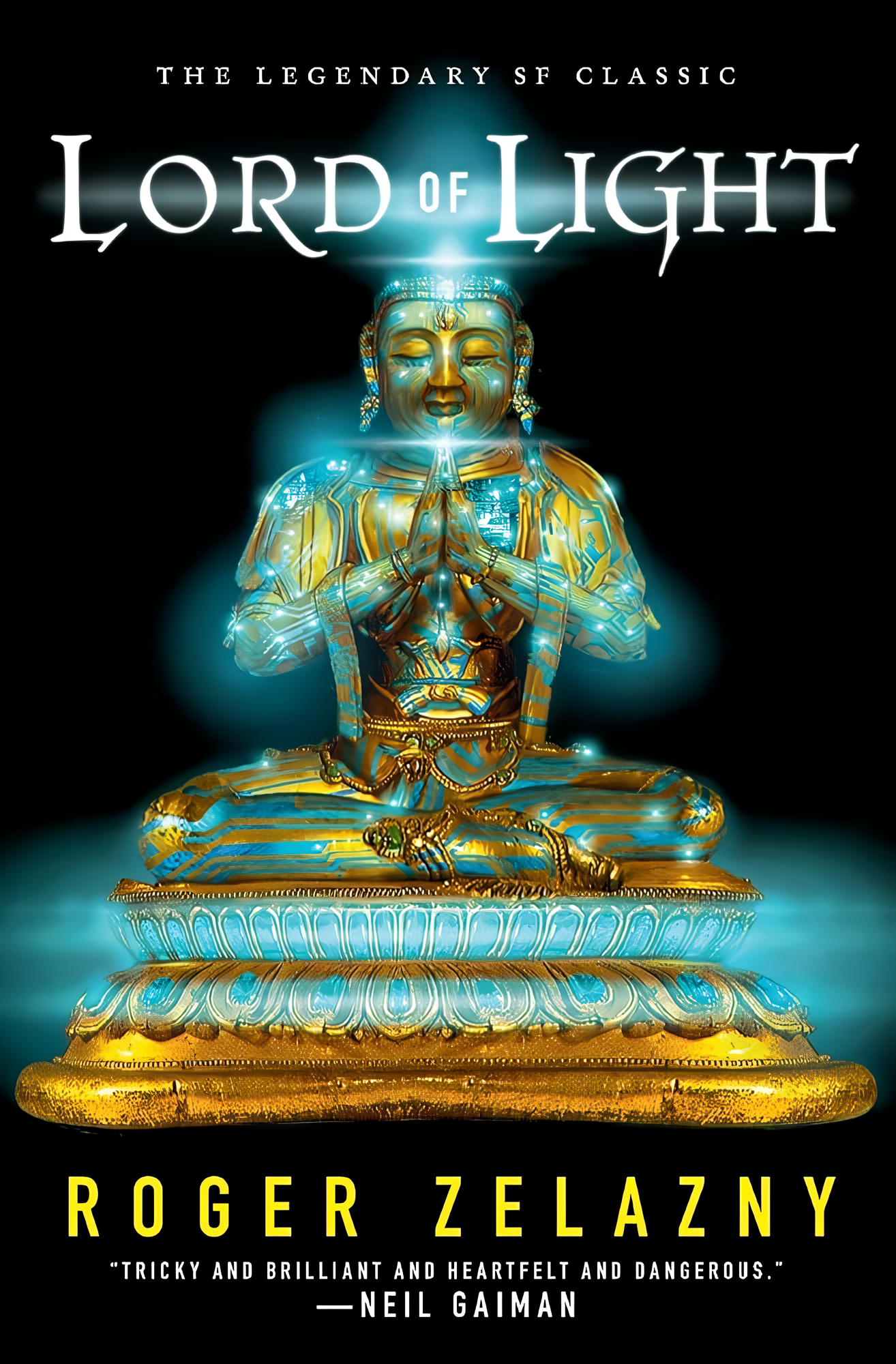
Lord of Light
Roger Zelazny · 1967 · Standalone
Closest Dune Connection Religion engineered as political
Main Difference It is compressed, nonlinear, playful, and built
technology, an elite controlling human development, and rebellion conducted through myth
from Hindu and Buddhist traditions rather than desert prophecy
The original colonists of a distant planet have used body transfer and advanced technology to install themselves as the Hindu pantheon. They control reincarnation, restrict scientific progress, and decide who may return in a desirable body. Their divinity is constructed, but construction does not make it powerless. Generations have lived inside the story the gods created.
Sam, one of the original crew, rebels by adopting the role of the Buddha and introducing a rival religion. Like the Bene Gesserit, he understands belief as a technology that can be seeded, adapted, and aimed at political structures. Like Paul, he discovers that performing a sacred role creates consequences larger than private intention.
Zelazny refuses the easy reveal that religion is fake because the machinery is scientific. The gods possess real abilities. Reincarnation actually occurs. Myths shape conduct even when their architects remember the equipment behind them. The interesting question is not whether the supernatural can be explained, but who controls the explanation.
The novel's nonlinear order and compressed cast require attention, while its use of living religions deserves more critical distance than older science fiction often gave it. It also lacks Dune's slow ecological construction. What it offers instead is a fiercely elegant version of one central Herbert idea: the person who controls the sacred vocabulary can challenge the person who controls the weapon.
We reviewed this: read our full review of Lord of Light →
5
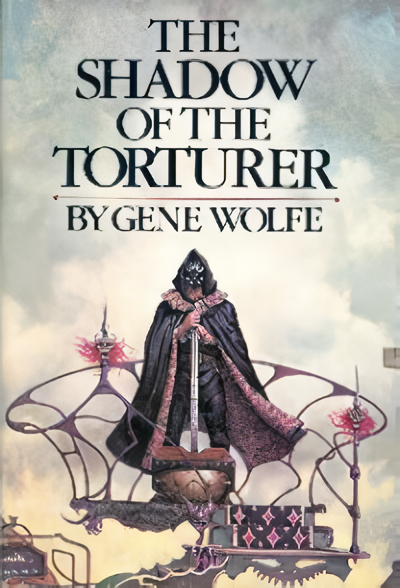
The Shadow of the Torturer
Gene Wolfe · 1980 · The Book of the New Sun, Volume 1
Closest Dune Connection Baroque far-future civilization, ritualized
Main Difference It hides its world rather than explaining it and
institutions, unreliable memory, and technology mistaken for myth
follows exile instead of imperial ascent
Severian is an apprentice in the guild of torturers who claims perfect memory. After showing mercy to a prisoner, he is exiled from the guild and sent away from the dying city of Nessus. His account seems precise, yet precision is one of the tools he uses to guide, excuse, and mislead the reader.
Like Dune, Wolfe's novel takes place so far in the future that history has become a physical atmosphere. Titles, ceremonies, relics, weapons, extinct species, and cosmic events survive after their original meanings have eroded. A tower may once have been a spacecraft. A miracle may be technology. Naming the mechanism does not dissolve the wonder because no character possesses enough context to restore a simple boundary between science and myth.
The similarity extends to power. Severian belongs to an institution that turns violence into solemn procedure, much as Herbert's houses and schools ritualize coercion. Both authors trust the reader to notice what the narrator's culture treats as normal. Neither supplies a neutral modern observer to settle every moral question.
This is the most difficult recommendation on the list. Plot can seem episodic, clues are rarely announced, Severian's treatment of women is disturbing, and the book expects rereading. Readers who love Dune for clear political machinery may feel abandoned. Readers who love its sensation of looking down through strata of forgotten history may find an even deeper abyss.
We reviewed this: read our full review of The Shadow of the Torturer →
4
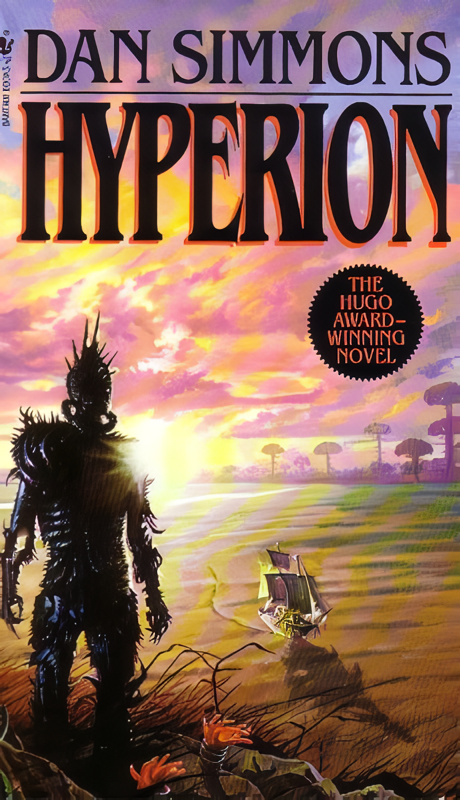
Hyperion
Dan Simmons · 1989 · The Hyperion Cantos, Book 1
Closest Dune Connection Pilgrimage, religion, interstellar
Main Difference It is built from linked personal tales and ends
politics, prophecy, time, and a world whose mystery threatens an empire
before the central pilgrimage resolves
Seven pilgrims travel to the Time Tombs on Hyperion as interstellar war approaches. Each has a connection to the Shrike, a metallic creature treated as god, monster, weapon, and judgment. On the journey, they tell the stories that brought them to the same impossible destination.
Simmons shares Herbert's appetite for making religion politically consequential without reducing belief to ignorance. The Shrike Church, the Hegemony, artificial intelligences, military power, resurrection, and prophetic time all compete to interpret the Tombs. No single institution understands the whole system, but each is willing to sacrifice people to secure its preferred answer.
The Canterbury Tales structure makes the cosmic intimate. One story becomes body horror, another military tragedy, another detective fiction, and another an almost unbearable study of parental love under time dilation. The result resembles Dune less in surface than in density: technology, myth, empire, ecology, and private grief keep changing one another's meaning.
The price is incompleteness. Hyperion ends at the threshold, and The Fall of Hyperion is required for narrative resolution. Some tales are stronger than others, and parts of the sexual politics have aged poorly. Even so, few books offer Dune readers a comparable sensation of ancient forces becoming active while political leaders continue pretending they control the timetable.
We reviewed this: read our full review of Hyperion →
3
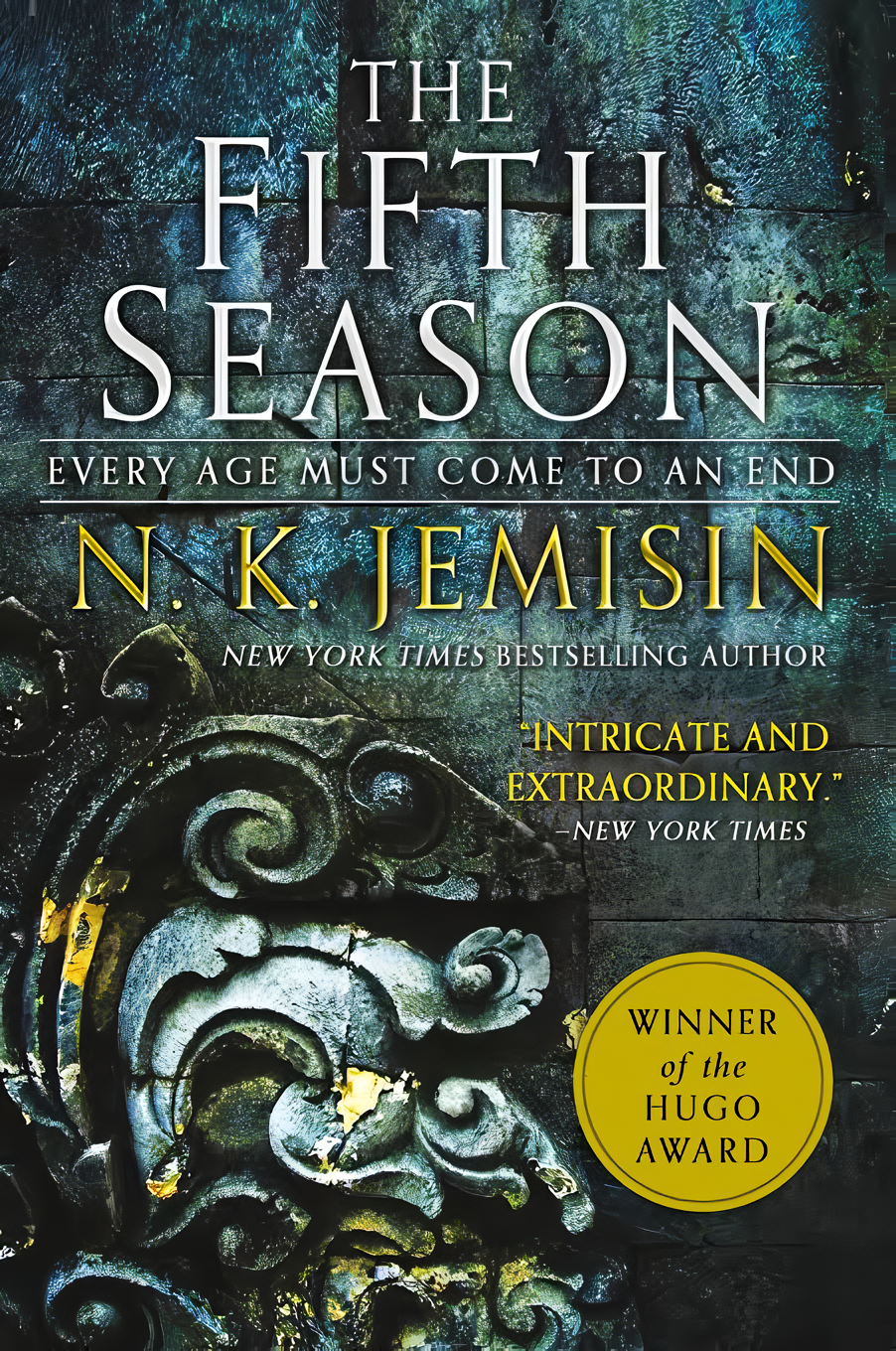
The Fifth Season
N. K. Jemisin · 2015 · The Broken Earth, Book 1
Closest Dune Connection Ecology as destiny, a persecuted population
Main Difference The catastrophe is geological and immediate, while
with essential power, imperial control, and the weaponization of human bodies
the narrative centers oppression, motherhood, and divided identity
The Stillness is a supercontinent shaped by recurring eras of catastrophic climate disruption. Its communities store supplies, preserve survival rules, and accept brutality as the cost of continuity. Orogenes can control seismic energy. Their abilities make them indispensable during disaster and dangerous to an empire that cannot tolerate power it does not own.
The Fulcrum captures, trains, breeds, and disciplines orogenes while describing the process as protection. That contradiction will feel familiar to readers of Dune: a ruling system depends on the people it dehumanizes, then treats control of those people as proof of its own necessity. Knowledge about the planet is distributed according to political usefulness.
Jemisin's geology is not scenery. Earthquakes determine architecture, food, movement, education, prejudice, and the stories societies tell about deserved survival. The world's missing moon, obelisks, engineered beings, and deep history gradually transform apparent fantasy into science fantasy without emptying its powers of awe.
The three narrative threads and second-person voice can initially feel forbidding, and the novel contains violence against children that makes it emotionally harder than most entries here. The structure eventually reveals itself as an expression of trauma rather than a puzzle for its own sake. For readers who believe Dune's ecology is inseparable from its politics, The Fifth Season is the strongest modern companion.
We reviewed this: read our full review of The Fifth Season →
2
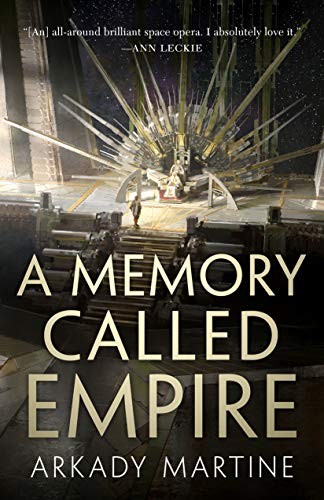
A Memory Called Empire
Arkady Martine · 2019 · Teixcalaan, Book 1
Closest Dune Connection Imperial politics, cultural assimilation,
Main Difference Its central weapons are language, diplomacy,
succession crisis, strategic memory, and the seduction of power
poetry, and identity rather than armies or ecological control
Mahit Dzmare arrives in the capital of the Teixcalaanli Empire as ambassador from tiny, independent Lsel Station. Her predecessor has died under suspicious circumstances, the emperor's succession has become unstable, and the outdated consciousness of that predecessor implanted in Mahit's mind is malfunctioning. She must investigate without revealing the technology her own culture considers essential.
This is the book for readers who loved the dinner scene in Dune, the Bene Gesserit conversations, and every moment when a phrase rearranges a room before anyone draws a weapon. Teixcalaan expands through military force, but its more durable conquest occurs through beauty. Mahit has spent her life loving its poetry and history. She wants to resist absorption by a culture that has already shaped her imagination.
Martine understands empire as an aesthetic experience. Names, verse, etiquette, public ritual, and historical memory determine who appears civilized enough to speak. The conflict is not between an authentic self and an obviously alien enemy. Mahit must protect her home while admitting that part of her longs to belong to the power threatening it.
The novel has little of Dune's ecology and its action is comparatively restrained. Readers wanting battles and monsters may find its diplomatic procedure too quiet. Its murder mystery is also less important than its cultural argument. As a study of why intelligent people can love an empire they know is dangerous, it stands closer to Herbert than most louder space operas.
1
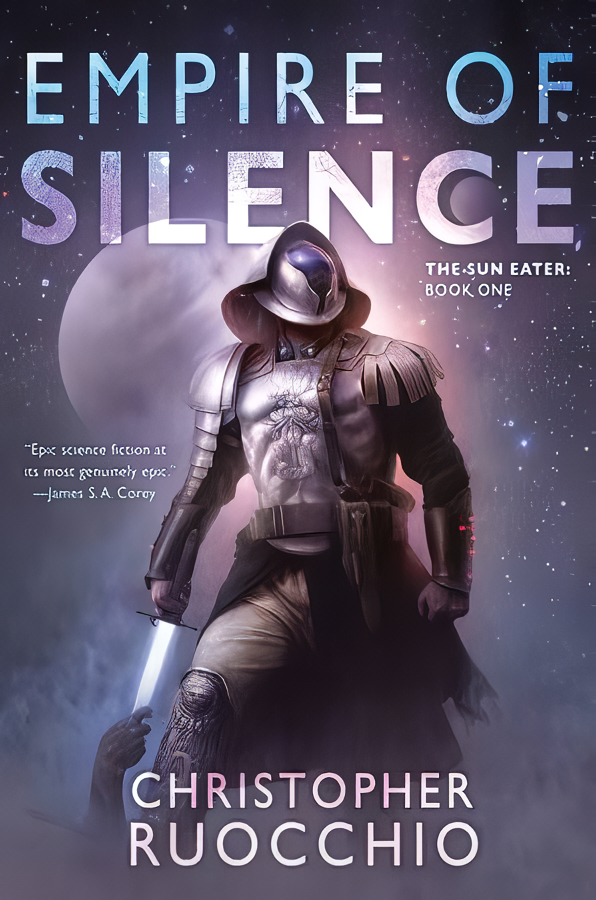
Empire of Silence
Christopher Ruocchio · 2018 · The Sun Eater, Book 1
Closest Dune Connection Feudal space empire, engineered nobility,
Main Difference It is a retrospective confession whose first volume
forbidden technology, religious authority, sword culture, and a famous heir caught inside historical myth
focuses on exile and identity rather than conquest
Hadrian Marlowe begins his memoir after history has already judged him. He is the Sun Eater, the man who destroyed a star and killed billions to end the Cielcin war. The young Hadrian introduced in Empire of Silence is not yet capable of imagining that ending. He is the heir to a powerful house who wants to abandon rule for the wandering life of a scholar.
The Sollan Empire supplies the closest overall atmosphere to Dune on this list. Great houses govern distant worlds. Aristocrats are genetically engineered and live for centuries. Advanced machines are morally and religiously restricted. Swords retain ritual importance beside starships. The Chantry controls doctrine, while interstellar travel stretches politics across lifetimes.
Ruocchio also shares Herbert's suspicion of the heroic identity his story is constructing. Hadrian is compassionate, intelligent, vain, theatrical, and eager to believe he is different from the people who raised him. The older narrator examines that self-image from the far side of catastrophe. Every apparent act of freedom becomes another step toward the legend announced at the beginning.
The comparison is so close that it exposes the novel's main weakness. Dune, The Book of the New Sun, and other genre landmarks are visible in the architecture, and the first half is deliberately slow. Hadrian's years on the streets and in the arena postpone the alien war the framing promises.
That patience eventually becomes the reason to recommend it. The novel gives its future destroyer time to be a failed son, fugitive, thief, friend, gladiator, and would-be peacemaker. Readers looking for the nearest modern equivalent to Dune's mixture of aristocracy, religion, history, and myth should begin here—then continue, because the scale of The Sun Eater only becomes clear after its hero leaves the first world that remade him.
We reviewed this: read our full review of Empire of Silence →