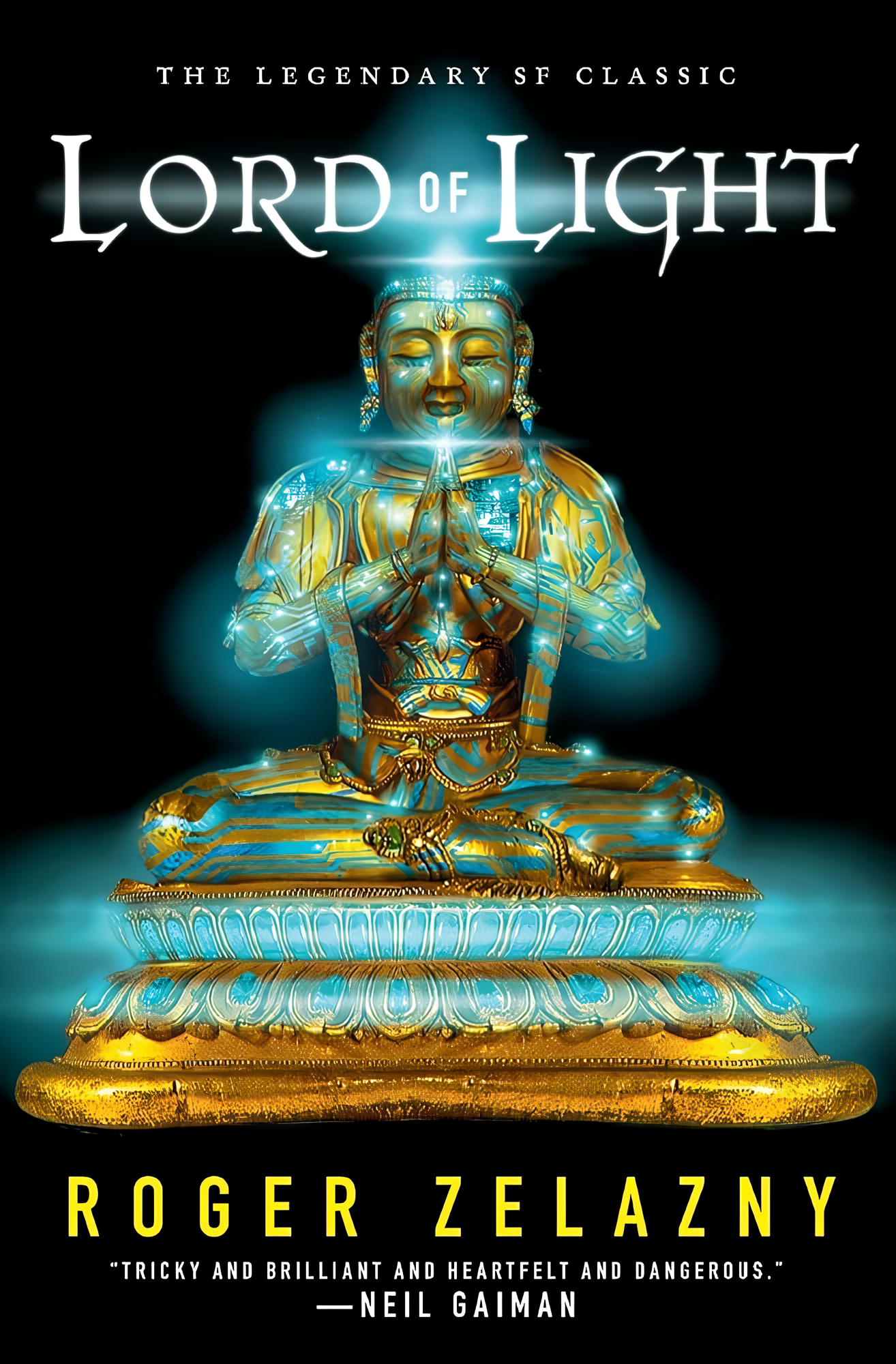
Roger Zelazny's Lord of Light opens with a resurrection performed by radio. Yama, who calls himself the god of death, retrieves a personality from the planet's magnetic ring and installs it in a waiting body. The scene sounds like ritual because the participants have spent centuries making technology indistinguishable from religion. Zelazny's most famous trick is not that the gods are really starship colonists. It is that, after enough reincarnations and worship, "really" stops being a simple word.
The planet was settled by the crew and passengers of the Star of India. The original crew mastered mind transfer, engineered new bodies, developed psychic abilities, and defeated the native energy beings they named demons. They then restricted technology, monopolized reincarnation, and adopted the identities of Hindu deities. Immortality becomes the basis of class rule. Karma is not merely doctrine; it is an administrative file used to decide whether a dissenter receives a beautiful body, a diseased one, or the body of an animal.
Against this order stands Sam, once a member of the First and occasionally a god himself. He is an accelerationist in the literal political sense: he wants scientific knowledge released so ordinary people can advance beyond the medieval world Heaven maintains. His rebellion is practical, theatrical, and morally slippery. He adopts the role of the Buddha not because he begins as a believer but because a doctrine of release can weaken a regime whose authority depends on better rebirth.
That cynical beginning becomes one of the novel's sharpest complications. Rild, the assassin sent to kill Sam, converts and becomes a more authentic teacher than the man who invented the movement as strategy. Sam may be the false Buddha who creates a true one. Zelazny refuses to let sincerity and manipulation remain opposites: a borrowed teaching can liberate, a manufactured god can exercise real power, and political theater can generate convictions its author cannot control.
The book's nonlinear structure initially obscures that argument. Chapter One occurs after the great defeat at Keenset, while the next five chapters move backward to show how Sam began his rebellion, created Buddhism, freed the demons, infiltrated Heaven, and lost the war. Only the final chapter returns to the revived Sam. The arrangement makes him legendary before he becomes understandable. Readers must reconstruct chronology in the same way the planet's inhabitants reconstruct myth from names, bodies, and contradictory stories.
Zelazny's prose is compressed, formal, and playful. Philosophical exchanges can become jokes; jokes can harden into prophecy; duels acquire the cadence of scripture before resolving through concealed machinery. The style rarely pauses to explain the rules at length. That economy gives the novel extraordinary speed for a book built from theology, politics, and centuries of history, though it can also leave minor characters and transitions feeling like fragments of a larger saga.
Yama provides the strongest counterweight to Sam. He is scientist, weapons designer, executioner, and genuine believer in order. His loyalty to Heaven is intellectual until his love for Kali exposes how casually that order treats persons as replaceable bodies. Their eventual alliance is not a conversion to Sam's philosophy so much as the result of Heaven making its own principles unbearable.
Kali is lover, enemy, warrior, and political force, but she is also the character most constrained by the book's masculine games of desire and betrayal. She embraces destruction because it gives her a stable identity across bodies, then assumes the male office of Brahma when power demands another transformation. The novel is fascinated by gender as something technologically mutable, yet its language and sexual politics remain recognizably those of the 1960s.
Its use of Hindu and Buddhist traditions likewise requires attention. Zelazny draws names, concepts, and imagery into a hybrid future governed by mostly Western-descended colonists. The result is dazzling science fantasy and a critique of cultural appropriation inside the plot—the gods have quite literally turned a religious vocabulary into an instrument of empire. The novel can still reproduce the appropriation it satirizes, especially when distinct traditions are treated as a single storehouse of mythic effects.
The final conflict refuses the comfort of a clean secular revolution. Sam allies with Heaven against Nirriti, the ship's former Christian chaplain, because Nirriti's crusade is more immediately annihilating than the regime Sam has spent centuries opposing. Ideological enemies cooperate, a demon sabotages diplomacy for pride, and victory leaves damaged survivors rather than a new constitution. Sam succeeds less by taking the throne than by making the old monopoly impossible to restore.
Lord of Light remains a landmark because its science and mythology are inseparable. Reincarnation is both data transfer and religious experience. Divine Attributes are engineered faculties made supernatural by history and belief. Zelazny asks whether exposing the machine destroys the god, then answers with a wry refusal: sometimes knowing how a miracle works only reveals who owns it.