The Book in Brief
On a planet colonized by the starship Star of India, the original crew have used mind-transfer technology and engineered powers to become the Hindu pantheon. They monopolize reincarnation, suppress technological development, and maintain a caste system through the Masters of Karma. Sam, one of the original crew, rejects their rule and believes scientific advancement should be available to everyone.
The novel opens after Sam's apparent defeat. Yama, Ratri, and Tak—now trapped in the body of an ape—retrieve Sam's disembodied mind from the planet's magnetic ring. Mara comes to find them and dies in Yama’s grip; as they make for Ratri’s palace in Khaipur, Sam remembers how his rebellion began. Living as the aging Prince Siddhartha, he visited the city of Mahartha for a new body and discovered how completely the gods had converted reincarnation into political control. After speaking with Jan Olvegg and Brahma, he raided the Hall of Karma, stole the transfer apparatus, and began open opposition.
Sam adopted the role of the Buddha and preached release from the cycle of reward controlled by Heaven. Kali sent the assassin Rild to kill him, but Sam found him sick in the marshes and nursed him back to health. Rild converted sincerely, took the name Sugata, and became a truer teacher than Sam. Yama killed Rild in a duel, but Sam escaped and promised to return with new weapons.
Seeking allies, Sam entered Hellwell and freed Taraka, leader of the native energy beings called demons. Taraka possessed Sam's body and indulged in conquest, but sharing consciousness gave the demon an unwanted conscience. When Agni attacked, Sam and Taraka fled to Hellwell and released more demons. Yama, Kali, Shiva, and Agni defeated them, and Sam was taken captive to Heaven.
In Heaven, Sam preached among the gods while preparing escape. With help from Helba, Goddess of Thieves, he tried to recover old technology, but the attempt failed. Kali and Brahma arranged for Sam and Helba to be hunted as sacrifices during Kali's wedding to Yama. Tak tried to save Sam and was punished by reincarnation as an ape. Sam appeared to die, but Taraka had strengthened his mind so it could survive without a body.
Sam displaced the demigod Murugan during a body transfer and secretly murdered Brahma and Shiva. Kubera discovered him but chose escape over betrayal. After defeating Sam in an Irish Stand-Down to prevent him from attacking Yama, Kubera brought him and Ratri toward Keenset, a city undergoing technological revival. Yama, disgusted by Kali's willingness to abandon their marriage and become the new Brahma, joined them. Their coalition included demons, rebels, and Nirriti's zombie soldiers. Heaven defeated them at enormous cost. Sam was projected into the magnetic ring, Ratri was exiled through undesirable bodies, Kubera hid among men, leaking scientific knowledge to them, and Yama disappeared after apparently developing remote reincarnation.
Returned years later, Sam reunites with Yama, Ratri, Kubera, and Krishna. Nirriti has become a conquering Christian warlord with advanced weapons and soulless armies. Taraka falsely reports that Nirriti refused an alliance because the demon wants his own duel with Yama. Sam therefore negotiates a temporary alliance with Heaven. The combined forces defeat Nirriti, though Ganesha betrays them and many gods die. Taraka is killed by Yama; the dying Nirriti asks Sam for a blessing and receives it.
Kali, now Brahma, is mortally wounded. Yama tries to transfer her mind into a new body, but the process leaves her childlike and mentally damaged; he calls her Murga. Kubera helps restore some of her mind. Tak and Ratri receive young bodies. Sam leaves without taking power, and Yama later follows. Their disappearances become another layer of legend, while technology, dissent, and the weakened authority of Heaven continue to spread.
Important Characters
Sam / Mahasamatman / Siddhartha / the Buddha: One of the First colonists and former Binder of Demons. His electrodirection controls electromagnetic forces, while his rebellion attacks Heaven's monopoly on knowledge and rebirth.
Yama: God of Death, supreme weapons designer, and master of the death gaze. He begins as Sam's most dangerous opponent and becomes his essential ally after Heaven's treatment of Kali destroys his loyalty.
Kali / Durga / Brahma: Goddess of destruction, former lover of Sam, and intended bride of Yama. Her appetite for chaos and power drives major betrayals; she later assumes the office and male body of Brahma.
Tak of the Bright Spear: Heaven's archivist and, in one life, Sam's son. He is punished for helping Sam by being transferred into an ape and assists in restoring him.
Kubera: Loyal friend of Yama, powerful technologist, and master of investing objects with emotion. His humor and appetite conceal formidable intelligence and physical strength.
Ratri: Goddess of Night, able to cast supernatural darkness. Her sympathy for Sam leads to exile, but she remains one of the rebellion's most durable members.
Rild / Sugata: Kali's executioner, sent to assassinate Sam. After conversion he becomes the movement's sincere Buddha and dies confronting Yama.
Taraka: Lord of the Rakasha, native energy beings called demons by the colonists. Possessing Sam gives him a conscience, but pride later sabotages the attempted alliance with Nirriti.
Nirriti the Black / Renfrew: Former Christian chaplain of the Star of India. He builds an army of soulless organic automata and wages a crusade against Heaven and its religions.
Ganesha: Court manipulator who believes he can control each new crisis. His plots weaken Heaven, empower Nirriti, and ultimately bring about his death.
Jan Olvegg: Former captain of the colony ship and one of the First. His account of the gods' transformation helps push Sam from retirement into rebellion.
Brahma: The original office of creator and ruler within the Trimurti. The holder Sam confronts was once Madeleine; after that Brahma's murder, Kali takes the role.
Spoiler Warning: The seven chapter summaries below reveal the novel's nonlinear chronology, Sam's identities, the battle of Keenset, the fall of Nirriti, and Kali's final fate.
Chapter Summary
Chapter 1. At a remote monastery, Yama, Ratri, and Tak use forbidden equipment to pull Sam's atman from the magnetic Bridge of the Gods and place it in a body. Sam claims the disembodied state was Nirvana and resists returning fully to sensation, but food, weather, meditation, and companionship draw him back. Mara arrives disguised to investigate the disturbance. Yama exposes and kills him, forcing the group to flee. As they travel, Sam begins remembering the long campaign that led to his imprisonment in the sky.
Chapter 2. Years earlier, the aging Prince Siddhartha enters Mahartha seeking reincarnation. The Masters of Karma probe applicants and use political records to assign bodies, punishing dissenters with illness or animal form. Siddhartha finds Jan Olvegg and reveals that he is Sam, a former member of the original crew. A conversation with Brahma shows how fully the First have learned to believe their own divine performance. Sam raids the Hall of Karma, steals the body-transfer machinery itself, and transfers the Chief Master into a dog. Retirement ends; his rebellion begins.
Chapter 3. Sam appears as the Buddha and teaches that liberation lies outside the cycle of better lives controlled by Heaven. Kali sends Rild to assassinate him, but Rild falls ill and is cared for by the very community he meant to destroy. Gratitude becomes conviction. He takes the name Sugata and develops into a teacher whose faith surpasses Sam's strategic imitation. When Yama comes for Sam, Sugata meets the death god on a log bridge and is killed. Sam deceives Yama, escapes, and warns that Kali's love belongs to chaos rather than to any lover.
Chapter 4. Sam enters Hellwell, where he once bound the native Rakasha, and bargains with Taraka for military aid. Taraka answers freedom with possession, taking Sam's body, overthrowing a local ruler, and indulging in luxury. Shared consciousness changes them both: Sam feels the demon's appetites, while Taraka acquires guilt and restraint. Agni attacks and recognizes two beings inside one body. They retreat, release the demons, and confront Yama, Kali, Shiva, and Agni. The gods defeat the Rakasha; Taraka abandons the body, and Sam is captured for transport to Heaven.
Chapter 5. Sam is held with deceptive freedom in Heaven during preparations for Yama and Kali's wedding. He preaches, renews his dangerous intimacy with Kali, and uses Helba's help to reach technology stored in a museum. Mara's illusions foil the escape. Kali, angry at Sam and herself, persuades Brahma to make Sam and Helba sacrificial prey for the White Tigers of Kaniburrha. Tak intervenes and is struck down by Ganesha, then condemned to an ape's body. Sam appears to die during the hunt, but the spiritual strength Taraka gave him allows his atman to survive.
Chapter 6. Sam steals Murugan's prepared body during transfer and murders Brahma and Shiva while hidden inside Heaven. Kubera detects him through the transfer records. Rather than surrender him, Kubera prevents Sam from targeting Yama, knocks him unconscious in an exchange of bare-handed blows, recruits Ratri, and escapes. Kali accepts reincarnation as the new Brahma, coldly ending her marriage before it begins; Yama turns against Heaven and joins Sam at Keenset. Rebels, technological progressives, demons, and Nirriti's dead armies battle the gods. The coalition loses, but Heaven is shattered. Sam is projected into the ring, Ratri exiled, Kubera hidden, and Yama presumed dead after demonstrating the possibility of remote transfer.
Chapter 7. The narrative returns to the revived Sam. He, Yama, Ratri, Kubera, and the exiled Krishna learn that Nirriti has become a stronger threat than Heaven, conquering cities with advanced weapons and soulless soldiers. Taraka lies about Nirriti's willingness to negotiate because he wants to challenge Yama. Sam therefore secures a temporary alliance with Brahma/Kali. In the final battle Ganesha betrays Heaven, Taraka attacks Yama and dies, and Nirriti's forces are destroyed at terrible cost. Nirriti dies asking the false Buddha for a blessing. Yama transfers the mortally wounded Kali into a damaged new mind and calls her Murga; Kubera helps awaken her. Tak and Ratri are restored, while Sam and later Yama depart into legend.
Ending Explained
Sam does not overthrow Heaven by replacing Brahma. He destroys its claim to inevitability. The gods lose key weapons, allies, bodies, and the secrecy that made their rule seem cosmic. Reincarnation and divine powers are still real experiences, but they can no longer be presented as gifts available only through an unquestionable sacred order.
The alliance against Nirriti prevents the final chapter from becoming a simple revolution-versus-tyranny victory. Sam works with the regime he hates because a crusade enforced by an army without wills would leave even less space for freedom. His blessing of Nirriti is not conversion; it is mercy offered across incompatible belief. The act also completes a transformation begun with Rild: Sam's performed compassion has become something he can sincerely practice.
Kali's fate is deliberately bitter. She gains the office of Brahma and loses it through the damage of another transfer. Yama, who once served order at the cost of love, now preserves her as Murga even when she can no longer embody the destructive goddess he desired. Kubera's intervention offers partial restoration, not a clean return. The immortals discover that continuity of data cannot guarantee continuity of personhood.
Sam's disappearance leaves revolution without a permanent messiah. This is consistent with the Buddhist language he once used as strategy: liberation cannot end in worship of another ruler. The myths that accumulate around him may distort his purpose, but the technological and political possibilities he released cannot be returned to Hellwell or Heaven.
Unresolved Questions
Where do Sam and Yama go after the final battle?
How much of Kali survives in Murga after the failed transfer?
Can Heaven continue to monopolize reincarnation after its losses and public divisions?
Will technological acceleration produce freedom, new elites, or both?
What becomes of the Rakasha after Taraka's death and the weakening of their bonds?
Did Sam ever become the teacher he pretended to be, or is his final compassion another strategic role?
Which later myths preserve the truth of the rebellion, and which rebuild hierarchy around it?
About the Book
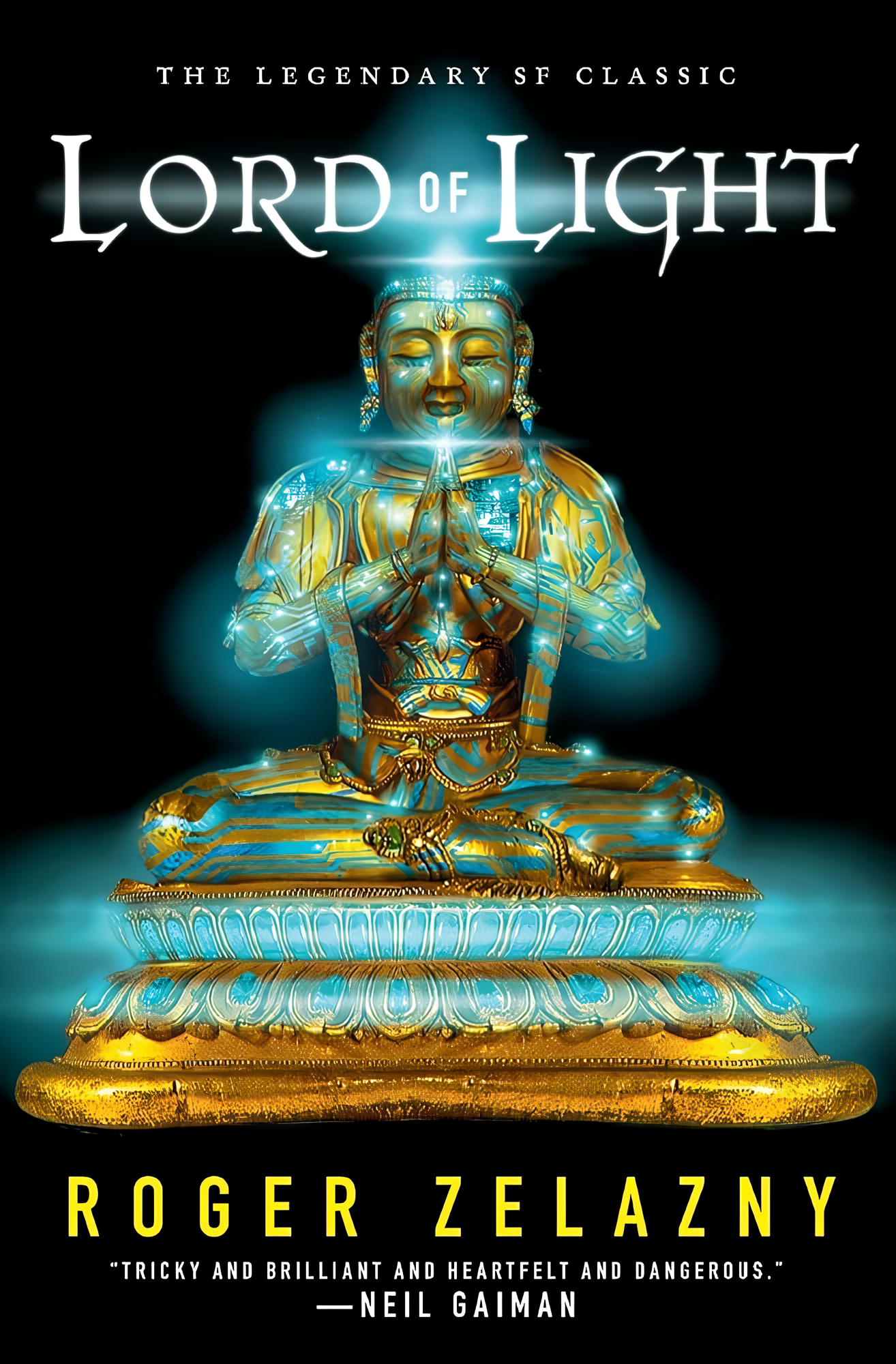
Doubleday published Lord of Light in 1967. It won the 1968 Hugo Award for Best Novel and was nominated for the Nebula Award. Two chapters appeared first in The Magazine of Fantasy and Science Fiction as the novelettes "Dawn" and "Death and the Executioner."
Zelazny designed the story so its events could be read through the language of either fantasy or science fiction. Its seven chapters are deliberately nonlinear: Chapter One establishes the aftermath of Keenset, Chapters Two through Six recount the rise and defeat of Sam's rebellion, and Chapter Seven resumes the opening timeline.