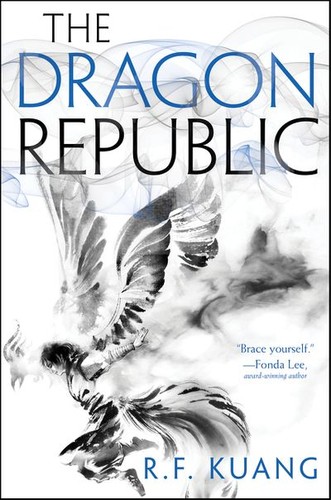
The Book in Brief
Broken by addiction after destroying Mugen, Rin runs contract killings for the pirate queen Moag until Nezha's warships intercept the Cike and carry them to Arlong. Yin Vaisra recruits them into his Dragon Republic with the promise of a coordinated war against the Empress — then sends Rin alone against Daji, who seals her mind. and Rin fights through the northern campaign beside Nezha and Kitay while the Republic courts Hesperian backing. When her link to the Phoenix stays blocked, the Ketreyid shaman Sorqan Sira binds Rin and Kitay together, returning her fire at a terrible cost. At Arlong the Republic wins — and Vaisra trades Rin to the Hesperians, Nezha complicit. Kitay frees her, and the survivors flee south.
Important Characters
Fang Runin (Rin): A Speerly shaman whose rage, trauma, and political usefulness make her both weapon and target.
Chen Kitay: Rin’s closest friend and moral counterweight; their lives become magically bound.
Yin Nezha: Rin’s former classmate and Vaisra’s son, torn between personal loyalty and family power.
Yin Vaisra: The Dragon Warlord and architect of the Republic, a reformer willing to purchase victory with submission.
Daji: The Vipress and Empress, whose warnings about foreign domination prove more credible than Rin wants.
Chaghan and Qara: Ketreyid twins whose knowledge of shamanism cannot protect the Cike from political collapse.
Sorqan Sira: A Ketreyid shaman who restores Rin’s access to power by creating her bond with Kitay.
What to Remember from the Previous Book
Rin rose from poverty to Sinegard, trained under Jiang, and discovered that she could summon the Phoenix. The Federation’s atrocities and Altan’s death pushed her to destroy Mugen with volcanic fire. The victory ended the invasion but killed civilians on an immense scale, leaving Rin addicted, hunted, and determined to kill Empress Daji.
Part I — A Broken Weapon
Chapter 1
Rin leads the Cike on Moag’s assassination missions while opium and visions of Altan erode her control.
Chapter 2
A raid exposes the unit’s exhaustion and Rin's opium habit and the visions of Altan that come with it.
Chapter 3
Rin runs Moag's contract killings out of Ankhiluun, the price of the pirate queen's promised help against Daji.
Chapter 4
Nezha's warships overtake the Cike, and he fakes their deaths to shake off Moag before bringing them to Arlong.
Chapter 5
Vaisra offers Rin a place in his planned Republic and frames Daji’s removal as national rescue.
Chapter 6
Nezha’s reappearance forces Rin to confront the classmate she believed had died of his wounds at Sinegard.
Chapter 7
Kitay joins the Republican cause but challenges Rin’s desire to solve every problem with divine violence.
Chapter 8
Rin learns that the Hesperians will supply the Republic only if Vaisra proves his movement governable.
Chapter 9
A demonstration of Hesperian technology reveals both its military value and its owners’ contempt for Nikara belief.
Chapter 10
Rin accepts Vaisra’s command because his campaign appears to offer the clearest route to Daji.
Part II — The Republic at War
Chapter 11
The fleet begins its campaign, and Rin discovers that Republican officers treat the Cike as expendable irregulars.
Chapter 12
Nezha and Rin recover some of their old ease, although his loyalty to Vaisra limits what he will admit.
Chapter 13
The Republic courts provincial leaders whose support depends more on advantage than democratic conviction.
Chapter 14
Rin’s attempts to break the Seal fail, deepening her fear that she is useful only as a symbol.
Chapter 15
Jinzha commands an aggressive northern operation that ignores warnings about terrain and supply.
Chapter 16
The army’s advance stalls as disease and hunger reveal the weakness beneath the Republic’s modern image.
Chapter 17
Poisoned water devastates the troops, and Rin sees commanders conceal responsibility to preserve authority.
Chapter 18
Niang works beyond exhaustion to save soldiers while strategic decisions keep producing more casualties.
Chapter 19
The Ketreyids arrive, bringing knowledge of the gods and a colder assessment of Rin’s connection to the Phoenix.
Chapter 20
Chaghan explains that removing the Seal alone will not repair the damage Rin has done to herself.
Chapter 21
Sorqan Sira proposes a life bond between Rin and Kitay as the only stable route back to shamanic power.
Chapter 22
Kitay accepts the bond, making Rin’s pain, power, and survival inseparable from his own.
Chapter 23
Rin reaches the Phoenix again and realizes that using it now places Kitay directly inside the consequence.
Chapter 24
The defeated force retreats toward Arlong while Vaisra converts military failure into propaganda for unity.
Part III — Arlong and Betrayal
Chapter 25
Arlong prepares for siege as rival Nikara factions converge on the city and civilians are trapped between them.
Chapter 26
Daji meets Rin and argues that the Hesperians intend to rule through the Republic rather than free Nikara.
Chapter 27
Rin rejects Daji’s appeal but cannot dismiss the evidence of Hesperian religious and racial arrogance.
Chapter 28
Feylen’s return turns the battle supernatural, forcing the Cike to confront one of their own as an uncontrolled god-host.
Chapter 29
Qara dies after Bekter’s betrayal, shattering Chaghan and further reducing Rin’s chosen family.
Chapter 30
Rin and Kitay use their bond to channel power without surrendering completely to the Phoenix.
Chapter 31
The defense of Arlong succeeds, giving Vaisra the victory he needs to claim national legitimacy.
Chapter 32
Republican leaders isolate Rin immediately after the battle, confirming that victory has not made her trusted.
Chapter 33
Vaisra reveals his bargain with the Hesperians and treats Rin as payment for their continued support.
Chapter 34
Nezha helps imprison Rin despite their renewed intimacy, choosing the Republic and his father over her.
Chapter 35
Hesperian observers prepare to examine and neutralize Rin as a dangerous religious specimen.
Chapter 36
Kitay exploits their bond and the confusion after the battle to free Rin from Republican custody.
Chapter 37
Rin escapes south with the remnants of her allies and turns her promised war from Daji toward Vaisra and Nezha.
Ending Explained
The final betrayal confirms that Vaisra never intended Rin to be a partner: he needed her Speerly identity, her battlefield power and her symbolic value, but his Hesperian-backed republic has no place for a shaman he cannot control. Nezha’s choice is personal as well as political — he cares for Rin and still accepts his family’s belief that stability justifies sacrificing her, which Rin experiences as proof that affection cannot survive class power when the privileged refuse to oppose it. Kitay’s rescue preserves her at the price their bond established: neither can now escape the other’s pain or death, and the flight south points The Burning God at both the foreign-backed Republic and the old imperial order.
Themes and Analysis
Revolution and dependency. The Republic promises liberation while making its survival dependent on an empire with its own racial, religious, and economic agenda.
The weaponized survivor. Every faction values Rin most when her trauma can be converted into violence.
Friendship as shared consequence. The bond with Kitay literalizes mutual responsibility: Rin can no longer pretend her self-destruction harms only herself.
Modernity and domination. Technology is not neutral when access to it requires accepting the provider’s political authority.
Content Notes
This book contains war, mass death and graphic battlefield injury, addiction and withdrawal, racism, colonialism and religious coercion, torture, medical experimentation and betrayal.