The Book in Brief
Alice Law blames herself for the magical accident that killed her Cambridge adviser, Jacob Grimes. Without his recommendation, she believes her academic future is finished. She prepares a forbidden descent into Hell, only for her rival Peter Murdoch to reveal that he has independently researched the same journey. They alter the ritual for two travelers, each surrender half of their remaining lifespan, and arrive in the Fields of Asphodel.
The pair learn that Grimes has already moved into the Eight Courts. Hell reshapes itself into a nightmarish version of Cambridge, where each court reflects a different moral failure. Alice and Peter escape Pride, survive Desire, and discover that ordinary chalk magick fails because the underworld absorbs its power. They are also hunted by skeletal constructs created by Nicomachus and Magnolia Kripke, dead magicians who use blood to make magick function in Hell.
After Alice falls into the Lethe, she reveals that Grimes tattooed a permanent pentagram into her skin, giving her perfect memory and resistance to the river. She then finds a soul-exchange calculation in Peter's notes and assumes he plans to sacrifice her to restore Grimes. Her distrust leads her to betray Peter during a test imposed by the Weaver Girl. Both are rescued by Elspeth Bayes, a former Grimes student who died by suicide and now travels the Lethe on a boat.
Elspeth teaches them to mix blood with chalk and tells them about the Dialetheia, a True Contradiction that could create an exception to Hell's rules. Alice and Peter attempt to trick Elspeth, but she discovers their plan. When she learns they are seeking Grimes, she throws them off her boat. They become trapped in an impossible structure built by the Kripkes and finally confess their secrets. Alice admits that she wanted to bind and control Grimes rather than rescue him. Peter reveals that Grimes stole his work and that his careless review helped cause the fatal accident.
Peter uses the Hangman's Paradox to eject Alice from the trap, sacrificing himself. The Kripkes kill him and drain his blood. Alone, Alice crosses the remaining courts, enters the city of Dis, and briefly considers joining a community of Shades who have chosen eternal stasis. She rejects them, survives another Kripke trap, and prepares an ambush beside the Lethe. Her plan destroys the Kripke family by erasing their identities in the river.
Elspeth rescues Alice and gives her the Dialetheia. At Lord Yama's court, Alice summons Grimes. He offers her an eternity of study, but she finally rejects him and uses Peter's exchange work to trade Grimes's soul for Peter's. Alice and Peter trade the Dialetheia for permission to leave and the restoration of part of their surrendered lifespans. They climb back to Cambridge together, choosing an uncertain life over the false certainty offered by Grimes and Hell.
Important Characters
Alice Law: A Cambridge doctoral student in analytic magick. Brilliant, ambitious, and unable to forget, Alice descends into Hell from a mixture of guilt, career desperation, and a hidden desire for revenge against Grimes.
Peter Murdoch: Alice's academic rival and former friend. His effortless-genius persona conceals Crohn's disease, fear of pity, and guilt about his part in Grimes's death.
Professor Jacob Octavian Grimes: A celebrated magician and abusive dissertation adviser. Grimes manipulates students through praise, competition, theft, humiliation, and sexual coercion while presenting himself as a servant of pure knowledge.
Elspeth Bayes: A former student of Grimes who died by suicide and became a resourceful traveler in Hell. She pilots the Neurath, understands blood-powered magick, and possesses the Dialetheia.
Nicomachus "Nick" Kripke: A dead magician who hunts other travelers through Hell. He uses their blood and research to continue his work.
Magnolia Kripke: Nick's wife and intellectual partner. Once a celebrated magician, she helps construct the bone creatures and traps that pursue Alice and Peter.
Theophrastus Kripke: The Kripkes' son, poisoned by them before their own lethal stage stunt, who travels with them through Hell as their dead child.
John Gradus: A long-dead Shade in the final court who guides Alice to Dis in exchange for stories about earthly life.
Gertrude: The leader of the Rebel Citadel. She rejects reincarnation and offers Alice safety in a community devoted to waiting for the eventual collapse of Hell.
The Weaver Girl: A supernatural being who tests Alice and Peter with a version of the prisoner's dilemma, exposing the mistrust between them.
Lord Yama: The ruler and judge of the underworld. He controls reincarnation and has the authority to grant exceptions when Alice brings him the Dialetheia.
Archimedes: The Cambridge department cat. Able to cross boundaries between worlds, he repeatedly appears at decisive moments and ultimately helps Alice survive.
> Content and Spoiler Warning: The summaries below reveal the entire novel and discuss sexual coercion and assault, suicide, self-harm, chronic illness, abuse, and death.
Chapters 1–9
Chapter 1. After Grimes dies, Alice researches how to retrieve his soul from Hell. Peter interrupts her ritual, reveals that he has been conducting the same research, and alters the pentagram to carry them both. Each accepts the price of half a lifetime. Alice remembers how an unclosed line in the spell she checked caused Grimes's body to come apart, then she and Peter complete the descent.
Chapter 2. Alice and Peter cross the empty outskirts of Hell and glimpse Cambridge through a Viewing Pavilion. In Asphodel, an offering summons the department cat Archimedes and four students killed in an old laboratory fire under Grimes's supervision. The dead students confirm that Grimes has already forced his way toward the courts, but they refuse to move toward reincarnation because they fear losing their identities and privilege.
Chapter 3. Vast queues of Shades wait at a wall made of bones. Unable to cut through, Alice and Peter climb it. Peter freezes because of his fear of heights, and Alice talks him through the ascent. From the top they see a shifting, non-Euclidean landscape and commit to continuing before Grimes passes beyond their reach.
Chapter 4. The pair descend into a desert and make camp. Conversation reveals that Peter received the prestigious Cooke Fellowship Alice expected, while Alice received an Italian research trip originally meant for Peter. Their resentment flares, but they agree to set Cambridge rivalries aside and trust each other. Alice remembers warnings that Grimes was dangerous and how thoroughly she ignored them.
Chapter 5. Alice and Peter compare incompatible maps of Hell. Peter proposes a shortcut toward the center, but Alice argues that they must search all eight courts in order. Their route back disappears, and the landscape transforms into a Gothic university campus, reflecting the moral world that defined Grimes.
Chapter 6. The First Court, Pride, resembles an enormous library where Shades must define and defend "the good." The philosopher G. E. Moore explains that failed candidates repeat their examinations indefinitely or are turned into statues. When Moore tries to keep them as assistants, Alice traps him in an endless chain of premises and escapes with Peter to the Lethe.
Chapter 7. The Lethe tempts Alice with the promise of forgetting. Peter anchors her by making her repeat the facts of her identity. As they follow the river toward Desire, skeletal hounds stitched together with chalk attack Peter. The creatures recoil from the Lethe, and their construction proves that another living magician is operating in Hell.
Chapter 8. Alice treats Peter's wounds and they attempt simple paradox spells, only to discover that Hell's silt absorbs ordinary chalk. Alice panics at losing the tool on which her training depends. Peter helps her regain control by treating the problem as something they can investigate. The injured Archimedes returns, suggesting the bone creatures are still nearby.
Chapter 9. Archimedes leads them to Desire, a decaying student center where Shades repeat empty compulsions. A sexual scene triggers Alice's memories of Grimes and sends her fleeing outside. Bone creatures attack beside the Lethe; Alice discovers the river dissolves them, but she is overwhelmed and falls into the water.
Chapters 10–18
Chapter 10. Peter pulls Alice from the Lethe and is shocked that she remembers everything. Alice reveals that Grimes carved a permanent pentagram into her arm, granting perfect recall and resistance to forgetting while leaving her with constant cognitive strain. Later, she reads Peter's notebook and finds an exchange spell with her name opposite Grimes's, leading her to believe Peter plans to trade her soul for their adviser.
Chapter 11. A flashback follows Alice and Peter's first years at Cambridge. Peter is brilliant and charming but chronically late, absent, and emotionally unavailable. He stands Alice up for drinks, yet they eventually become effective laboratory partners. Their connection never fits neatly into either friendship or rivalry because Peter repeatedly withdraws without explanation.
Chapter 12. Alice's fear of Peter intensifies as they cross a bridge made from petrified souls. The Weaver Girl separates them and presents a loyalty test: cooperation will reward both, mutual selfishness will destroy both, and a split choice will protect only the person who chooses to travel alone. Peter chooses cooperation, but Alice, driven by panic and resentment, chooses herself.
Chapter 13. A flashback shows Alice and Peter working late together after a senior assistant leaves Grimes's laboratory. Their shared intellectual excitement becomes emotional intimacy, and Alice falls in love. When the project ends, Peter abruptly avoids her and ignores her attempt to talk. Alice uses philosophical theories about personal identity to tell herself that the person she loved no longer exists.
Chapter 14. The Weaver Girl binds Peter as punishment for Alice's betrayal. Bone creatures interrupt, attacking the spirit and carrying Alice toward the Lethe. A theatrical masked ferryman arrives on a strange barge, fights the constructs with Lethe water, rescues Alice and Peter, and escapes with them downriver.
Chapter 15. The ferryman reveals herself as Elspeth Bayes, a former Grimes student. She identifies the bone-creature makers as Nick and Magnolia Kripke, who travel Hell with their dead son and hunt magicians for blood and research. Elspeth demonstrates that blood protects chalk from Hell's silt and allows Peter to heal and duplicate a flask. She also describes the Dialetheia, a True Contradiction capable of creating an exception to Hell's rules.
Chapter 16. On the Neurath, Elspeth explains how Shades maintain their physical forms through constant effort. She speaks openly about her suicide, academic disillusionment, and Grimes's cruelty. Alice continues to defend his intellectual importance, revealing how deeply his influence remains embedded in her. Elspeth warns that gradual compromises can make intolerable suffering appear normal.
Chapter 17. Alice privately urges Peter to help steal the Dialetheia from Elspeth. She proposes using a Liar-Paradox spell, but Peter objects that Elspeth saved their lives and may be protected. Alice nevertheless convinces herself that her devotion is to scholarship rather than prestige and that betraying Elspeth is justified by the importance of the mission.
Chapter 18. Elspeth carries them past Greed and into Wrath. While she gathers magical embers, Alice distracts her and Peter draws the trap. Archimedes exposes the hidden pentagram, allowing Elspeth to reverse it into a truth-binding spell. When Alice and Peter admit they are looking for Grimes, Elspeth becomes furious and throws them off the boat.
Chapters 19–27
Chapter 19. Stranded in Wrath, Alice and Peter nearly drown in a bog of angry Shades and lose supplies. They push onward into Violence but fall into an Escher-like pit whose stairs never rise. A mechanical signal calls the Kripkes toward them. During another bitter argument, Alice finally says that she killed Grimes.
Chapter 20. Alice remembers the sexism and rumors that shaped her life at Cambridge. Grimes corners her after dinner and sexually assaults her; Peter sees part of the encounter and misunderstands what is happening. Afterwards Grimes punishes her academically while the department treats her as the cause of the conflict. Isolated and desperate, she later makes the exhausted error that causes his fatal magical explosion.
Chapter 21. Trapped with Peter, Alice explains that she never truly planned to rescue Grimes. She intended to bind his soul into his ruined body and force him to speak under her control. Peter respects the ingenuity even as Alice recognizes that revenge would not heal her. He then admits that the exchange spell was meant to sacrifice himself, not Alice, because he also believes he caused Grimes's death.
Chapter 22. Peter's history reveals that his apparent carelessness hides severe Crohn's disease and a fear of being pitied. After major surgery, he returns to discover that Grimes has published Peter's research without credit. Peter deliberately performs only a superficial check of the fatal experiment, then interprets the accident as his responsibility. When he sees Alice preparing to descend, he decides to follow and offer himself in exchange for Grimes.
Chapter 23. Alice and Peter realize that Grimes deliberately made them compete, allowing each to believe the other was favored. With the trap slowly killing them, Peter constructs an escape based on the Hangman's Paradox. It can save only one person. Despite Alice's refusal, he powers the spell with his blood and ejects her, leaving himself for the approaching Kripkes.
Chapter 24. A flashback returns to Alice's first meeting with Grimes. He welcomes her warmly, praises her application, and tells her she belongs at Cambridge. His approval feels life-changing. The chapter recounts his rise from poverty through wartime magick to academic fame, explaining why Alice once experienced his attention as a debt she could never repay.
Chapter 25. Alice cannot break Peter's prison and hears the Kripkes torture and kill him for his blood. She crosses Violence and Cruelty alone, then faces the Erinyes, who ask which oaths she has broken and why. Entering Tyranny, she finds the dead endlessly writing defenses of their crimes. The wounded Archimedes briefly returns and gives her a reason to keep moving.
Chapter 26. A Shade named John Gradus offers to guide Alice to Dis in exchange for stories about living sensations. He explains that the damned must write truthful dissertations about their sins, although he has never seen anyone succeed. Dis is a beautiful city of traitors and oath-breakers. Gradus warns Alice never to ask a resident what crime brought them there.
Chapter 27. Inside Dis, scholars submit endless dissertations without receiving answers. The city contains essay sellers, deterministic excuses, and workshops where the dead criticize one another instead of confessing. During a destructive visit from Cerberus, Alice meets Gertrude, who rejects both the dissertation system and reincarnation. Gertrude invites Alice to the Rebel Citadel and promises another way out.
Chapters 28–35
Chapter 28. Gertrude's citadel offers safety through patient waiting for Hell's eventual collapse. Alice discovers Shades who have rooted themselves into trees and monks who worship time. She tries to accept stillness but cannot stop thinking or feeling guilty. After another Shade throws itself into the Lethe, Alice recognizes the citadel as another form of death and escapes through an illusion by exploiting its language.
Chapter 29. Lost in the desert, Alice clings to a few basic facts about herself. She and a starving cat are caught in a Kripke trap built on Zeno's paradox. The mechanism bleeds the animal to power its blades. Alice uses its blood, chalk, and calculus to break the trap, then cooks the carcass. The brutal meal reconnects her to physical survival and gives her a new will to live.
Chapter 30. Gradus finds Alice again and admits that he has spent years unable to choose between meaningless existence and oblivion. Alice refuses to hide in Dis and decides to hunt the Kripkes. She makes weapons and armor from bone, leaves their signal active as bait, and inhales magical chalk to heighten her perception. She then openly challenges them to come for her.
Chapter 31. Alice prepares a battlefield above the Lethe with concealed paradoxes. Her traps destroy the bone horde and freeze Magnolia and Theophrastus in place. She uses a soul tether to force Nick temporarily into a corpse prepared in Cambridge, but he breaks the connection and attacks her. Archimedes intervenes, and an unseen force pushes Alice and Nick over the cliff toward the river.
Chapter 32. Alice survives the fall while the Lethe strips Nick of his memories and identity. Magnolia prevents Theophrastus from killing Alice, then carries her child into the river, where both dissolve. Gradus boards a radiant boat, drinks from the Lethe, and moves on to another existence. Alice is denied passage and begins losing Grimes's tattoo and her memories until Elspeth arrives.
Chapter 33. Elspeth brings Alice back aboard the Neurath and confirms that Grimes's inscriptions are disappearing from her body. She reveals that she possesses the Dialetheia and that the Kripkes were pursuing her for it. Elspeth gives the artifact to Alice so she can bargain for one exception. She takes Alice to Lord Yama's island but chooses not to accompany her farther.
Chapter 34. Alice presents the Dialetheia to Lord Yama and asks to see Grimes. Grimes admits influencing her dreams and invites her to remain in Hell as his student forever. Alice finally chooses life, rejects his claim on her, and adapts Peter's exchange work into a binding. Grimes goes into the ledger in Peter's place, and a door opens through which Peter returns.
Chapter 35. Alice and Peter reunite and confess what they misunderstood about one another. They offer the Dialetheia to Yama for safe passage and restoration of their surrendered years. Yama returns half of what they gave up and opens a staircase to the surface. Alice and Peter emerge at Magdalene College beneath the stars, holding hands and choosing to build a life together.
Ending Explained
Alice begins the novel believing that Grimes's approval is necessary for her work and suffering to have value. At Yama's court, Grimes offers the purest form of that fantasy: endless study, freedom from the body, and permanent access to the mentor whose recognition she once craved. Her refusal shows that she has separated her love of thought from her loyalty to him. Knowledge is still valuable, but it no longer requires her destruction.
Grimes's dissolution is not simply revenge. Alice uses the exchange work Peter created for self-sacrifice and redirects it toward saving Peter. This reverses the logic Grimes taught them. Instead of treating students as replaceable materials in a greater intellectual project, Alice treats a human relationship as more important than preserving the famous professor.
The Dialetheia represents a genuine exception to a seemingly closed system. Throughout the novel, characters assume they must choose among the options Hell, Cambridge, or formal logic provides. The True Contradiction proves that systems are not always complete. Elspeth's gift and Yama's willingness to bargain introduce grace: an outcome that cannot be earned through perfect reasoning alone.
Yama does not return all the years Alice and Peter sacrificed. They recover half of what they surrendered, leaving the journey with a permanent cost. This prevents the ending from erasing their choices while still allowing them a future. Their remaining lives are shorter, but they now understand that finitude is what makes time precious.
The final ascent answers the novel's fascination with death. Alice and Peter once treated self-sacrifice as proof of seriousness. By climbing together, they accept uncertainty, physical limitation, imperfect careers, and ordinary affection. Survival is not presented as cowardice or compromise. It becomes their most difficult and meaningful act.
Unresolved Questions
What academic lives will Alice and Peter build without Grimes's protection or recommendation?
How much of Alice's perfect memory survives after the Lethe erases Grimes's pentagram?
What new existence awaits Gradus after he boards the radiant boat?
Will Elspeth eventually choose reincarnation, or will she continue traveling Hell?
Was Elspeth's butterfly responsible for pushing Alice and Nick over the cliff?
Can the residents of Dis ever complete a truthful confession, or is their assignment designed to be impossible?
Will Gertrude's Rebel Citadel endure, collapse, or become another permanent institution within Hell?
How will losing part of their natural lifespans affect Alice and Peter after they return?
About the Book
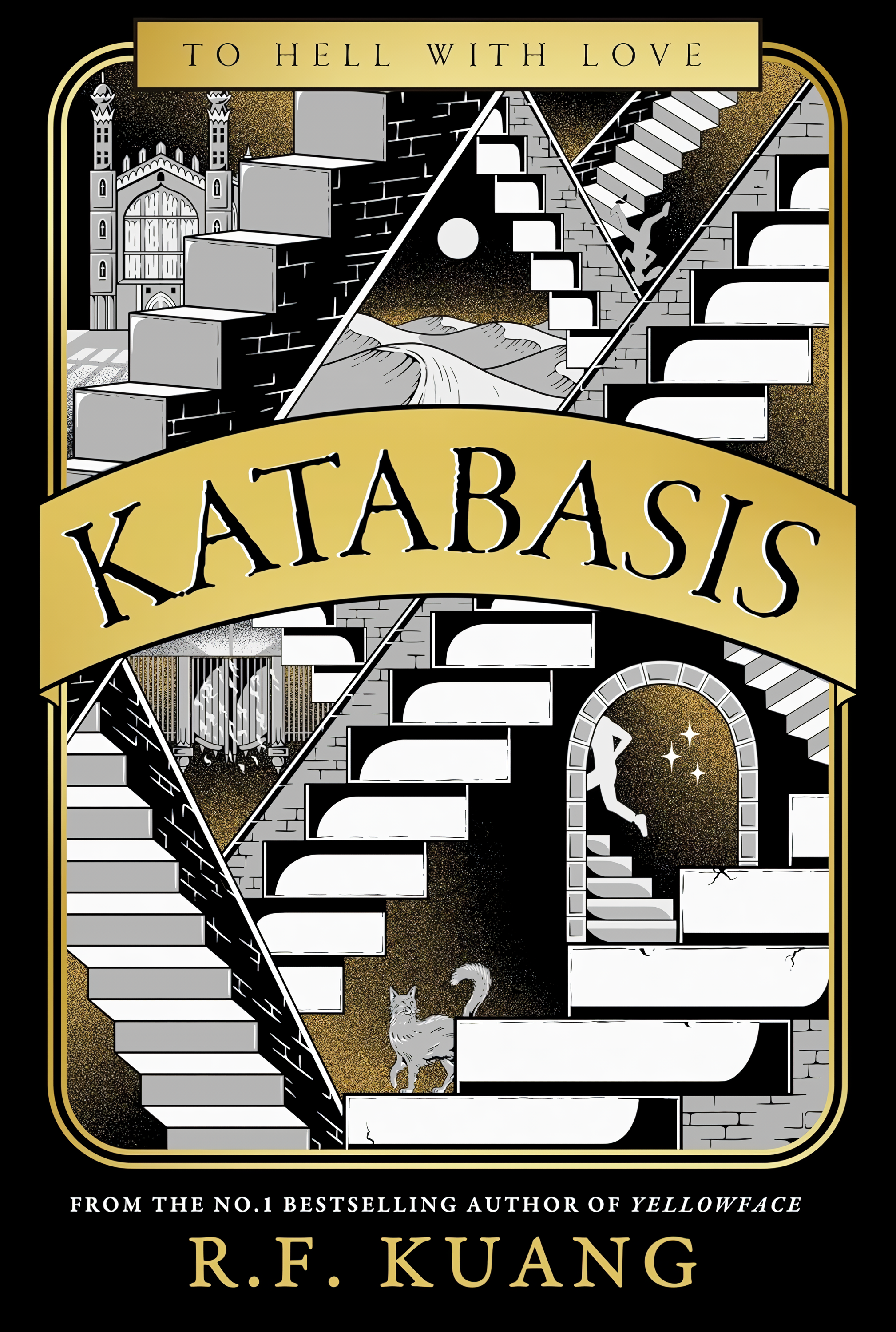
Katabasis was published in the United States by Harper Voyager on August 26, 2025. The title comes from the Ancient Greek term for a descent, especially a hero's journey into the underworld. The novel is set primarily in the 1980s and combines dark academia with an underworld assembled from multiple mythological, religious, literary, philosophical, and mathematical traditions.
The standard U.S. hardcover edition is 560 pages and contains 35 numbered chapters. The audiobook is narrated by Morag Sims and Will Watt. Screen rights were optioned by Amazon MGM Studios before publication, with Angela Kang attached to develop the television adaptation.