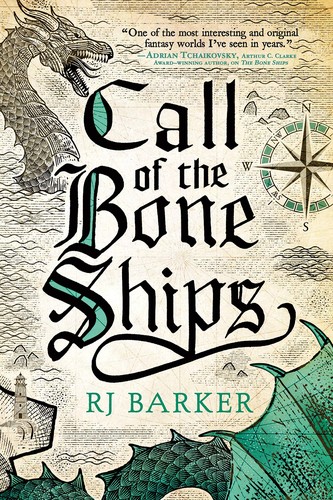
The Book in Brief
Condemned to the black ship Tide Child, Joron Twiner loses command to Lucky Meas Gilbryn, who remakes the crew and takes on a secret mission: escort the first living arakeesian — sea dragon — seen in generations beyond the reach of both warring island nations, then kill it so its bones can build no new fleets. Raiders, wind towers and the white ship Hag’s Hunter stand in the way, and Karrad’s spy Dinyl becomes Joron’s lover. When the dragon saves the ship, Dinyl tries to complete the kill; Joron stops him at terrible cost, and Meas throws the poison overboard, letting the arakeesian live.
Important Characters
Joron Twiner: The disgraced shipwife of Tide Child. He begins as an alcoholic, ineffective commander and develops into a responsible deckkeeper.
“Lucky” Meas Gilbryn: A legendary shipwife and the condemned daughter of the Hundred Isles’ ruler. She takes command of Tide Child and pursues a secret peace mission.
Dinyl Kiveth: An operative placed aboard by Indyl Karrad. His relationship with Joron becomes genuine even though his loyalty to the mission remains divided.
Kept Indyl Karrad: A politically connected member of the peace faction. He supplies the mission, the poisoned bolts, and Dinyl’s hidden assignment.
The gullaime: A birdlike windtalker whose magic drives the ship. The crew’s treatment of the gullaime exposes how the islands convert living beings into tools.
Farys: One of the youngest of Tide Child’s crew, whom Joron mentors as he learns the responsibilities of command.
Cwell: A dangerous crew member who loathes Joron in particular, testing the authority Meas is building aboard the ship.
Kyrie Gilbryn: Meas’s sister and captain of Hag’s Hunter. Her pursuit turns family rivalry into a major naval threat.
The arakeesian: A living sea dragon whose return could provide bones for new warships. Its intelligence changes the moral meaning of the mission.
Chapter 1
Joron drinks on a beach instead of commanding Tide Child. Lucky Meas confronts him and challenges his right to the two-tailed shipwife’s hat.
Chapter 2
Meas defeats Joron in the formal duel but refuses the customary killing blow. She takes command and makes the humiliated former shipwife her deckkeeper.
Chapter 3
Joron returns to a vessel whose condition reflects his neglect. Meas inspects the ship, the stores, and the crew, identifying failures that have become accepted as fate.
Chapter 4
Meas imposes work, discipline, and a clear chain of command. The condemned deckchilder resist, but her competence begins to replace fear as the basis of authority.
Chapter 5
Joron learns the practical demands of being deckkeeper. He resents Meas’s control while recognizing that she is treating Tide Child as a ship worth saving.
Chapter 6
The crew prepares to leave under the direction of the gullaime, whose wind magic is essential to sailing. Joron notices that everyone relies on the creature while refusing to regard it as an equal.
Chapter 7
Life at sea exposes shortages, damaged gear, and old rivalries. Meas uses routine to make the crew answerable to one another rather than to their individual sentences.
Chapter 8
Raiders threaten Tide Child, forcing the newly organized crew into action. Joron must communicate orders and manage fear instead of retreating into drink.
Chapter 9
The battle damages the already weakened ship. Meas’s tactics prevent destruction, but the encounter proves that discipline cannot substitute indefinitely for repairs and supplies.
Chapter 10
After the fighting, Joron helps account for the dead, wounded, and damaged sections. The unglamorous work of recovery begins changing how the crew sees him.
Chapter 11
Tide Child approaches Bernshulme. Returning to the center of Hundred Isles power reminds Meas and Joron that a black ship’s crew is considered expendable even when useful.
Chapter 12
Repairs begin under political scrutiny. Meas meets contacts while Joron observes the hierarchy of Bern, Kept, sailors, and laborers that organizes the city.
Chapter 13
Kept Indyl Karrad reveals the report of a living arakeesian. Its bones could create an unmatched new fleet and extend the war for another generation.
Chapter 14
Karrad and Meas explain their covert plan: guide the arakeesian beyond both powers and kill it where no government can claim the skeleton. Peace is being pursued through a secret act of destruction.
Chapter 15
The ship receives hiyl-poisoned bolts capable of killing the creature. Joron understands that Tide Child has been selected partly because a condemned crew can disappear with the mission’s secrets.
Chapter 16
Meas recruits specialists, loyal sailors, and additional convicts. Dinyl Kiveth joins under Karrad’s authority, giving Joron a companion whose official purpose remains unclear.
Chapter 17
The renewed ship leaves Bernshulme. Joron works between Meas and the deckchilder, discovering that second-in-command requires persuasion as often as punishment.
Chapter 18
Dinyl and Joron begin to trust one another during watches and shared work. Their intimacy offers Joron a life beyond shame, though Dinyl continues reporting to Karrad.
Chapter 19
The crew searches for the arakeesian’s route while avoiding forces from both island powers. Signs in the sea suggest that the supposedly extinct creature is close.
Chapter 20
Meas reveals only the information needed for each decision. Joron challenges her secrecy, and she forces him to consider whether command can survive if every fear is distributed to the whole crew.
Chapter 21
Raiders and hostile towers threaten the passage ahead. The mission shifts from pursuit to clearing a route before the arakeesian is driven toward a fleet that will kill it for bones.
Chapter 22
The gullaime calls dangerous winds during combat and spends too much of its strength. Tide Child survives, but the windtalker collapses into windsickness.
Chapter 23
The crew heads toward the first of the remaining wind towers. Without a restored gullaime, both the ship and the arakeesian’s safe passage are at risk.
Chapter 24
Joron joins the shore party moving toward the windspire. Away from the ship’s familiar hierarchy, he must make decisions without waiting for Meas to define every step.
Chapter 25
The party confronts defenders and the hostile terrain around the tower. Joron’s concern for the gullaime begins to exceed the crew’s conventional view of it as replaceable equipment.
Chapter 26
At the windspire, the gullaime regains access to the power it needs. Joron’s contact with the place creates an unexpected mental or spiritual connection between them.
Chapter 27
The restored gullaime helps destroy the towers controlling the passage. The victory clears the route and demonstrates that the mission depends on a being the Hundred Isles refuse to treat as a person.
Chapter 28
Back aboard Tide Child, Joron struggles to understand the new bond. The gullaime’s perceptions enter his awareness in fragments, expanding the story beyond human explanations of wind and sea.
Chapter 29
The crew sees the living arakeesian more clearly. Its scale and intelligence make the plan to reduce it to ship material morally harder to describe as a neutral act.
Chapter 30
Meas continues the escort while ships from the Hundred Isles close in. Her history and reputation make it increasingly likely that the pursuit is personal as well as military.
Chapter 31
Hag’s Hunter, commanded by Meas’s sister Kyrie, catches Tide Child. The white ship’s stronger bones and better condition expose how much the black ship is risking.
Chapter 32
Meas prepares the condemned crew for a battle they are unlikely to win. Joron carries orders across the decks and finds that the crew now looks to him because he has kept working beside them.
Chapter 33
The ships exchange fire and maneuver for advantage. Damage accumulates faster on Tide Child, while the gullaime strains to give Meas the wind required for escape.
Chapter 34
Hag’s Hunter gains the upper hand and Meas considers surrender to save her people. The conflict tests whether her legend matters when material power belongs entirely to the enemy.
Chapter 35
The arakeesian intervenes and destroys Hag’s Hunter. Its action proves that the creature is not passive cargo and overturns the battle before Meas must complete her surrender.
Chapter 36
In the aftermath, Dinyl moves to use the hiyl bolts against the arakeesian. His commitment to Karrad’s original plan conflicts directly with Joron’s changed understanding of the creature.
Chapter 37
Joron stops Dinyl and cuts off his hand. The choice saves the arakeesian but destroys their relationship, showing that Joron can now place responsibility above the refuge of personal attachment.
Chapter 38
The gullaime tells the crew that the returning creature is not alone and that more arakeesians will come. The information turns one secret hunt into evidence of a broader ecological and political transformation.
Chapter 39
Meas rejects the original mission and orders the poisoned bolts thrown into the sea. The arakeesian departs alive, while Tide Child sails on as a condemned ship whose crew has chosen a purpose dangerous to both warring powers.
Ending Explained
Meas begins the voyage believing one secret kill can starve both navies of new bones and shorten the war; the voyage teaches her that the plan treats an intelligent creature exactly as the governments she opposes would. The arakeesian’s destruction of Hag’s Hunter is proof of awareness and choice, not luck — after it, firing the hiyl bolts would be the murder of an ally. Dinyl’s attempt to finish the mission anyway forces Joron’s defining act: he cuts off his lover’s hand rather than let the dragon die. With the gullaime’s warning that more arakeesians are coming, Meas orders the poison thrown overboard, and the condemned ship chooses its own purpose.
Themes and Analysis
Command and earned authority. Joron begins with a title but no leadership. Meas removes the title and teaches him to earn trust through responsibility.
People treated as resources. The crew, gullaime, sacrificed children, disabled citizens, and arakeesians are all assigned value according to what institutions can extract from them.
War and manufactured scarcity. The absence of new bones turns every surviving ship into inherited capital and every arakeesian into a prospective weapon.
Redemption through work. Joron changes through repeated duties, losses, and choices rather than a single heroic revelation.
Language and worldview. The novel’s unfamiliar vocabulary makes social assumptions visible. A different word for captain or sailor carries a different history of rank and obligation.
Chosen family. Condemned people become a crew because they decide that one another’s lives matter despite the state’s judgment.
Content Notes
This book contains graphic naval combat, alcohol dependence, child sacrifice within the setting’s social system, ableist caste structures, reproductive coercion, amputation and the dehumanization of nonhuman beings.